






 Portuguese
  Spanish


Cristiano Gonçalves is a fisherman by profession and a carpenter by family tradition. He lives on the riverbanks in Abaetetuba, in the interior of Pará, and has always harbored a specific desire: to have a jet ski. Buying one was beyond the financial reality of the fisherman, but the desire never left his mind. He researched everything he could find on the internet, gathered materials, and decided to build it himself, using what he had known how to do since childhood: working with wood. The result was a vessel that, according to Domingo Espetacular, arouses curiosity wherever it goes, because at first glance no one believes it is made of wood.
The fisherman did not achieve the final result on the first try. The first model, painted blue, came out in 2012 with an adapted car engine and did not work. Fisherman Cristiano returned to the project, changed the engine, adjusted the structure, and arrived at a second version that finally worked: a wooden jet ski with a 38-horsepower outboard motor, a bicycle handlebar adapted for the rudder, a motorcycle throttle, and an air cooling system installed by the fisherman himself to compensate for the fact that the engine is not water-cooled. It took a year to finish the model that worked, and today the contraption passes through the region’s rivers, catching the attention of everyone who sees it.
A carpenter fisherman with a specific dream

Those who live along the banks of the Amazon rivers in the region depend on boats for practically everything: work, transportation, supply, and leisure. Cristiano Gonçalves grew up in this context, learned carpentry with his family, and began building canoes for clients in the region. But the fisherman never stopped wanting something different from what he made for others.
-
From Painting Houses in the U.S. to Producing Beyoncé and Paul McCartney Shows, Entrepreneur Opens Luxury Hotel in Brazil’s Trancoso with $8 Million Revenue Goal

-
Massive 109-Meter, 5,500-Ton Ship Built to Supply Energy in War Crossed the Atlantic, Powered Rio in the 1950s, and Was Sunk in Pará to Protect Tocantins Riverbank

-
Brazilian Domestic Worker Lived 55 Years Without a Salary, Had Welfare Benefits Controlled by Employer
-
Former PE Teacher Turns São Paulo Thrift Store into Online Sensation with 1 Million Followers, Now Earning $50,000 Monthly with Son and Plans to Expand Nationwide



The jet ski is a type of vessel that combines speed, maneuverability, and compact design, quite different from the canoes and boats the fisherman built professionally. To buy a manufactured one, the price is far from the reality of a fisherman and carpenter from the interior of Pará. It was this gap between desire and purchasing power that pushed Cristiano to the internet, where the fisherman researched engines, structures, steering systems, and ways to combine all this into a vessel he could build himself in his own workshop by the river.
The first attempt in 2012: car engine and nightmare
The fisherman Cristiano did not start with the version that Domingo Espetacular went to test. In 2012, he built a first prototype painted blue and tried to adapt it with a car engine. The idea did not work. The mechanics of a car engine have characteristics that do not easily transfer to the propulsion of a vessel without specific technical adaptations, and the fisherman did not have the resources or equipment to solve these problems at that time. The first model was a failure that Cristiano described as “a dream that became a nightmare”.
The failure did not end the project. The fisherman kept the experience, continued building canoes for clients, and kept the dream of the jet ski in the background. The second attempt changed the central component of the problem: instead of trying to adapt a car engine, the fisherman Cristiano chose a longtail motor, an engine widely used in small boats throughout Brazil and especially in the riverine regions of the Amazon. It was an engine the fisherman already knew by heart, made sense in the aquatic context, and had accessible parts for maintenance in the interior of Pará.
The wooden jet ski: structure, engine, and detail by detail
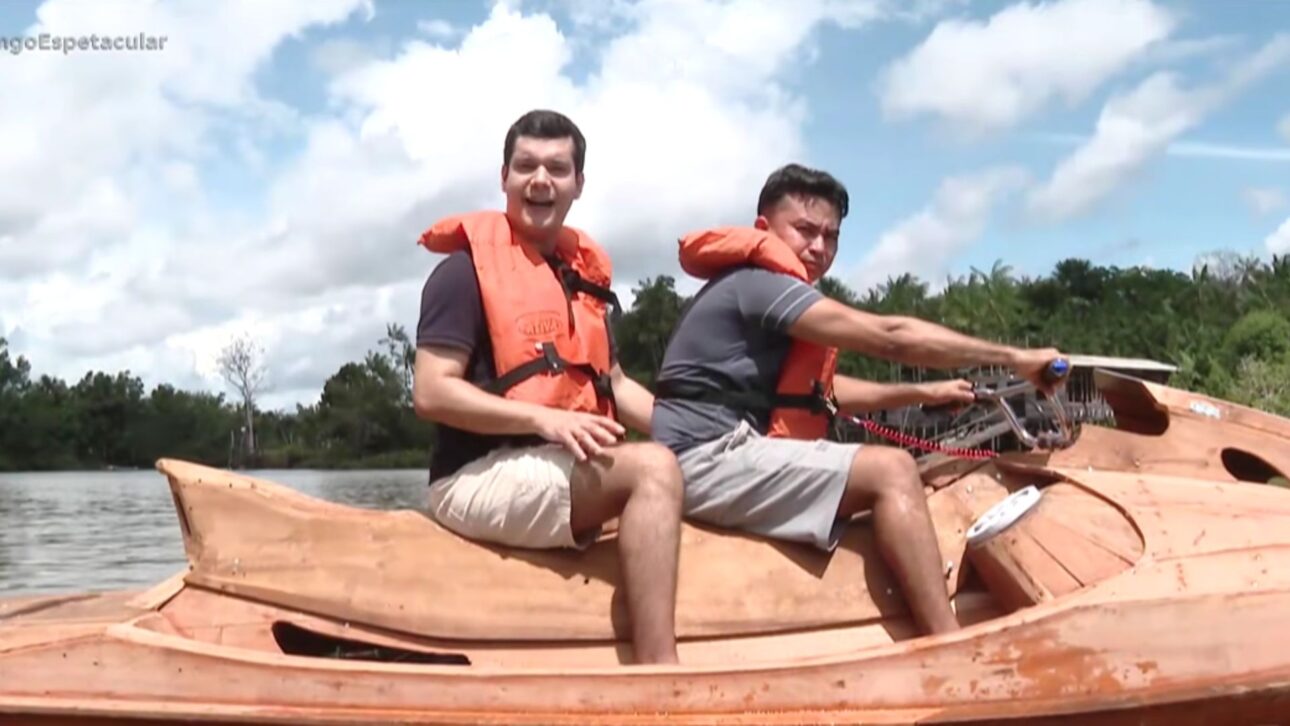
The painting and visual finish deceive those who don’t know: “Everyone comes wanting to see if it’s really wood or not, because that one, as I painted it, doesn’t look like it,” said the fisherman on the program. The carpentry work that Cristiano does for the region’s clients is the same he applied to his own vessel, with the difference that the jet ski required a shape that goes beyond the conventional canoe.
The engine chosen by the fisherman was a tail motor with 38 horsepower. Since this engine is not water-cooled, the fisherman designed air intakes in the structure to ensure ventilation during navigation and prevent overheating. The steering was done with an adapted bicycle handlebar, connected to the rear rudder by a system the fisherman himself created. The throttle came from a motorcycle. The brake uses an adapted choke. Each component was chosen by the fisherman Cristiano based on what was accessible, functional, and possible to adapt with the tools he had in the workshop.
A year of work alongside clients’ canoes


The fisherman Cristiano did not stop working while building the jet ski. He continued making canoes for clients throughout the project’s development period. The jet ski was built during breaks, in the hours left between orders, with the material and time that the routine of a carpenter fisherman in the interior of Pará allows. The second version of the project took a year to be completed.
This combination of continuous work and parallel project is common among popular inventors in riverine regions, where creativity is a way to overcome the limitation of access to industrialized products. In Abaetetuba, boat building is part of the identity of many families, according to Domingo Espetacular. The fisherman Cristiano went beyond what local tradition required: he transformed the carpentry technique inherited from the family into an improvised engineering project that no family member had attempted before. The jet ski is the point where the carpenter fisherman’s heritage met what he researched on his own on the internet.
The live test: stability, speed, and doubt at the start
When Domingo Espetacular went to Abaetetuba to test the fisherman Cristiano’s jet ski, the first doubt was about stability. The compact-shaped wooden structure raised the question: does this vessel capsize? The fisherman himself answered before entering the water: it doesn’t capsize. The test confirmed it. The jet ski proved stable, glided on the river’s surface without sinking or capsizing, accelerated with the 38-horsepower tail motor, and worked as the fisherman Cristiano had planned since he changed the motor on the second attempt.
The assembly of the boat before the test showed the constructive logic of the fisherman: first the engine, then the panel, then the shaft, then the rudder, adjustment of screws and tools, and finally the seat. The set fits together and can be disassembled, which facilitates transport and maintenance by the fisherman himself. According to Domingo Espetacular, the wooden jet ski slid easily over the waters and fun was guaranteed, with the fisherman piloting his own invention through the rivers of Abaetetuba while residents came to see up close if the boat was really made of the material it appeared to be.
The fisherman who manufactures for anyone who wants
The wooden jet ski ceased to be just the personal project of the fisherman Cristiano Gonçalves. According to Domingo Espetacular, he started manufacturing such boats for clients who wanted them, in different models and sizes as needed. “Any model and size, as the client needs, we make,” said the fisherman on the program. The invention that began as a solution for a personal desire turned into a product that the fisherman offers along with the canoes he already manufactured.
This movement of turning a personal solution into a product for others is characteristic of popular riverside inventors, who operate without a patent, without a company, and without access to industrial financing, but with a technical adaptation capacity that solves real problems with available materials. Fisherman Cristiano did not invent the jet ski. He invented the version of the jet ski that he could build, with wood, a 38-horsepower tail engine, bicycle handlebars, and a motorcycle throttle. And it works.
What the wooden jet ski represents for the riverside Amazon
The story of the fisherman Cristiano Gonçalves is documented in Domingo Espetacular as a curiosity, but it points to something broader about how Amazonian riverside communities solve access problems to products that the formal market offers at inaccessible prices. In a region where the river is the main road, having a fast and maneuverable boat has practical utility beyond leisure. The fisherman used the jet ski in daily tasks, not just for fun.
The internet research that fisherman Cristiano did to develop the project is itself a relevant fact: access to online technical information has reached the banks of the Amazon rivers and is being used by carpenter fishermen to solve problems that the industry has not arrived to solve. The wooden jet ski is improbable, it works, and it was made by a 37-year-old fisherman who never studied engineering, but learned enough to create what he needed. Sometimes the most creative inventor is not in the lab, but by the river researching on their phone what doesn’t yet exist in the market itself.
A fisherman from the interior of Pará who researches on the internet, fails on the first attempt, learns from the mistake, and arrives at a functioning wooden jet ski is an example of popular creativity that deserves more recognition, or should this type of invention have technical and financial support to go beyond makeshift solutions? Should the fisherman receive a patent for this? Leave your opinion in the comments.


