Portuguese
  Spanish


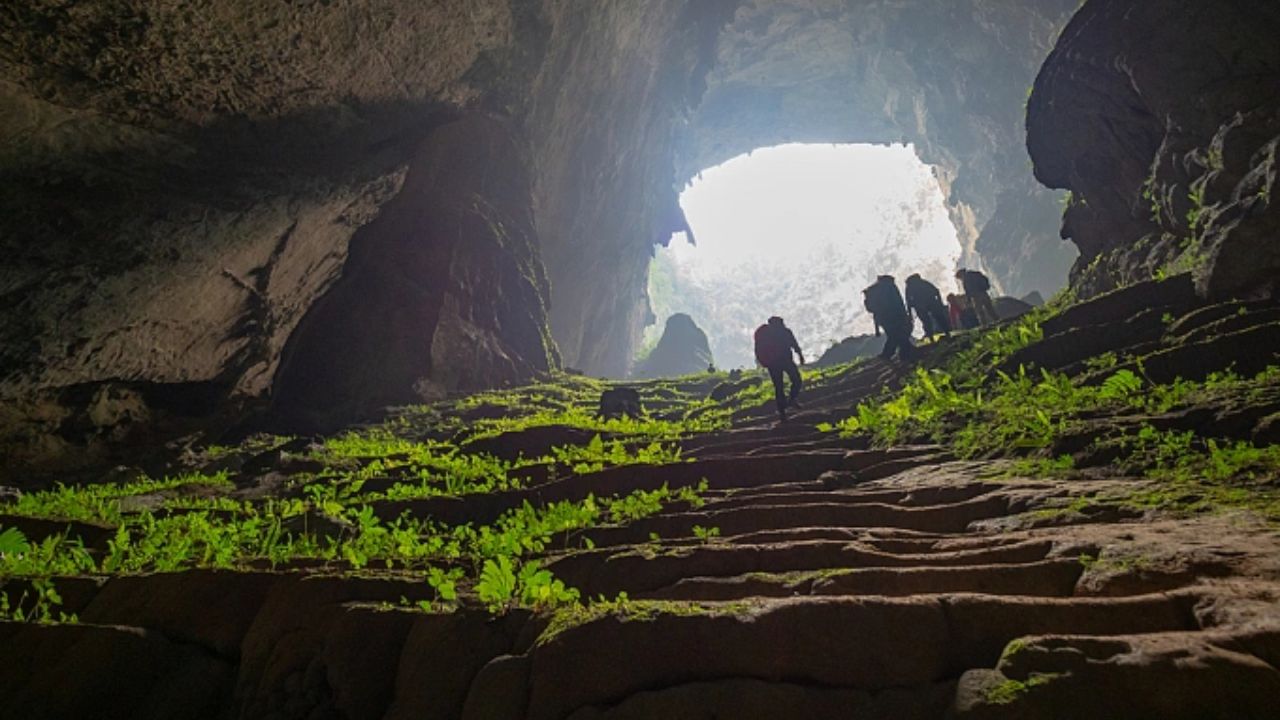


Located in Vietnam, Son Doong is the Largest Cave on Earth; Discover How Real Clouds and an Entire Forest Survive in This Isolation.
Imagine an underground location so colossal that it has its own climate, real clouds and a virgin forest untouched by modern man until recently. Located in Vietnam, the largest cave on Earth defies human understanding with titanic dimensions capable of housing a 40-story skyscraper entirely within its limestone passages.
Hidden from the outside world for millions of years and fully explored only in 2009, the Son Doong cave offers an isolated journey into the geological past of the planet. Restricted access reveals a world where sunlight occasionally penetrates through openings in the ceiling to create underground jungles and sustain exotic life forms that evolved in complete darkness.
A Giant and Self-Sustaining Ecosystem
The internal volume of this natural monument is impressive, containing about 38.5 million cubic meters of empty space. The scale is so vast that clouds form inside the cave due to the temperature difference between the external and internal environment. Walking through its 9 kilometers of length, explorers feel tiny in the face of stalagmites that rise like towers from ancient cities, reaching up to 80 meters high, the largest measurement ever recorded in the world for these formations.
-
Brazilian Family-Owned Notebook Brand Animativa, Known for Scented Notebooks and Turma da Mônica Licenses, Reaches $42 Million in Revenue

-
Indian Inventor, 58, Develops Steering Wheel-Free Agricultural Machine Operated by Levers, Offering Cost-Effective Alternative to Expensive Tractors

-
Brazilian Senate Approves Bill to Automate Child Support Payments Directly from Debtors’ Accounts
-
Brazilian Student in the U.S. Helps Provide Clean Water to 50 Families in São Paulo Slum, Launches Year-Long Volunteer Project with National Expansion Plans


The geological structure of the largest cave on Earth has been sculpted by water erosion and tectonic movements over millions of years. Fast underground rivers flow in the darkness, shaping limestone that dates back 450 million years, considered the oldest in Vietnam. In certain areas of Son Doong, the ceiling collapsed in the past, allowing light to enter and the birth of two ecosystems where the forest grows freely.
Wildlife Adapted to Darkness


The geographical isolation has transformed Son Doong into a sanctuary for biodiversity. More than 250 species of endemic plants and animals live in this underground world, including seven newly discovered species. Adaptation to the lightless environment has generated fascinating creatures, such as transparent fish and eyeless crickets. In areas where the forest dominates, monkeys descend through the openings to feed, while the phenomenon of clouds maintains constant humidity.
The fertile soil, enriched by centuries-old layers of bat guano, sustains this unique biome. Fossils of corals extinct for 300 million years can be found on the walls, proving that that region of Vietnam was once the bottom of the ocean.
Rare Formations and the Great Wall
The journey through the largest cave on Earth culminates in a final challenge known as the Great Wall of Vietnam, an 80-meter limestone cliff. Before reaching the exit, explorers cross jade-green lakes and submerged passages, witnessing the grandeur of a place that remained hidden for 3 million years.
Would you dare to camp in the darkness to see this underground forest?