






 Portuguese
  Spanish
  5 min of reading
  0 comments


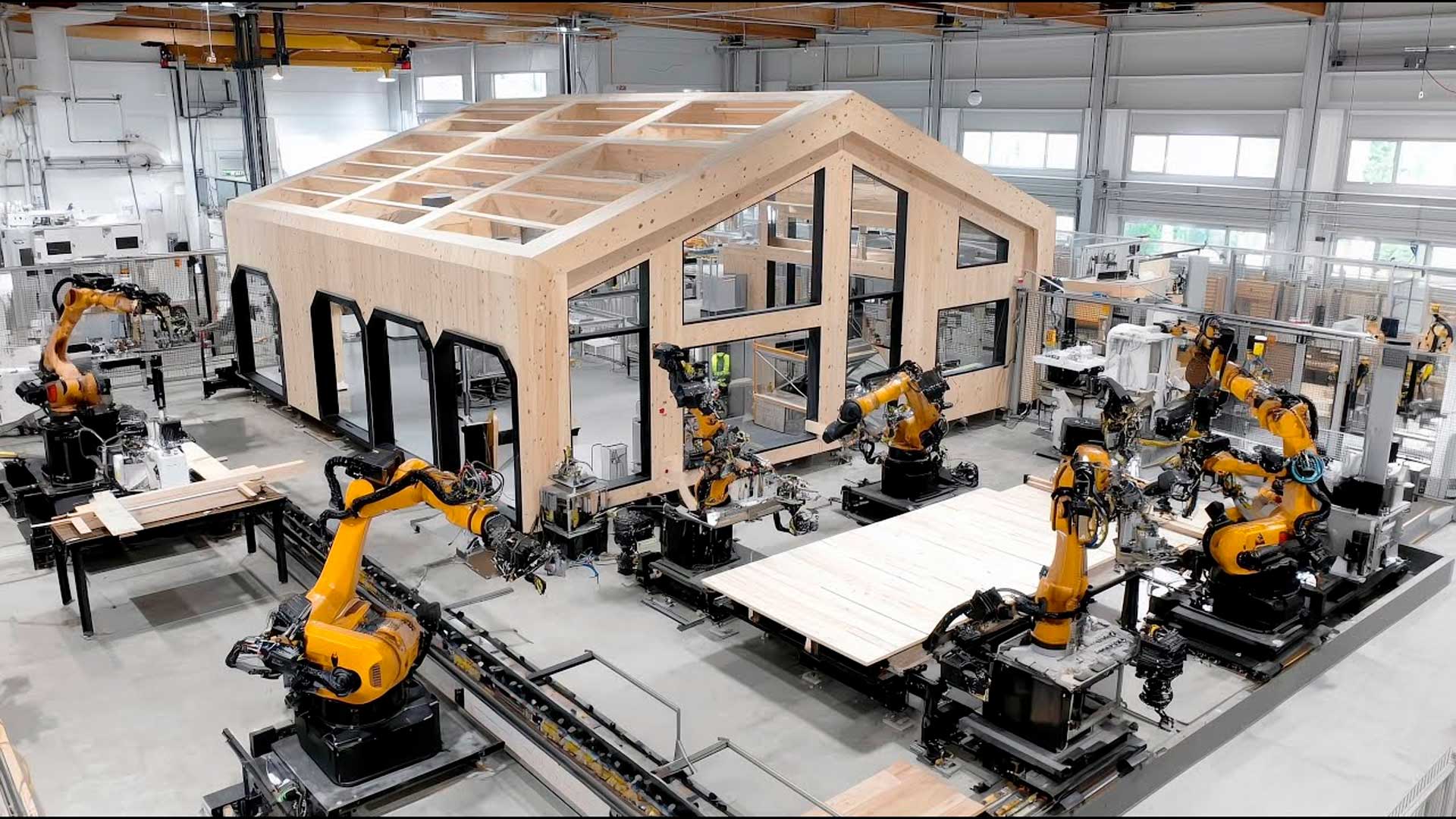
An Automated Factory in South Korea Transforms Walls and Modules into a Production Line and Reignites the Debate on Cost, Quality, and Jobs in Construction
The idea of seeing robots building a wooden house in a matter of days is no longer fiction and is already appearing in behind-the-scenes videos recorded inside highly automated factories.
In South Korea, the company Gonggan Jaejakso, also presented as Space Factory in international materials, operates a model of modular and prefabricated construction that brings most of the work inside a controlled warehouse.
The goal is to reduce common delays in traditional construction, such as weather, labor shortages, and quality variations, treating the house as a product assembled in stages.
-
Helicopter Drops 180 Tons of Sand and Gravel on Swedish River to Revive Ecosystem Damaged by Decades of Exploitation

-
Brazilian Company Launches Retro Smartphone with 48 MP Camera, T9 Keyboard, and Privacy Features for Social Media-Free Use

-
Self-Taught Chinese Farmer Builds 5-Ton Submarine from Scrap, Launches It in Anhui River
-
Invisible Induction Technology Enables Wireless Power for Blenders, Coffee Makers, and Air Fryers, Reducing Countertop Cables





The promise attracts attention because of the speed, but also because it exposes a sensitive point: what changes when the construction industry begins to operate like an industry.
A Smart Factory for Wooden Houses That Functions as an Industry

Field reporting from the Korean site ZDNet describes a complex in Hwaseong where robotic arms cut, move, and assemble parts, while few people act more as supervisors and quality control than as manual labor.
According to the report, the site is able to “dispatch” about two houses per day and the company itself claims that, with a higher operating rate, it could increase that volume to something like five units daily.
In May 2025, Hyundai Engineering and Construction announced an agreement to apply off-site modular wood technology in auxiliary structures of condominiums, citing Gonggan Jaejakso as owner of a cutting-edge automated system, with BIM design and high-precision production.
How Robots Are Involved in Wood Cutting and Assembly of Walls and Modules
In the tour described by ZDNet, heavy work is concentrated in repetitive stages, such as moving pieces with suction, cutting openings, and assembly with automatic fastening, the type of task where consistency and rhythm matter more than improvisation.
The same report mentions the involvement of a robotics solutions company in designing the system and mentions high-capacity and reach industrial equipment, along with specialized grippers for wood assembly with sensors and vision to deal with component variations.
The central point is that the wall stops “emerging” at the construction site and starts being finished in sequence, moving from one station to another via elevators and internal conveyors, while humans become more responsible for inspection and anomaly checking.
This type of automation, according to the report, would have reduced the time of one of the stages by about 40 percent, with gains in standardization in items that impact performance such as sealing and insulation.
Why Modular and Off-Site Construction Has Become a Bet Against Delays and High Costs
Modular construction has gained traction worldwide by addressing longstanding issues in the sector, such as low productivity, labor bottlenecks, and difficulties in scaling deliveries with predictable quality, an argument reinforced in market analyses on the topic.
Academic reviews also point out that producing off-site and assembling on-site tends to shorten timelines because part of the work occurs in parallel and with less exposure to interruptions such as weather and material shortages at the construction site.
At the same time, government agencies and regulators have drawn attention to specific risks, particularly at the interface between factory and installation, when safety and performance details need to be integrated from the outset of the project.
In South Korea, a showcase of this movement appears in industrial case studies about Space Factory, which report the transition from manual processes to more automated lines aimed at scaling annual production and standardizing quality in modular wooden houses.
What It Means to Have a House Ready in 3 Days and What the Video Does Not Show
The video that popularized the topic usually summarizes in a few minutes a journey that, in real life, depends on what is being counted as “ready,” whether it’s just the manufacturing of panels and the pre-assembly of the module, or also foundations, permits, water and electricity connections, and final finishing.
An interview published on the Daum portal, with declared collaboration from the company itself, describes that the factory stage for the structure can take about three weeks, and that the path to occupancy is typically longer when assembly, finishing, and interiors are involved.
In the same type of institutional material, there is reference to a complex of about six thousand pyeong, which is approximately 20,000 square meters, since 1 pyeong equals about 3.3058 m².
It is also in these contents that the ambition for scale and infrastructure emerges for something in the neighborhood of 1,700 units per year, a number that describes capacity and industrial intent, not necessarily deliveries already made in all models and markets.
The Controversy Behind the House Made by Robots
The speed is impressive, but the inevitable discussion is the impact on employment and the supply chain, since automation replaces part of the construction site work with roles in operation, maintenance, programming, and quality control.
The very debate about robots in factories in South Korea has generated friction in other sectors, with unions warning of the risk of replacement and demanding negotiation before expanding the use of humanoid robots and advanced automation.
In the case of modular wooden houses, advocates argue that the focus is on reducing waste and variability, while critics demand transparency about final costs, durability, excessive standardization, and the fate of traditional construction professionals.
If the promise of a “house ready in days” becomes standard, the dispute is likely to shift from the construction site to the industry, and consumers will demand what they have always demanded, fair price and proven quality, but now with the extra question of who loses and who gains in this transition.
Would you live in a modular house made by robots and set up on your property in a few days, or do you think that could increase risks and overly standardize homes? Leave a comment saying whether automation will truly lower costs or just swap jobs for promises.




-

-

-

-

-

-

26 people reacted to this.