






 Portuguese
  Spanish


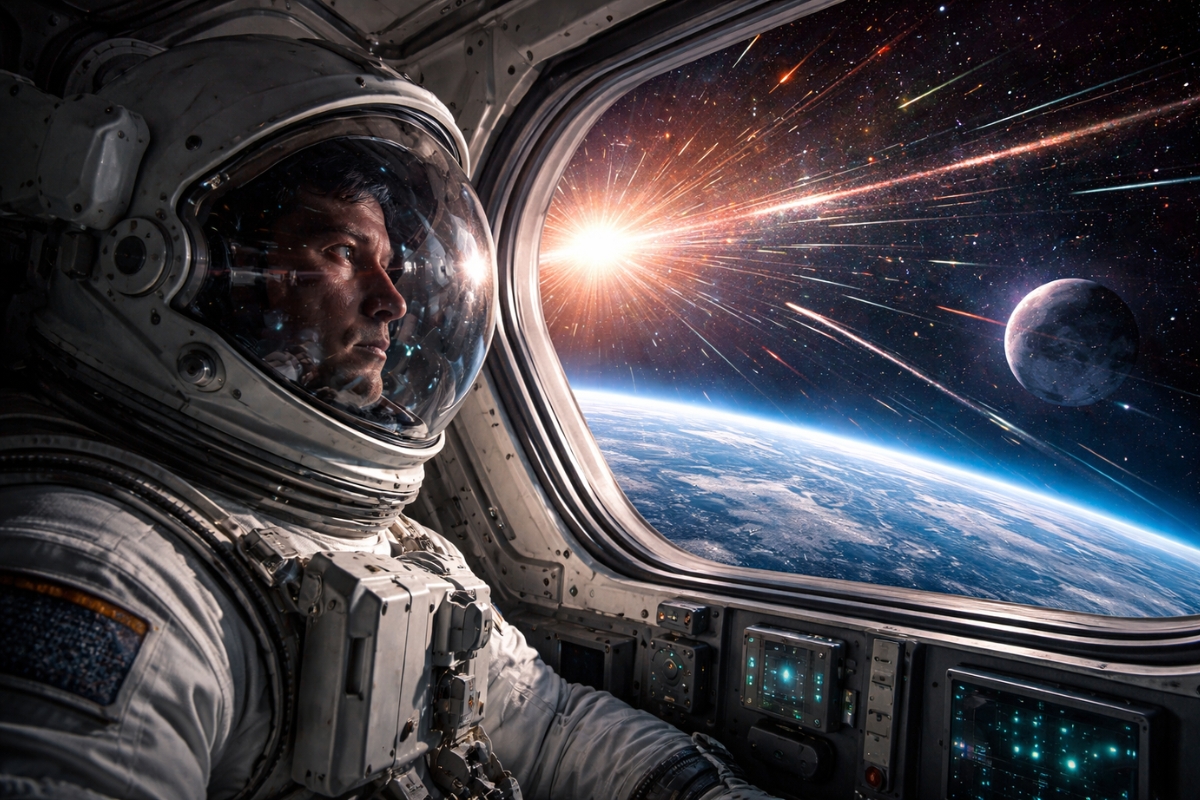


Space Radiation And The Challenge For Artemis II Astronauts
Jeremy Hansen spent years simulating disasters in Italian caves and submerged capsules off the coast of Florida, preparing for isolation and psychological stress. However, the greatest danger of his upcoming journey is invisible and impossible to fully replicate on Earth: space radiation. Next month, with the launch of NASA’s Artemis II mission, Hansen and his team will be the first humans in over half a century to leave the protection of Earth’s magnetic field, facing a bombardment of atomic particles that tests human biology.
Space Radiation And The Challenge For Artemis II Astronauts
Unlike low Earth orbit, where the International Space Station (ISS) resides under the protection of the magnetosphere, the Artemis II astronauts will be exposed to the raw “space weather.” The space radiation they will face comes from three main sources:
- Van Allen Belts: Clouds of electrons and protons trapped by Earth’s gravity and magnetism that the Orion capsule must quickly traverse.
- Solar Particle Events (SPEs): Solar storms that can elevate radiation levels to lethal thresholds in a matter of hours.
- Galactic Cosmic Rays (GCRs): The most insidious danger. These are nuclei of heavy elements, like iron, that travel nearly at the speed of light. When they strike the human body, they act like “atomic bullets,” fragmenting DNA chains and generating free radicals that cause systemic biochemical chaos.
Although the estimated dose for the 10-day mission is comparable to a full-body CT scan, chronic exposure is the main hurdle for colonizing the Moon or Mars. “This is the main limitation on how far we can explore our Solar System,” says Aleksandra Stankovic of Massachusetts General Hospital.
-
Scientists Confirm “Greening” of Antarctica: Ice on the World’s Coldest Continent Turns Green as Mosses Multiply Over Tenfold in Four Decades

-
2,000-Year-Old Gold Rings Found with Human Bones in Thailand Reveal Rare Burial and Feature Ancient Indian Inscription

-
Lenovo Unveils Legion Y700 Tablet with RGB Backlighting, 5G, and SIM Card Support

-
World’s First Nuclear Hydrogen Unit Begins Operation: Copper-Chlorine Technology with Initial Capacity of 150 Liters per Hour, Aiming for 3,000 Liters per Hour



Medical Innovation: Cells On Chips And Bioinformatics
To face space radiation, NASA is utilizing a revolutionary bioengineering technology: “organ chips.” Recently, stem cells were extracted from Jeremy Hansen’s own blood to create microfluidic models of his bone marrow — the most radiation-sensitive tissue and vital for the immune system.
These customized chips will fly aboard the Orion while their “biological twins” remain on Earth for monitoring. The goal is to compare how the deep space environment accelerates cellular aging and induces mutations in real-time. This approach allows scientists to test specific countermeasures, such as new antioxidants and gene therapies, before astronauts present clinical symptoms. In the future, each crew member may have a personalized medical kit tailored to their genetic vulnerabilities against space radiation.
Shields And Shelters: Survival Engineering
Physical protection has also made technological leaps. The Orion capsule is designed with a “storm shelter” beneath the cabin floor, where the crew must take refuge if the Sun emits a severe eruption. Additionally, hydrogen-rich materials, such as polyethylene, water, and even the astronauts’ clothing, are used as shielding since hydrogen is the most efficient element for slowing down solar protons.
Another bet is the AstroRad vest, developed by the startup StemRad. Tested with mannequins on the uncrewed Artemis I mission, the vest demonstrated a reduction of radiation dose to vital organs by up to 60%. Although the payload weight is still a limiting factor for Artemis II, this technology will be essential for long-duration missions.
Despite the risks of cancer, heart disease, and cognitive damage, the history of Apollo-era astronauts carries a note of optimism: most lived to their 80s or 90s. However, for humanity to become truly multiplanetary, overcoming space radiation will not only be a matter of rocket engineering but also of leveraging biology and biotechnology in favor of the explorer.





E há 60 anos eles usavam o quê, que conseguiram ir lá?🤔🤣🤣🤣🤣🤣🤣🤣🤣🤣🤣
Conseguiram mas muitos contraíram câncer linfático.
Há tá em 1969 eles tinhão está tecnologia