






 Portuguese
  Spanish


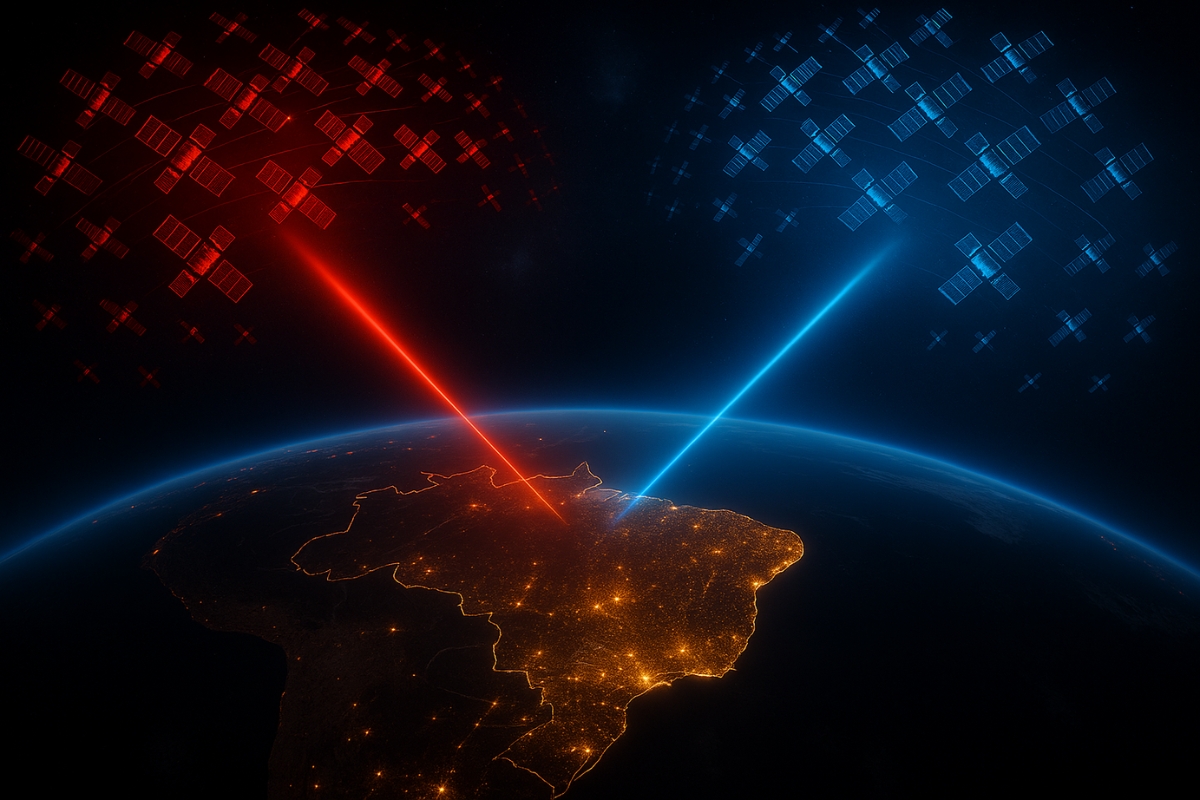


The Dispute Between the USA and China for Satellite Internet Accelerates a New Digital Cold War, with Gigantic Constellations in Low Orbit and Brazil Emerging as a Strategic Piece to Connect and Influence All of South America
Space internet has ceased to be just a solution for remote areas and has become the center of a global dispute involving billions of dollars, military strategies, and the sovereignty of entire countries. While governments discuss regulations and private companies accelerate launches, the perception grows that the greatest technological war of the 21st century is silently happening above our heads, in Earth’s orbit. And, in this dispute, Brazil emerges as one of the most important pieces on the board.
What once seemed distant, reserved for space agencies and government missions, is now part of a frantic race for the occupation of near-Earth space. The new battle for connectivity involves the United States, China, Europe, India, and major private giants, all trying to secure a slice of what promises to be the world’s largest emerging digital market.
The Planet is Surrounded: 100 Thousand Satellites Could Occupy Orbit by 2030
A few years ago, humanity had about 1,500 active satellites. Today, the number exceeds 9,000, and estimates from consultancies like Euroconsult point to over 100,000 units in the next five years. Most will be in low orbit, where it is possible to offer ultra-fast internet with minimal latency, something essential for live broadcasts, military systems, autonomous cars, and industrial applications.
-
Pennsylvania Mine Creates Ice in Summer Heat and Melts in Winter, Turning a Mountain Crevice into a Reverse Natural Refrigerator

-
China Accelerates Global Expansion of Robotics: From Smart Vacuums to Industrial and Humanoid Machines, Millions Exported to Over 150 Markets
-
Polar Air Mass to Hit Brazil: Temperatures to Plummet in Nine States, Near Freezing in the South with Frost Risk Until Monday
-
Chinese “dark factories” produce electric cars 24/7 with minimal human intervention, as Zeekr assembles 800 units daily, raising concerns in Brazil.





Starlink, SpaceX’s network, already operates approximately 7,000 satellites and plans to reach 42,000 by the end of the decade. Amazon wants to launch 3,200 units with Project Kuiper. OneWeb operates another network with over 630 satellites. Europe and India are working on their own constellations, trying not to fall behind in the technological advancement that promises to impact everything from agriculture to defense.
But no one is advancing more strongly than China. The Asian country is preparing multiple constellations, including the Qianfan, known as the Thousand Sails, in addition to other initiatives that together could exceed 43,000 satellites. It is the most ambitious move ever recorded in the history of global connectivity, funded by state programs of digital sovereignty.

The Dispute Between the USA and China is Already the Most Important Technological Confrontation of This Century
LEO satellites have become a strategic tool. Who controls the orbit controls the information. Who controls the information controls the world. And it is exactly this logic that is guiding global powers.
The United States bets on the strength of the private sector, especially Starlink, which has already demonstrated military power by maintaining critical communications during the war in Ukraine. The American government sees the network as a national asset, even though it is managed by a company. The White House is even discussing ways to limit external dependency and strengthen its orbital presence.
China follows a different path. Its projects are state-run, centralized, and aligned with the national plan to become fully self-sufficient in strategic technology. Networks like SpaceSail, which recently expanded operations to other continents, are part of a coordinated ecosystem aimed at ensuring total independence for the Chinese government from Western systems.
This scenario creates tension between the two largest economies on the planet. For cybersecurity experts, the race for orbital internet has already replaced, in many aspects, the old nuclear arms race. Instead of warheads, the weapon now is the ability to connect billions of people, companies, and governments, determining who controls the global flow of data.

Brazil Becomes a Key Piece by Emerging as a Support Point for New Networks
In the middle of this board, Brazil has become one of the most strategic territories in the southern hemisphere. The privileged geography and the capacity to install control centers make the country a natural candidate to host part of the infrastructure necessary to operate global constellations.
In recent months, the country has entered the radar of major space initiatives. American commercial projects are studying to expand their reception and transmission bases in Brazilian territory, while Chinese companies have already established partnerships with national entities for the operation of ground antennas, monitoring stations, and gateways.
For Brazil, the arrival of multiple foreign actors can represent a leap in connectivity. The Amazon, which has suffered from digital blackouts for decades, is one of the regions that stands to benefit the most from this advancement. The same goes for riverside communities, rural districts, mountainous areas, and agricultural regions that rely on telemetry and reliable internet to operate precision systems.
In the long run, the country could become the main satellite internet hub in South America, distributing signals to neighboring countries and increasing its geopolitical importance.

The Risk of Dependency and the Debate on Digital Sovereignty
The new digital space race, however, raises concerns. Dependency on private networks or foreign constellations can create vulnerabilities for Brazil. The remote shutdown of a constellation, whether for political or commercial reasons, would have an immediate impact on essential sectors such as online education, telemedicine, agribusiness, and public safety.
European Union countries are already discussing legislation to prevent their critical communications from relying on structures controlled by governments outside the bloc. The USA and China treat their systems as strategic defense assets, not just as commercial solutions.
Experts argue that Brazil needs to accelerate its own projects, like SGDC-2, and expand the use of national technologies to reduce long-term risks. The combination of private networks, government systems, and balanced international partnerships can ensure greater security.
The Future of Space Internet in Brazil Changes the History of Connectivity on the Continent
Regardless of who wins the global race, the fact is that Brazil is undergoing a moment of profound transformation. The arrival of new networks promises to reduce regional inequalities, enable advances in agribusiness, boost connected schools, and facilitate environmental monitoring systems that today rely on precarious structures.
As Earth’s orbit becomes increasingly congested, the role of emerging countries is also growing. Brazil, once a distant spectator, now occupies a prominent position at the technological negotiation table of the 21st century.
The new digital Cold War is taking place in space, well above the field of vision of the average citizen. And, in this silent dispute, Brazil has just gained a role that could shape the future of connectivity throughout the southern hemisphere.







Sucesso sempre