Portuguese
  Spanish


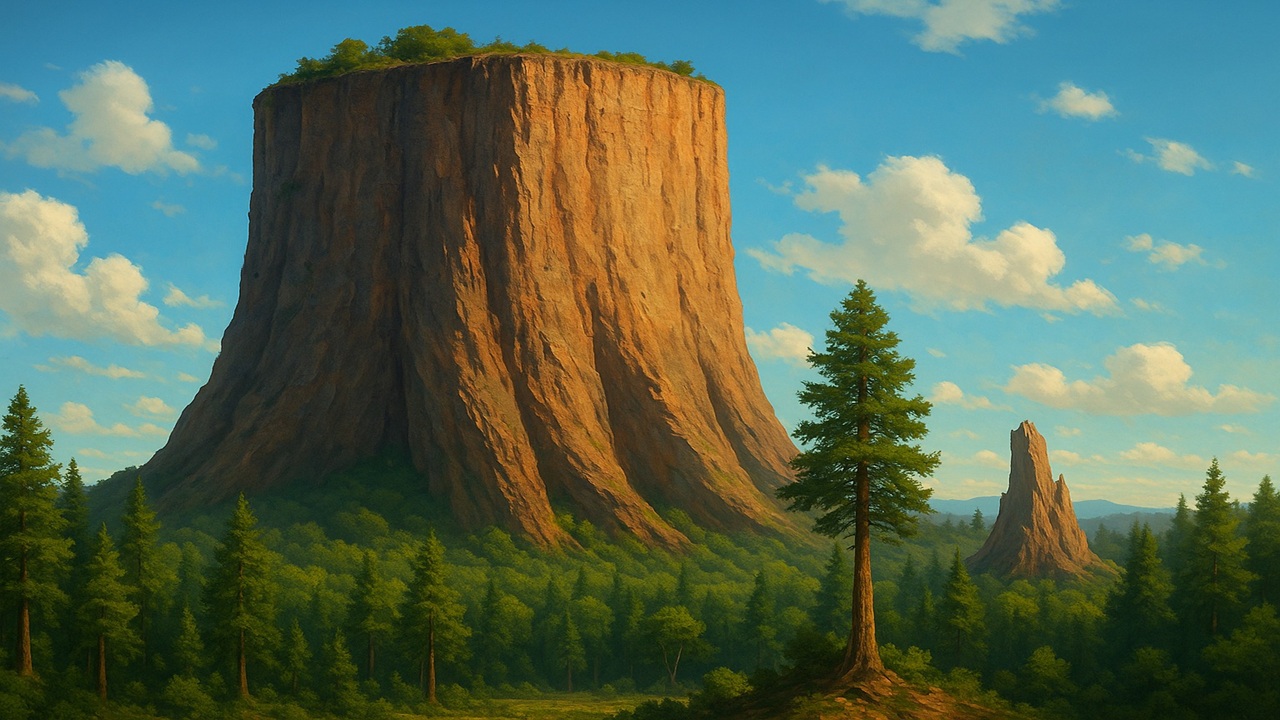

The New Theory Circulating Among Flat Earth Advocates Tries to Rewrite Natural History by Claiming That Trees Do Not Exist. According to the Narrative, Today’s Forests Would Be Just Fragments of 64 km Giants Destroyed by an Ancestral Cataclysm, Creating Another Controversial Chapter Within This Movement
The idea that trees do not exist is part of a set of new beliefs defended in circles linked to Flat Earth theory. This interpretation gained traction after the publication of a video in 2016, on YouTube, by a man from Crimea whose account was later deactivated.
The material reached hundreds of thousands of views and continues to circulate in derivative versions that maintain the same argumentative line.
The video argues that what we see today in forests, parks, and gardens would not be trees. For the author, they would merely be shrubs and saplings of ancestral trees that would have reached 64 kilometers in height and had trunks with 3 kilometers in diameter.
-
Living Robots Made from Human Cells Crawl on Their Own in Lab, Help Heal Neuron “Wounds” and Turn Human Tissue into Microscopic Biological Machines

-
Xlinks Project to Lay 3,800 Kilometers of Cable Across the Atlantic to Export Solar Energy from Morocco Directly to UK Outlets Without Using a Single Turbine

-
Floating Solar Panels Aim for Rougher Seas with Norwegian Rope Mesh Technology, Following DNV Review, Opening New Clean Energy Opportunities in Coastal Areas
-
Olympus Mons: The Solar System’s Tallest Volcano, Over Three Times the Height of Mount Everest, Puzzles Scientists with Its Prolonged Volcanic Activity



The presentation describes a cataclysmic event capable of destroying 99% of the planet’s biosphere, eliminating these gigantic structures.
According to the material, formations such as buttes, mountains, plateaus, and mesas would be remnants of these monumental trees. The images place Uluru in Australia, the Giant’s Causeway in Northern Ireland, and Devil’s Tower in Wyoming side by side with real stumps, suggesting that the visual similarity would indicate a common origin.
The argument ignores that material and scale are fundamental elements for differentiating natural structures.
The Interpretation of Rocks as Debris
The video’s author claims that much of the rocks would not actually be rock. For him, they would be debris resulting from the destruction of ancestral trees.
This interpretation extends to flat-topped mountains, treated as giant stumps left after the event that would have reshaped the earth’s surface. The proposta rejects established geological explanations and attributes biological origin to structures composed of minerals.
An arborist consulted by Quartz highlights essential differences between trees and rocks. Trees are living organisms, primarily made of carbon.
Rocks are inorganic structures, composed of minerals. This distinction invalidates the equivalence suggested by the video and dismantles the premise that geological formations could be remnants of colossal organisms.
Independent Verification and Poe’s Law
The theory has already been analyzed and debunked by various sources. Snopes refuted claims associated with the topic, including the assertion that the Flattop Mountain National Monument has a root system.
This story originated from a satirical page and illustrates the difficulty of distinguishing extreme beliefs from parodies when there is no clear indication of intent, a phenomenon known as Poe’s Law.
Although it does not have a direct link to the belief that the Earth is a flat disk, the theory of giant trees circulates among flat Earthers. Issues like balance, distribution, and the impact of these structures in a flat Earth scenario are not discussed in the materials supporting the idea.
The lack of complementary explanations reinforces the speculative nature of the content and leaves it to the reader to evaluate whether the theory requires belief or functions as provocation within the group itself.