






 Portuguese
  Spanish


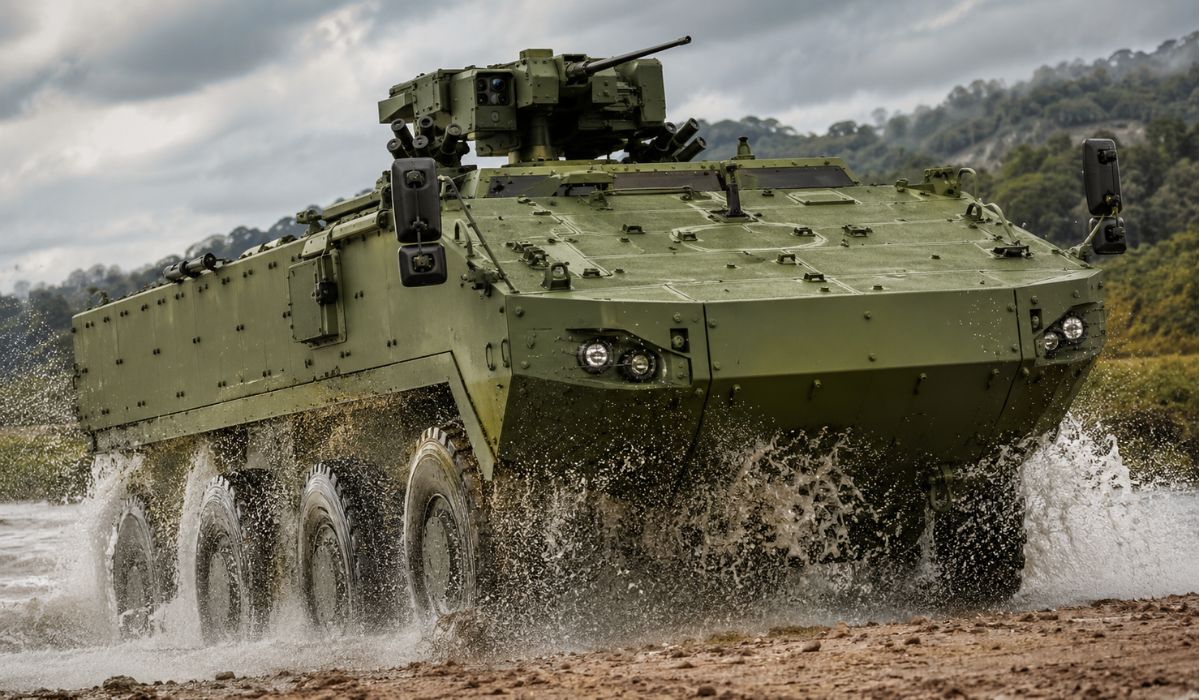

Guarani Armored Vehicle combines military engineering, amphibious mobility, and anti-mine protection in a platform used by the Brazilian Army to transport troops, operate in difficult terrains, and integrate remote weapon systems.
The Guarani armored vehicle was developed to transport troops with protection, mobility in varied terrains, and amphibious capability.
The vehicle, known by the acronym VBTP-MR 6×6, weighs about 18 tons, carries up to 11 occupants, has six-wheel drive, and can reach up to 110 km/h on roads, according to the Ministry of Defense.
The Army reported that more than 700 units of the model are in operation in Infantry and Cavalry brigades.
-
Polyformer Machine Converts PET Bottles into 3D Printer Filament, Reducing Costs and Expanding to Over 50 Countries

-
Realme C100x Launches in Brazil: Features 8,000 mAh Battery, Military Durability, 120 Hz Display, and Android 16

-
Clay Tubes Form Honeycomb Structure for Natural Air Conditioning, Cooling Air with Water and Evaporation Without Refrigerants, Turning Terracotta into Heat-Resistant Technology in India

-
Cassini Discovers Fresh Organic Molecules Emanating from Enceladus’ Hidden Ocean, Making Saturn’s Icy Moon a Prime Target in the Search for Extraterrestrial Life



Designed in partnership with Iveco Defence Vehicles, the Guarani is part of the Brazilian Army’s armored fleet modernization program.
The proposal is to gradually replace vehicles from previous generations and enhance the mobility of mechanized troops in different operational environments.
Instead of functioning solely as transport, the vehicle combines ballistic protection, anti-mine features, electronic systems, and the possibility of employing remotely controlled weapons.
The wheeled configuration distinguishes the Guarani from tracked vehicles, common in heavier armored vehicles.
With six-wheel drive, the model was designed to travel on highways, dirt roads, and areas with less infrastructure.
This feature allows use in border patrol, military exercises, security operations, and support actions for the population, as described by the Army in institutional communications.
How the Guarani Armored Vehicle Crosses Water
The amphibious capability is one of the technical features of the Guarani.
The Ministry of Defense states that the vehicle has amphibious function, in addition to 6×6 drive, capacity for 11 people, and an approximate weight of 18 tons.
In practice, the design includes a sealed structure and its own propulsion for movement in controlled aquatic environments.
This feature allows the troop to cross watercourses under certain operational conditions, without immediately relying on bridges, ferries, or other crossing means.
The performance in water is often reported in technical materials and specialized reports as close to 10 km/h, although the open official confirmation does not bring all these data together in a single public sheet.

In Brazil, the characteristic is directly related to geography.
Border areas, riverside regions, flooded zones, and places affected by floods may require military movement through unstable terrains.
The Army recorded the use of the Guarani in support actions for the population in Operation Taquari II, in Rio Grande do Sul, in 2024, within the context of employing military means in emergency situations.
V-shaped hull and anti-mine protection
Protection against explosions under the vehicle is associated with the design of the V-shaped hull.
This shape aims to redirect part of the energy generated by mines or explosive devices, moving the shock wave away from the central area of the floor.
The principle is used in different modern armored vehicles intended for troop transport.
In the Guarani, protection does not rely solely on external geometry.
The elevated cabin, suspended seats, and internal containment materials help reduce the direct transfer of impact to the occupants.
Instead of attaching the seats directly to the floor, the design uses seats fixed to the upper structure, a solution adopted to reduce the vertical effect of an explosion on the soldiers’ legs and spine.
Technical reports on the vehicle, based on information from engineers involved in the project, indicate resistance to explosives under the armored vehicle.
As no official public, current, and consolidated Army sheet with all anti-mine protection parameters was found, the information on the exact explosive limit was kept in the final note as unconfirmed data in an official open source.
Ballistic protection also involves modular armor.
This type of solution allows adapting the level of protection according to the mission and the anticipated threat level.
In military vehicles, modularity helps balance weight, mobility, and safety, as additional armor can increase the total mass and alter the vehicle’s performance.
383 horsepower engine and 6×6 traction
The mechanical set of the Guarani was sized to move an 18-ton armored vehicle with crew, armament, and equipment.
The engine associated with the model is the FPT Cursor 9, with 383 hp, according to technical publications and specialized reports on the vehicle.
The official open confirmation located by the Ministry of Defense informs the weight, traction, amphibious capacity, occupancy, and maximum speed, but does not detail the engine on the same page.
The power serves to maintain movement in situations where the vehicle’s weight influences acceleration, recovery, and overcoming obstacles.
In terrains like mud, sand, and hard-packed earth, 6×6 traction helps distribute force between the axles and reduce loss of grip.
The maximum speed of up to 110 km/h on the road, as reported by the Ministry of Defense, does not mean that the vehicle is always used at this limit.
In real operations, speed depends on terrain, troop safety, presence of obstacles, transported weight, and mission conditions.
However, this data helps position the Guarani among wheeled transport armored vehicles capable of accompanying mechanized movements.


Remote weapons on the VBTP-MR Guarani
The Guarani can be equipped with weapon systems operated from inside the vehicle.
One of the equipment associated with the model is the REMAX, a remotely controlled station developed from the Brazilian Army’s requirements, with participation from ARES and the Army Technological Center, according to ABIMDE.
The station is gyro-stabilized and can use .50 and 7.62 mm machine guns.
ARES states that its weapon systems feature two-axis stabilization, protected operation inside the vehicle, daytime camera, thermal camera, laser rangefinder, and touch-sensitive monitor, among other features.
These components allow observation and aiming without the operator needing to be exposed outside the armored vehicle.
With remote operation, the shooter monitors the environment through screens and sensors.
The solution allows supporting troop disembarkation and maintaining reaction capability with the soldier protected by the armor.
In low-light conditions, the thermal camera enhances observation, always within the system’s technical limits and terrain conditions.
Modernization of the Army’s armored fleet
The Ministry of Defense states that the Guarani is the result of the modernization of the Brazilian Army’s fleet, which retains the intellectual property of the armored vehicle.
The vehicle was created to gradually replace previous troop transport models and serve as a base for a family of medium wheeled armored vehicles.
The project does not only involve the delivery of vehicles.
It also includes military training, maintenance, logistical adaptation, command and control systems, and the development of specialized versions.
The Government of Minas stated, back in 2011, that the VBTP Guarani could originate different configurations, such as command post, communications, mortar, rescue, workshop, and ambulance.
This standardization facilitates the use of the same platform for different functions.
For a mechanized force, employing vehicles with a common base can simplify training, spare parts, and maintenance.
The Army also reported that the Guarani Project completed 20 years in 2025 and continues to be associated with the strengthening of the Defense Industrial Base.
Production in Brazil and defense industrial chain
The production of the Guarani is linked to the installation of Iveco Defence Vehicles in Sete Lagoas, Minas Gerais.
The Government of Minas recorded that the project involved national suppliers and the creation of a unit focused on armored vehicles.
The Army states that the initiative contributed to research, development, and innovation in defense products in the country.
In the military area, manufacturing and maintaining equipment in the country can reduce external dependencies in part of the logistics chain.
This assessment appears recurrently in documents and communications about the Defense Industrial Base, always related to the capacity for production, maintenance, and evolution of systems used by the Armed Forces.
The program also continues with recent deliveries.
A monitoring document from the Ministry of Defense informs that, in 2024, 60 Guarani 6×6 vehicles were delivered, in addition to REMAX systems and command and control systems.
The same report points to new deliveries in 2025 within the programs monitored by the department.
Mobile fortress on wheels
The expression “mobile fortress,” present in the title, describes the combination of protection, transport, and mobility features of the Guarani.
The vehicle combines armored hull, 6×6 traction, amphibious function, capacity for a troop fraction, electronic systems, and remote weapon option.
From a technical standpoint, the vehicle concentrates solutions in mechanical engineering, electronics, ballistics, and materials science.
The V-shaped hull acts in dispersing energy from lower explosions.
The traction on the six wheels favors movement on irregular terrains.
The amphibious function allows crossings in controlled aquatic environments.
Meanwhile, remote weapon systems reduce the direct exposure of the operator.
The combination of these elements explains why the Guarani occupies a central role in the Brazilian mechanized infantry.
The platform does not replace all types of armored vehicles, nor does it function as a heavy combat vehicle, but it meets a specific need: transporting military personnel with protection, mobility, and support capability in different scenarios.


