Portuguese
  Spanish


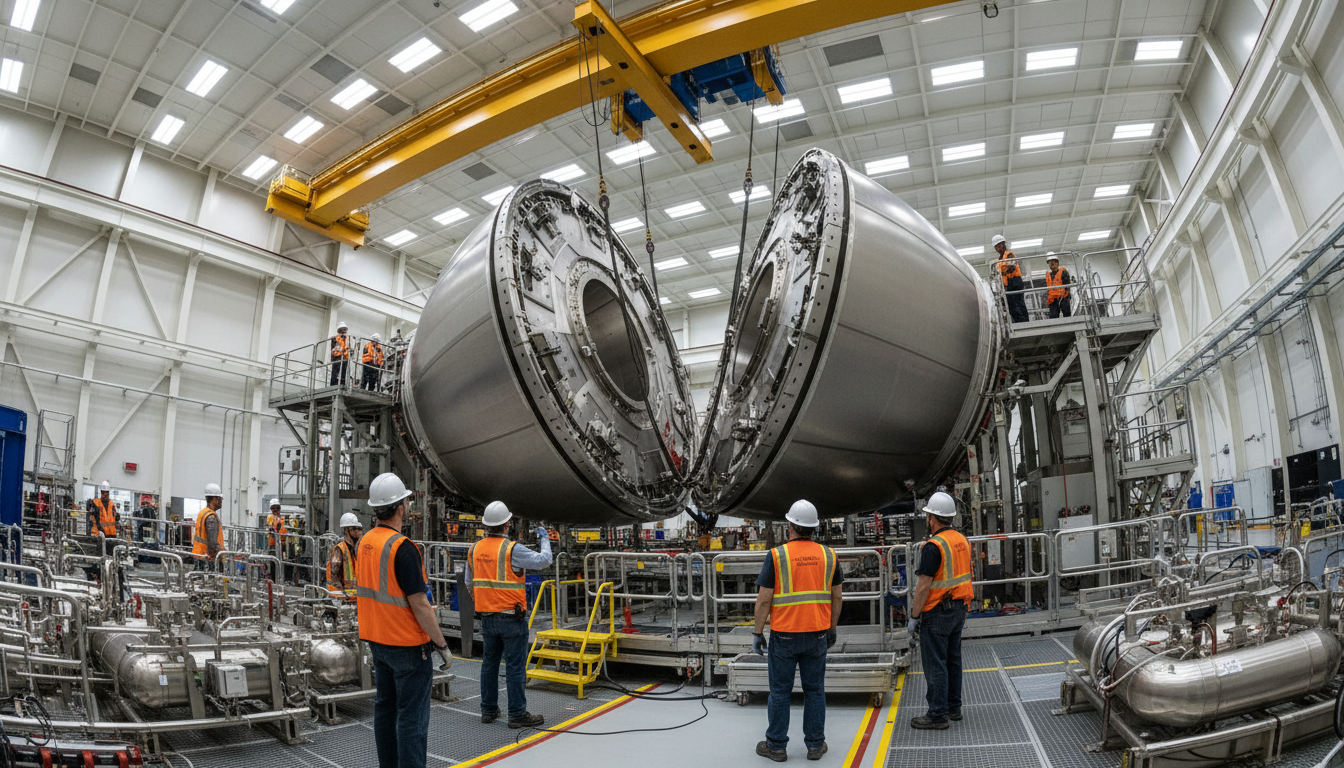


Commonwealth Fusion Systems reached 75% of the SPARC tokamak in Massachusetts by installing the second half of the 48-ton vessel that will house plasma at over 100 million degrees to attempt net energy gain in 2027.
In May 2026, in Devens, Massachusetts, engineers from Commonwealth Fusion Systems lowered the second half of the SPARC vacuum vessel by crane. It is a 48-ton steel ring.
According to the report by the Interesting Engineering portal, the installation brings the tokamak to 75% completion. The company promises first plasma in 2026 and net energy gain in 2027.
The milestone is significant. It puts the US private sector ahead of public giants like ITER, whose schedule has been delayed to 2039.
-
Texas Teens Win $50,000 at World’s Largest Science Fair for Developing Non-Surgical Brain-Controlled Bionic Prosthesis with 98% Accuracy

-
Samsung Galaxy A27 Launches with 6.7-inch Super AMOLED Display, Full HD+ Resolution, Android 16, Six Years of Updates, Snapdragon 6 Gen 3, and Dust and Splash Resistance; Available for Pre-order in the US for $350

-
Five Brazilian Students Invent Drug Test Pen That Detects Date Rape Drugs in Seconds
-
Viedma Glacier Retreat in Patagonia Uncovers 900-Meter-Deep Basin, Making Viedma the Deepest Lake in the Americas


Indeed, CFS wants to compete for the title of the world’s first positive-return fusion reaction outside state laboratories.
For Brazil, the topic matters for two reasons. First, the next generation of commercial plants could reshape the electricity supply.
Additionally, Brazilian heavy equipment companies are already seeking partnerships in superconductors and cryogenic instrumentation.
The SPARC vacuum vessel inside

The newly installed vessel completes the chamber where the machine’s plasma will be confined. It is a torus-shaped chamber.
The walls are made of stainless steel with controlled thickness. They withstand deep vacuum and intense neutron flows.
According to the official CFS technical blog, the vessel was manufactured in two halves to facilitate the assembly of internal components.
Subsequently, the two halves are joined around the assembly that receives the superconducting magnets. The first half had already been delivered months earlier.
With the arrival of the second half in May 2026, the complete structure of the tokamak took its final shape. According to the disclosed schedule, the closure of the external cryostat and the integration of the fuel lines are still pending.
In turn, the interior assembly requires tolerance of a few millimeters. Any mismatch between the chamber and magnetic fields compromises plasma stability.
In practice, CFS opted to build the machine on a reduced scale. It used a strong combination of high-temperature superconducting coils.
HTS Magnets, the game-changer

The technical leap of CFS lies in the REBCO superconducting tape magnets. These materials conduct current without loss when cooled.
Therefore, they generate much more intense magnetic fields per square meter. As co-founder Brandon Sorbom detailed in technical interviews, it is this field density that allows the tokamak to shrink.
Similarly, it reduces the total investment. While ITER, based on low-temperature magnets, costs over $20 billion, SPARC is budgeted at dozens of times less.
In comparison, the TFMC coil set, tested by CFS at MIT in 2021, reached 20 tesla, a world record for large-aperture magnets.
This result unlocked the company’s private funding. Subsequently, CFS raised $863 million in a Series B2 round in 2025.
The total accumulated exceeds $2 billion. Among the investors are the Italian giant ENI, Bill Gates’ Breakthrough Energy, and Khosla Ventures.
SPARC vacuum vessel schedule

According to the official blog, the planned sequence is as follows. First plasma in 2026, calibration of neutron diagnostics in 2027, and an attempt for Q greater than 1 later that year.
If the feat is confirmed, it will be the first time in history that a private machine produces more fusion energy than it received. For now, the absolute record belongs to NIF.
The Lawrence Livermore National Laboratory achieved 3.15 MJ released in 2022 with lasers. It was the world’s first laboratory ignition.
In parallel, CFS has already started building the ARC commercial plant. It is a 400 MW plant in Chesterfield County, Virginia.
In April 2026, according to the report by E&E News, CFS filed the first request from a fusion company to connect a plant to the PJM Interconnection.
In May 2026, the Italian ENI signed a billion-dollar contract for the early purchase of energy from CFS. At that moment, it became clear that part of the market is already pricing fusion in real commercial terms.
The global context of fusion

The fusion race in 2026 goes beyond CFS. Helion Energy, in Washington, reached plasma at 150 million degrees with deuterium-tritium fuel in its Polaris prototype in February.
According to the company, this was the first documented use of D-T fuel by a private machine. As documented by CPG in a report on the Korean tokamak KSTAR, this level is essential.
In parallel, TAE Technologies has been operating with hydrogen-boron. As shown by the CPG portal in coverage of TAE Technologies, this alternative fuel avoids radioactive waste.
On the other hand, private fusion startups raised about $9.8 billion by mid-2025. Despite this, a study in Nature Energy warned that many economic models overestimate learning gains.
Still, the US regulatory agency, the NRC, published a specific regulatory framework for fusion in February. The regulation explicitly separates fusion from fission.
And Brazil in this equation
Although no commercial tokamak is planned for Brazil, there are concrete participation opportunities. First, suppliers of special steel and cryogenic equipment can enter global chains.
Second, Brazilian universities are already participating in projects at IPEN with small-scale plasmas. These groups can cooperate with CFS and MIT in the long term.
As the CPG portal showed in coverage of the Microsoft-Chevron agreement, the advancement of fusion is directly connected to electricity demand. The explosion of AI pressures the global energy mix.
Next steps
According to the CFS blog, the next twelve months will involve closing the cryostat. Next comes the integration of the hydrogen and helium lines of the cooling system.
Subsequently, neutron diagnostics will be calibrated in a vacuum. Only then will the first plasma pulse be injected.
This first plasma will use only hydrogen, without D-T, to check basic stability. Despite this, the window for Q greater than 1 is concentrated in 2027.
If the target slips, CFS will lose its advantage over rivals like Helion and Tokamak Energy. Therefore, SPARC functions as an industrial showcase.
- Mass of the vessel: 48 tons, second half
- Physical completion of SPARC: about 75% in May 2026
- Location: Devens, Massachusetts, USA
- First plasma expected: still in 2026
- Target for Q greater than 1: from 2027
- CFS private investment: over $2 billion
- ARC commercial plant: 400 MW in Virginia, 2030s
Caveats and what could go wrong
According to MIT researchers consulted by the specialized press, there are still physical uncertainties about the high-density operating regime. Despite this, simulations conducted on supercomputers indicate a margin for Q greater than 1.
According to the study by Tang and Schmidt published in 2026 in Nature Energy, even if the technical target is achieved, the leveled cost of fusion may not compete with solar plus batteries until 2040.
Still, the maturity of HTS magnets has already changed the heavy equipment sector. Similarly, CFS can popularize superconducting tapes in the industry.
Finally, the question remains. If the SPARC vacuum vessel indeed delivers Q greater than 1 in 2027, will Brazil be ready to enter an industrial fusion chain?