Portuguese
  Spanish


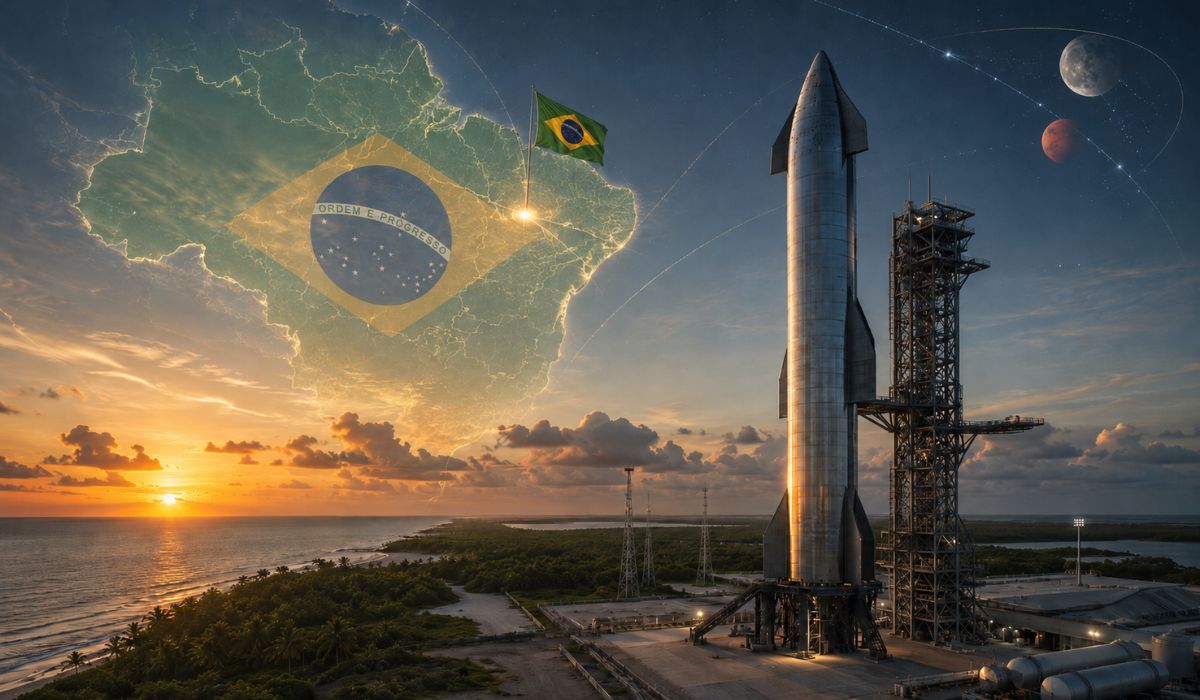

SpaceX’s search for new bases for the Starship rekindles interest in Alcântara and exposes how international agreements can influence the future of space launches outside the United States.
SpaceX is considering expanding the launch sites for the Starship, a rocket developed to transport cargo and crews to Earth’s orbit, the Moon, and Mars.
In this scenario, Brazil was mentioned among the countries that could meet legal requirements for future operations outside the United States, although there is no public announcement of an agreement between the company and the Brazilian government for the use of the Alcântara Base in Maranhão.
The possibility came into discussion after the company stated, in a publication on X, formerly Twitter, that it is looking for viable points to expand Starship operations.
-
Berries, Strawberries, and Blueberries Could Transform Agriculture in Northeastern Brazil, New Tests Reveal

-
Danish Resident Discovers Six Viking Gold Bracelets Weighing 762.5 Grams, Third Largest Gold Treasure in Denmark

-
Over 200 Cities in Southern Brazil on Storm Alert as Cyclone Near Uruguay Brings Heavy Rain, Hail, and Winds Up to 100 km/h

-
Archaeologists Discover 2,300-Year-Old Beer in Sealed Bronze Vessel from Ancient Chinese Tomb




The statement was made in response to comments about rumors of acquiring a large area on the coast of Louisiana, in the United States.
The company did not confirm the purchase of the land but detailed that its strategy depends on a larger network of launch bases.
“It’s no secret that we intend to launch the Starship frequently, with a goal of thousands of flights per year,” stated SpaceX.
In the same publication, the company said that this pace would require launch capacity in different locations and that, therefore, it is evaluating alternatives “both domestically and internationally.”
Brazil enters the radar because of Alcântara
The mention of Brazil is linked to the Technological Safeguards Agreement signed with the United States.
The treaty, signed in 2019 and enacted in 2020, establishes rules to protect American technologies in launches conducted from the Alcântara Space Center.
This type of agreement is relevant because rockets, launch systems, and associated components are treated by the United States government as technologies subject to specific controls.
For American companies to operate outside the country’s territory, it is necessary to comply with technological protection and export regulations.
In the case of Alcântara, the agreement allows Brazil to receive launches with equipment of American origin, provided that the rules outlined in the treaty are observed.
The text does not represent automatic authorization for any company to operate at the location, but it creates a legal basis for commercial negotiations involving United States technology.
The location of the Maranhão center is also often pointed out by authorities and space sector technicians as a factor of interest.
Alcântara is close to the Equator, a condition that can favor certain mission profiles by reducing the need for fuel to reach some orbits.
This characteristic, however, does not eliminate the need for specific infrastructure, licensing, regulatory authorization, and operational agreements.
So far, there is no public confirmation of formal negotiations between SpaceX and the Brazilian government to launch the Starship from Maranhão.
For this reason, Brazil appears as a possibility mentioned in the international debate, and not as a defined destination for the mega rocket.

US rules condition launches outside the country
The international expansion of the Starship depends on United States regulations on the control of sensitive technologies.
Part of these rules is associated with ITAR, the acronym for International Traffic in Arms Regulations, which covers aerospace equipment and launch systems.
These regulations do not prevent launches in other countries but make the process subject to additional authorization steps.
In practice, the host country needs to provide guarantees that protected technologies will not be accessed, copied, or transferred without permission.
Besides Brazil, countries like Australia, the United Kingdom, Norway, and New Zealand have also been mentioned in international analyses for having technological safeguard agreements with the United States.
New Zealand already hosts launch operations for Rocket Lab, a company founded in the country and headquartered in the United States, which shows a model of transnational operation within this type of regulatory structure.
For Brazil, the discussion revisits the role of Alcântara in the space launch market.
The center has been presented by different governments as a structure capable of attracting foreign companies, but contracts of this magnitude depend on legal, technical, environmental, and commercial conditions.
Starship tests remain concentrated in Texas
Currently, Starship test flights depart from the Starbase, SpaceX’s facility in Boca Chica, southern Texas.
It is at this location that the company develops and tests the set formed by the Super Heavy booster and the Starship spacecraft.
The expansion within the United States is also advancing.
SpaceX is working on structures associated with the Starship in Florida, including areas at the Kennedy Space Center and Cape Canaveral.
The United States Federal Aviation Administration, the FAA, has completed an environmental review related to operations of the Starship-Super Heavy system at Complex 39A, but this type of step does not replace the need for specific launch licenses.
The Starship is also part of NASA’s plans for the Artemis program.
The American space agency selected a version of the vehicle as a lunar landing system for manned missions, within the project to return astronauts to the surface of the Moon.
However, operational use still depends on tests, demonstrations, and certifications.

New Starship test flight is scheduled for 2026
The schedule released by SpaceX foresees the twelfth Starship test flight for May 19, 2026, from Starbase, Texas.
The mission is expected to mark the debut of version 3 of the system, with changes to the Super Heavy booster, Raptor engines, and the spacecraft structure.
According to the company, the new configuration was designed to expand the vehicle’s capacity and test features related to reuse, in-orbit propellant transfer, and longer-duration missions.
The operation is also expected to evaluate components that still need to be validated in flight before commercial or manned applications.
Even with the expected expansion, the volume mentioned by SpaceX, of thousands of annual launches, would still require a network of bases, licenses, teams, safety corridors, propellant production, and coordination with authorities from different countries.
The company itself indicated that the search for new locations is part of a long-term strategy to sustain a higher frequency of missions.
In this context, Brazil’s presence in the debate stems mainly from the safeguard agreement with the United States and the location of Alcântara.
The potential operation of the Starship in the country would depend on official announcements, contracts, licenses, and infrastructure compatible with a large vehicle.
The discussion, for now, shows how the expansion of the Starship system could involve not only American bases but also countries with agreements already recognized by the United States.
For Alcântara, the question is whether the legal and geographical conditions will be sufficient to attract an operation of this scale in the coming years.