Portuguese
  Spanish


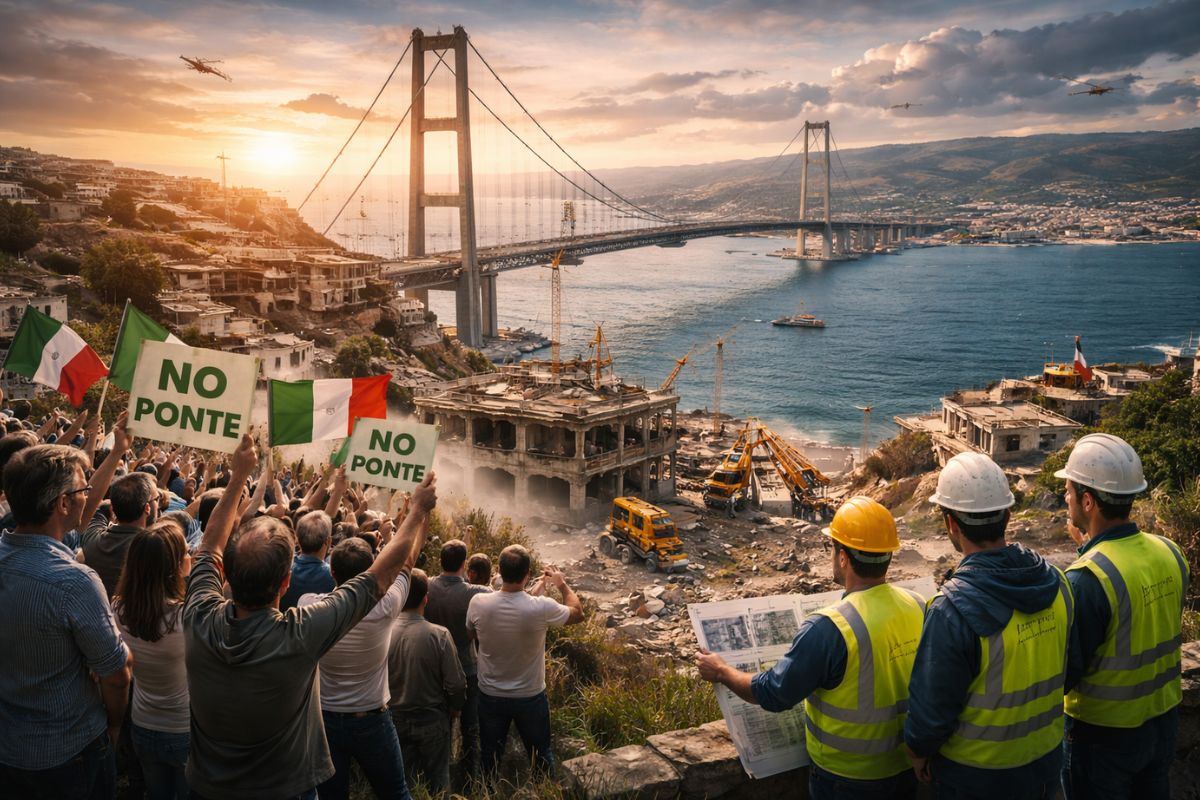

The Megaproject of the Suspension Bridge Over the Strait of Messina Reappears with Costs Above 13 Billion Euros, Demolition Forecasts in Messina and Vila San Giovanni, and Promises from Matteo Salvini About Trains and Cars, While Residents and Environmentalists Question Risk, Priority, and Public Return for Italy.
The planned suspension bridge to cross the Strait of Messina has once again divided Italy between the promise of shortening the crossing and the fear that a symbol of grandeur may turn into a public expense without delivery. On paper, it is just over three kilometers separating Sicily from the mainland, currently crossed by ferry in about 20 minutes.
The discussion has gained new traction with the political resumption of the project and the discourse that the work would close a corridor that, according to supporters, begins in Palermo and ends in Helsinki. On the other side, residents of Messina and Vila San Giovanni, along with environmentalists, point out demolitions, the risk of capture by criminal interests, and the impact on a migratory route for birds.
A Short Strait, A Giant Project

The Strait of Messina is narrow on the map, but brutal in engineering.
-
Prefabricated Home Assembled in Days Offers Cleaner, More Efficient Construction with Factory-Made Panels, Requires Technical Design to Prevent Moisture Issues

-
Single Mother Working Three Jobs Receives 111 m² 3D-Printed Home with Concrete Walls Built in 12 Hours, Featuring 3 Bedrooms, 2 Bathrooms, and a Printer for Replacement Parts

-
Simple Technique to Restore Rusty Metal Window Grilles Gains Attention for Revitalizing Old Structures Without Full Replacement

-
Couple Transforms Suffolk’s Last 1891 Windmill into Luxurious Four-Story Home with Zinc Observation Room in England



The proposed suspension bridge would be the longest in the world of this type of structure, with spans and towers designed to withstand winds, currents, and a terrain that quickly changes between coast and hills.
The time-saving is the easiest argument to communicate: going from a 20-minute ferry ride to a crossing of just a few minutes.
The issue is that saved minutes do not alone resolve decades of distrust surrounding budget, timelines, and risk control in the Strait of Messina.
Messina and Vila San Giovanni in the Bridge Layout

In Messina and Vila San Giovanni, the megaproject shifts from model to address.
The local debate revolves around expropriations, demolitions, and resettlements: the estimated figure is 450 buildings to be destroyed, with families fearing losing what they have built over the years.
A resident, Rosa, summarizes the social dilemma: she asserts that she does not intend to leave, says that she made sacrifices to buy the house, and that she planned to age there.
When the human cost enters the equation, the suspension bridge ceases to be merely infrastructure and turns into a decision about who pays the immediate price in Messina and Vila San Giovanni.
Matteo Salvini, Ambitious Numbers, and the Fight for Legitimacy
In Rome, Matteo Salvini has become the most visible face of the defense of the suspension bridge.
He treats the connection as strategic for European infrastructure and hints at high demand, citing scenarios like six thousand vehicles per hour and 200 trains per day.
The figures presented include an investment cost stated to be above 13 billion euros, with the figure of 13.5 billion euros appearing in government accounts.
Promises of added value and jobs are also included, but the Italian Court of Auditors has already suspended the project, raising doubts about funding and pointing out problems with European Union competition rules.
This is where the discourse turns into a credibility test.
The Risk of Crime and the Fear of Becoming an Out-of-Control Construction Site
Activists from “No Bridge” claim that the construction could open the door to more crime and disputes between organizations.
The argument is that a contract of this scale would attract not only traditional groups but a constellation of interests, in a territory where distrust is already historical.
The fear mixes with scandals and memories of old promises that have not materialized.
When the discussion reaches the point of comparing the region to 1930s Chicago, the message is about governance: who oversees each stage, who wins each bid, and how execution is protected in Messina and Vila San Giovanni.
Migratory Birds, Environmental Reserve, and the Invisible Cost

Beyond concrete, there is the sky. Environmentalists highlight that the Strait of Messina is a crucial migratory route and that the suspension bridge would be erected in a bird protection area, which, according to them, would violate European Union guidelines.
The criticism points to a cascading effect: winds could throw birds against cables, towers, and structures, and the death of individuals could affect entire populations.
Volunteers report years of rescuing injured birds in the hills above Messina.
For this group, the central question is not whether the suspension bridge is beautiful, but whether it is defensible in light of environmental risk and public cost.
In the end, the suspension bridge over the Strait of Messina remains caught in the same knot: promise of rapid integration, cost above 13 billion euros, and local conflicts in Messina and Vila San Giovanni, with Matteo Salvini insisting on viability and critics insisting on real necessity.
The project goes back, retreats, reappears, and leaves a question that spans decades.
If the suspension bridge were to be built, would you accept living with demolitions and construction around for years in Messina and Vila San Giovanni, or do you think the Strait of Messina needs more basic investments first? What signal, for you, separates a necessary megaproject from a megaproject that only consumes the budget?