Portuguese
  Spanish


Developed by a team led by Anand Mishra from West Virginia University, the robotic hand was tested on strawberries and harvests the fruit by twisting the stem. The study was published in Nature Communications, but it is a prototype, and the almost 100% accuracy refers to shape prediction.
A flexible robotic hand, capable of using touch and vision to assess the ripeness and pick delicate fruits without causing damage, was developed by researchers. According to the material, the device identifies when the fruit is ready and harvests it without bruising, which can reduce waste and improve efficiency in the field. The research brings together a team that includes Professor Anand Mishra at West Virginia University, USA, and began at Cornell University.
According to the report, the soft silicone and polyurethane fingers are equipped with various sensors. They measure the size, shape, color, and firmness of the fruit before deciding if it is ripe. The system was tested on strawberries and removes the fruit by twisting the stem, instead of cutting, and the study was published in the journal Nature Communications on March 23.
How the robotic hand that harvests fruits by touch works
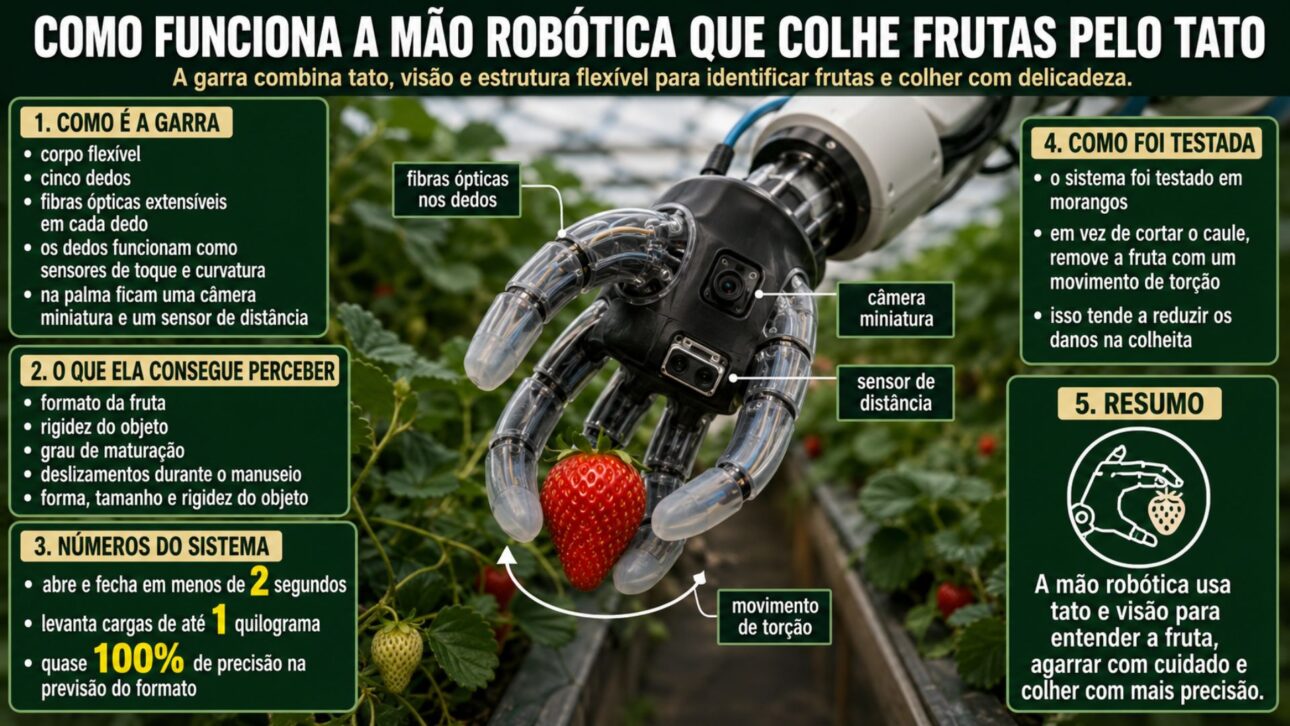
The robotic hand combines touch and vision sensors in a flexible body. According to the material, stretchable optical fibers embedded in each finger function as touch and bending sensors, while a miniature camera and a distance sensor are located in the palm. The five-fingered claw can identify the shape, rigidity, and ripeness of the fruit, as well as detect slippage during handling.
-
Orphaned Youth Turns Dismissed Idea into Global Prestige with Innovative Wristwatch

-
English Skills Boost Career Opportunities in the Oil and Gas Industry

-
Brazil Secures Second Place at WorldSkills 2024 in Lyon, with 64 Young Professionals and 8 Medals, Including Gold from a Rio de Janeiro Hairdresser

-
3,000 Military Personnel from 10 Countries, Including US and Chinese Marines, Train Together in Brazil’s Savanna: Operation Formosa Becomes Largest Naval Ground Exercise Before First Cancellation Since 1988



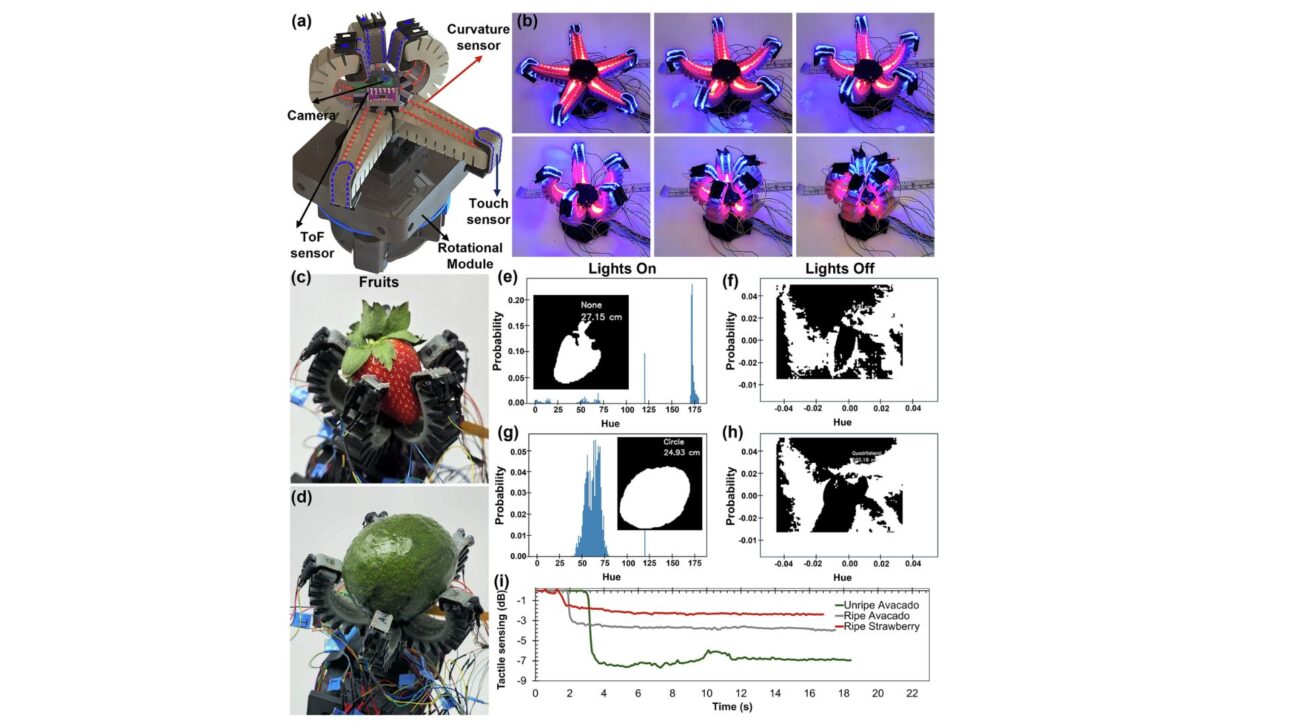
image: Nature
The numbers reported by the team help to understand the device’s range. According to the report, the claw opens and closes in less than two seconds, lifts loads of up to one kilogram, and achieves almost 100% accuracy in shape prediction. The system was tested on strawberries and, instead of cutting the stem, removes the fruit with a twisting motion, which tends to reduce damage during harvesting.
The challenge of picking delicate fruits at the right time
The robotic hand tries to solve an old problem in agriculture. According to the material, picking delicate fruits at the right ripeness is difficult because strawberries and raspberries have a narrow harvest window and are easily damaged during harvesting, transport, and storage. For the team, fruit inspections are crucial and traditionally relied on human workers.
However, manual labor faces limits. According to the report, the team cites the shortage of workers, health concerns, and inaccuracies in harvesting as challenges of human labor. Agricultural robots have already been proposed as a solution, but many systems are designed for controlled greenhouses, not for open farms, and traditional rigid claws can bruise soft fruits.
Inspiration from biology and almost 100% accuracy
The design of the robotic hand comes from nature itself. According to the material, the structure is inspired by biological systems and resembles both a human hand and a starfish. In Mishra’s lab at West Virginia University, the focus is on robots that mimic biology, as he summarizes: “we design soft, flexible, and rubbery robots inspired by animals.”
Flexibility explains part of the result. According to the report, the malleable structure absorbs forces differently from rigid robots, making it more suitable for delicate objects. It is worth noting that the almost 100% accuracy mentioned refers to the prediction of the fruit’s shape, and the technology tends to be useful for fruits without clear visual signs of ripeness, like avocados, where producers rely on touch.
Uses beyond the orchard and what is still missing
The potential of the robotic hand is not limited to fruit. According to the material, the team points to uses in space exploration, healthcare, food processing, and underwater manipulation, and in biomedical robotics, the combination of curvature detection and touch could improve wearable and rehabilitation devices. The researchers believe that soft materials combined with integrated sensors help robots interact more safely with objects and the environment.
Even so, it is necessary to separate what already exists from what is a promise. According to the report, the equipment is a research prototype, tested mainly on strawberries, and most of the cited applications are potential, not ready products. The leap from the laboratory to various fruits and real farms still needs to be proven, although the study has already been published in Nature Communications.
The robotic hand created by Anand Mishra’s team shows how the intersection of touch, vision, and flexible materials can change the way delicate fruits are harvested. The laboratory numbers are impressive, from the time of less than two seconds to open and close to almost 100% accuracy in shape prediction, and the range of uses goes from the orchard to space exploration. For now, however, it is a prototype, and the real test will be taking the technology from strawberries to other fruits and to the open field.
And you, would you trust a robotic hand to select and pick the fruits that reach your table? Comment on what you think of this technology and exchange ideas with other readers about the future of harvesting and combating food waste.