Portuguese
  Spanish


The autonomous coffee shop brand is Capipoint, from the Russian holding Franch.Global, which invested more than R$ 2.5 million in the country. The number of 600 stores, however, is an ambitious goal given the current 15 locations, and the return values per unit are projections from the company itself.
A Russian franchise group has chosen Brazil to expand, according to information from PEGN, its autonomous coffee shop, Capipoint, with the goal of reaching 600 units by 2026. The brand belongs to the holding Franch.Global, which is betting on the country’s coffee consumption, and the plans and numbers of the project were presented by the company’s founder, Sergey Degtyarev, and the development director of Capipoint in Brazil, Irina Rybina.
The justification for the choice lies in the Brazilian appetite for the beverage. According to the founder’s assessment, Brazilians drink four times more coffee than Russians, and the country’s franchise market does not impose a limit on the number of units a single franchisee can operate. After about two months of a pilot project, the expansion began last month, and the network currently has 15 points of sale in six cities, nine of them franchises, with a forecast of 20 by the end of this month and an investment of R$ 75,000 per unit.
The Russian bet on an autonomous coffee shop in the Brazilian market
Franch.Global arrives in the country with 14 years of experience in franchising. The holding operates its own brands and accelerates other businesses, totaling 30,000 units in operation in its ecosystem. Interest in coffee emerged in 2019, and Brazil gradually entered the radar, until it became the turn for an autonomous coffee shop called Capipoint, which has the capybara as the brand’s symbol and the proposal of a fully autonomous kiosk, with low prices and convenience for both the consumer and the franchisee.
-
Man with Metal Detector Finds Medieval Silver Seal in England, Uncovers 2,000-Year-Old Roman Gem with ‘Richard’s Secret’

-
Brazil’s BNDES Funded Metro and Steel Plant Projects in Venezuela with Brazilian Support

-
Thailand Converts 8 Tons of PET Bottles into 3,500 School Backpacks, Showcasing Circular Economy with Over 40 Factories Involved

-
Mysterious Bats Spotted in Paris’s Père Lachaise Cemetery, Drawing Tourists to the “Vampire Cemetery”



The size of the coffee market weighed in the decision. Brazil is the world’s largest producer and also a major consumer, with around 13% of global demand, according to the International Coffee Organization. To structure the project aimed at the Brazilian public, the group invested more than R$ 2.5 million, equivalent to over US$ 500,000 at the current exchange rate, targeting a market that, in the company’s view, combines high beverage consumption with an already mature franchising sector.
How the autonomous kiosk of Capipoint works
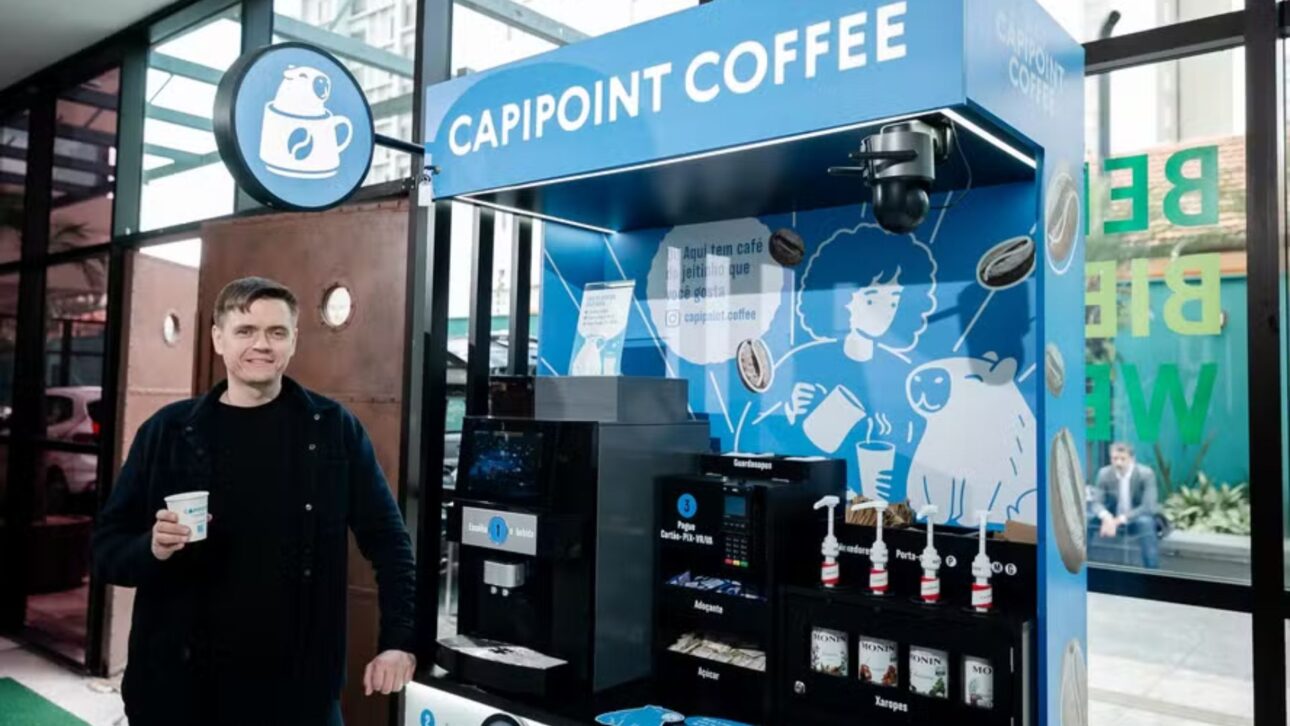
The structure mixes imported technology and local inputs. Capipoint’s autonomous coffee shop offers a menu with 20 beverage options, including size variations and non-coffee items, as well as four syrups that can be added to the preparations, with recipes developed by Brazilian baristas. The model was designed for high-traffic locations such as parking lots, business centers, hospitals, stations, schools, universities, shopping malls, airports, and supermarkets, and the unit can be easily moved to another space if the results do not meet expectations.
The operation does not require staff at the point of sale. The machines are equipped with security cameras with artificial intelligence to enhance equipment protection, while the franchisee monitors the business with weekly visits, and monitoring is done online through a platform that indicates the need for restocking supplies and any occurrences. The company’s view is that self-service has already become popular with Brazilians in areas such as laundromats, autonomous markets, and vending machines. “Brazil is adept and likes this mode of consumption,” summarizes Rybina.
From 15 points to the goal of 600 units by December
For now, the actual number is far from the announced goal. The first tests were conducted with five own units, a format that should continue in the strategy even with the focus on franchises, and the network reached 15 points of sale divided between São Paulo, Rio de Janeiro, Atibaia, Osasco, Suzano, and Curitiba, with nine franchises. There are no specific states targeted, and the idea is to grow nationwide, in any city with more than 10,000 inhabitants, with an estimate of 20 units in operation by the end of this month.
The expected leap relies on the brand’s history abroad. In this autonomous coffee shop format, the network would have reached 5,000 units in two years outside Brazil, where the group also operates two other self-service networks, Hohoro and Lifehacker. The goal of 600 operations in Brazil by December 2026 is the company’s declared target for the year, a significant advance compared to the current 15 points.
Investment, return, and the risks of an aggressive goal
The numbers offered to the franchisee have a defined entry value. Each autonomous coffee shop unit requires an initial investment of R$ 75,000, with an average return forecast of 10 to 18 months and an estimated average monthly revenue of R$ 12,000. These figures help explain the model’s appeal for those wanting to enter franchising with a lean operation and no fixed team.
These values, however, are projections from the franchisor, not guarantees. The return and revenue vary according to the location and operation, and the goal of 600 stores is ambitious given the current 15 locations and a model with only two months of piloting in the country, which makes the leap depend on a quick adherence of new franchisees. Those considering investing need to weigh the presented projections against the common risks of any franchise.
The Russian holding Franch.Global brought its autonomous coffee shop Capipoint to Brazil, with the capybara as its symbol, betting on the country’s strong coffee consumption, which the founder estimates to be four times that of Russia. With imported technology, Brazilian supplies, and baristas, the company set a goal of 600 units by December 2026, quite a leap from the current 15 locations in six cities. The model of R$ 75,000 per unit, with a projected return of 10 to 18 months, is the company’s bet, and the aggressive target, built on a two-month pilot, will test if the appetite of Brazilian franchising matches the plan.
And you, would you buy coffee from a fully autonomous kiosk, or do you prefer the service of a traditional coffee shop? Would you invest in a franchise like this? Share your opinion and exchange ideas with other readers about the advancement of self-service in Brazil, respecting different views.