Portuguese
  Spanish


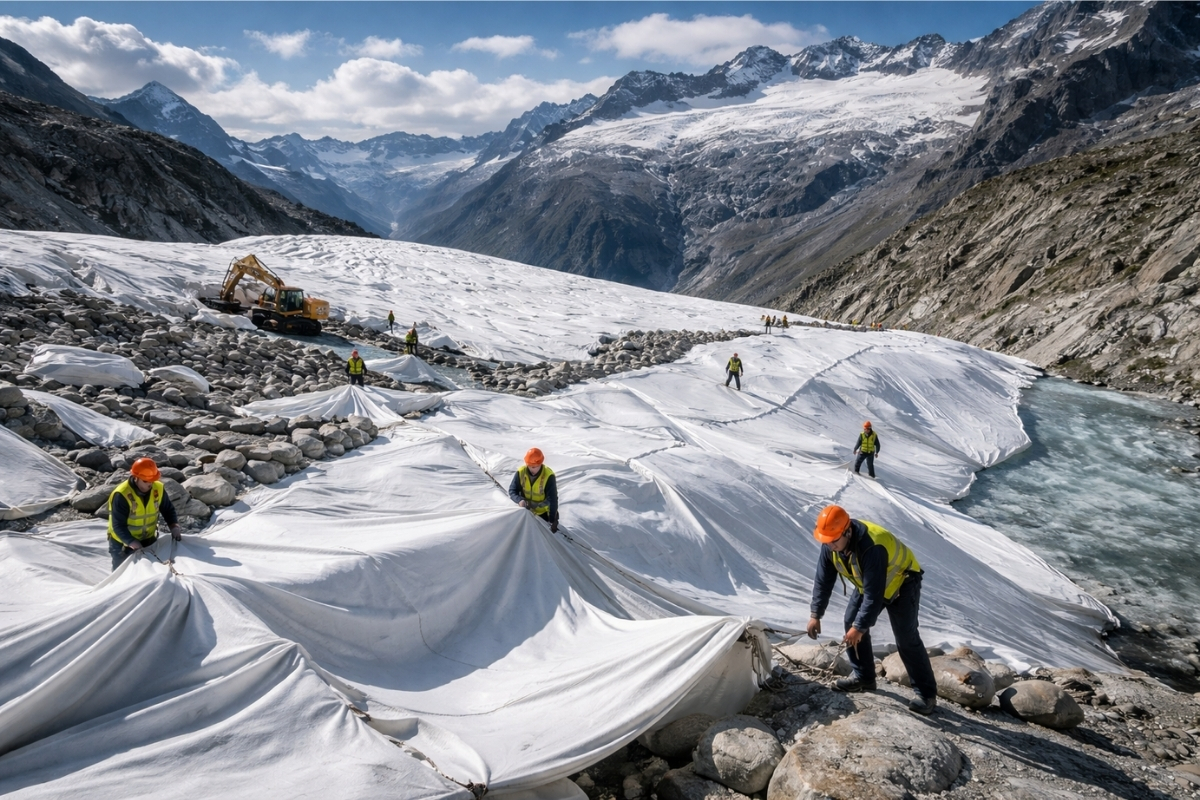


The Strategy Uses White Covers to Reflect the Sun, Preserve Ice in Specific Areas, and Maintain Economic Activities Related to Snow in the Alps.
Switzerland has started covering parts of its mountains with huge white blankets to try to slow down the melting of glaciers in the summer. In the Alps, white no longer comes only from snow but also from the geotextile material applied over the ice.
At the Rhone Glacier, one of the oldest and most visited in Europe, the measure has become an annual routine and changed the landscape. The idea is to protect strategic sections, even with the accelerated loss of volume in surrounding areas.
What Has Changed at the Rhone Glacier with the White Covers
The covering creates a visible contrast between the protected ice and the rest of the glacier. While the covered area remains more preserved, exposed regions continue to melt rapidly during the warmer months.
-
China Tests Giant 582-Ton Magnets to Contain Plasma Hotter Than the Sun’s Core, Aiming to Cut Superconductor Costs and Generate First Electricity from “Artificial Sun” by 2030

-
Seventh Grader Builds Nuclear Fusion Machine at Home, Aiming for Guinness World Record

-
Ancient Ritual Circle, Hidden for 5,000 Years, Discovered in Scotland’s Machrie Moor Using Sensors, Revealing a “Phantom Stonehenge”

-
Engineers Develop Fridge-Sized Machine to Produce 95-Octane Synthetic Fuel from Air and Water, Aiming to Sustain Combustion Engines Without Oil




The practice began as an experiment nearly two decades ago and is now repeated every year. The goal is to keep essential points functioning longer, mainly related to tourism.
How the Albedo Effect Helps to Hold the Ice in Heat

The strategy relies on the albedo effect, which defines how much a surface reflects sunlight. When the ice darkens due to dust and pollution, it absorbs more heat and melts faster.
The covers act as a shield, blocking direct radiation and reflecting some light. As a result, the melting of snow and ice beneath the cover decreases by 50% to 70%.
What Are the Geotextiles Used in the Alps
The blankets are made with polyester and polypropylene fibers, designed to withstand UV radiation and extreme weather. They allow the passage of some moisture but reduce direct heating on the ice.
In practice, the cover helps maintain a lower temperature in the covered area. The result is localized preservation, without preventing the total loss of the glacier.
Why the Operation Is Expensive and Requires Manual Labor
Installation takes place in the spring when teams ascend to the highest areas to unroll and adjust the covers. After that, they are sewn and secured with sandbags and stones to withstand storms and strong winds.
In the fall, the material needs to be removed before winter snow. If it freezes with the ice, it can be damaged and increase costs even further.
How Much It Costs and Why the Focus Is on Tourism and Ski Slopes
The cost ranges between $60,000 and $85,000 per hectare per year, which limits application in large areas. Therefore, the measure focuses on commercial points, such as ski slopes and tourist areas.
One of the protected locations is the ice cave of the Rhone Glacier, which generates income for the region. The blanket helps keep this attraction active longer.
Microplastics and Scale Limit Increase Criticism
With wear, the covers may release fibers that become microplastics, affecting the ice and following with the meltwater to rivers and alpine ecosystems. This raises questions about the environmental impact of the solution.
Furthermore, Switzerland has about 1,400 glaciers, and covering all of them would be unfeasible. In the past two years, Swiss glaciers have lost 10% of their total volume, showing that the technique protects only small areas while the larger problem continues to advance.