Portuguese
  Spanish



Renewable tidal energy advances in Indonesia with a 10 MW project by HydroWing in East Nusa Tenggara, using bidirectional turbines installed on the seabed to harness currents between the Pacific and Indian Oceans, while PLN conducts socio-environmental studies and licensing for a pilot-scale tidal plant.
Renewable tidal energy has taken a new step in Indonesia with HydroWing, a division of Inyanga Marine Energy Group, preparing a 10 MW project in East Nusa Tenggara. The initiative involves a subsidiary of PLN, the state-owned company responsible for the Indonesian national power grid, and aims to transform ocean currents into predictable electricity.
According to Enlit World, the project was announced in 2024, following a process initiated with a memorandum of understanding signed in 2022. The proposal targets a region of the archipelago where the movement of waters between the Pacific Ocean and the Indian Ocean creates favorable conditions for tidal generation, especially in narrow passages between islands.
Tidal energy enters Indonesia’s radar

Indonesia is made up of thousands of islands, making electricity distribution a technical and logistical challenge. In several regions, generation needs to consider distance, terrain, maritime access, and supply stability. In this scenario, renewable tidal energy emerges as an alternative different from the more well-known sources like solar and wind.
-
World’s Largest Engie Solar Plant in Brazil Highlights Billion-Dollar Energy Waste Issue: Company Considers Batteries and Bitcoin Mining to Avoid Wasting Production

-
Air Products Cancels $2.9 Billion Clean Hydrogen Megaproject in Louisiana, Shuts Down Arizona Unit, Highlighting High Costs of U.S. Energy Transition
-
Over 60 Tractors Take to the Streets in Lopera as Solar Parks Compete with Olive Groves, Affecting 13,000 to 100,000 Trees According to Conflicting Reports

-
Green Hydrogen Projects in Northeastern Brazil Stalled for 18 Months Awaiting Government Decree, Delaying Billions in Investments


HydroWing’s bet draws attention because it does not depend on daytime solar radiation or wind variation. The logic lies in the predictable movement of the tides, which rise and fall in known cycles and can be calculated in advance. For coastal communities and remote islands, this predictability can be an important differential.
HydroWing prepares 10 MW project in East Nusa Tenggara
The plan involves the installation of a 10 MW project in East Nusa Tenggara, a province located in the Indonesian archipelago. The area was chosen after evaluating different sites with potential for tidal energy in the country, considering natural resources, maritime conditions, and technical feasibility.
HydroWing will be responsible for feasibility studies, technological analyses, implementation schedules, and operation and maintenance plans. Meanwhile, the PLN subsidiary is expected to conduct field surveys, such as bathymetry, topography, ADCP measurements, sediment collection, and interconnection studies. Before any definitive deployment, the project depends on a series of technical, environmental, and regulatory checks.
How turbines work on the seabed
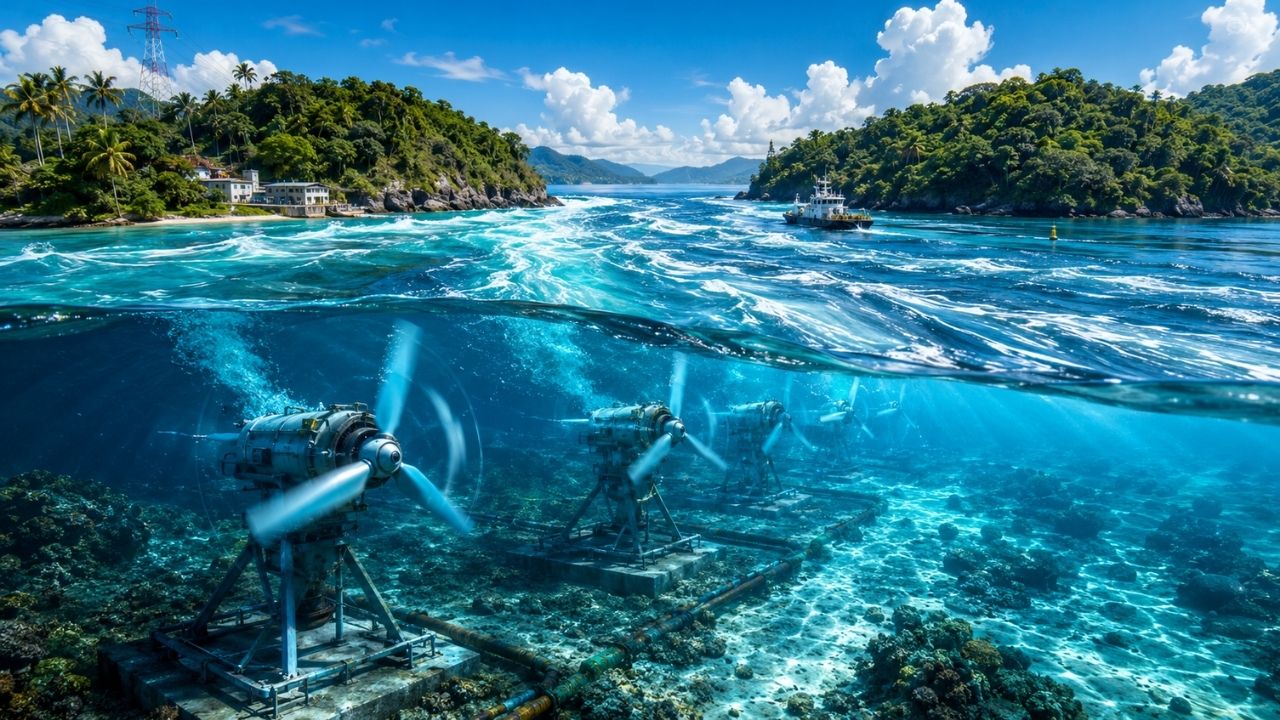
HydroWing’s technology uses a structure supported on the seabed by its own weight. On this base, “wings” are positioned to support turbines capable of operating with the water flow. The system is designed to work in ocean currents and transform tidal movement into electricity.
The turbines are bidirectional, meaning they can generate energy both during the rising and falling tide. This increases the utilization of the natural resource because generation does not depend on just one direction of flow. The concept also uses a multi-rotor device, designed to enhance energy availability and bring redundancy to the system.
Funnel effect between islands increases potential

One of the central points of choosing Indonesia is the so-called funnel effect between islands. In some narrow passages, the water moving between oceanic masses is compressed by the archipelago’s terrain, which can intensify the speed of the currents. This behavior strengthens the potential of renewable tidal energy.
In the Indonesian case, the flow between the Pacific Ocean and the Indian Ocean is seen as a strategic factor. When geography naturally accelerates the water, installing turbines at well-selected points can transform a territorial feature into electricity generation. Still, each location needs to be measured precisely before receiving equipment.
Technical studies will define the next steps
The current phase is not limited to choosing the location. For the tidal power plant to progress, surveys of the seabed, sediment analysis, current measurements, studies of network connection impact, and socio-environmental assessment will be necessary. This data helps to understand if the structure can operate safely and efficiently.
Bathymetry reveals the shape of the seabed, while the topographic survey helps to map the conditions of the support area. ADCP measurements indicate the speed and behavior of currents at different depths. Without this data, tidal renewable energy risks being implemented without understanding the environment it intends to use.
Project could pave the way for commercial scale
The 10 MW project in Indonesia acts as a pilot, but the declared ambition is to advance to larger commercial enterprises. HydroWing and its local partners intend to use this stage to test technology, licensing, logistics, offshore installation, operation, and maintenance in a region with strong maritime potential.
The Inyanga Marine Energy Group is also involved in projects in the UK, including initiatives in Morlais, Wales. This experience helps the company bring the technology to other markets, but Indonesia presents its own characteristics. The challenge is not just to install turbines, but to adapt the solution to a vast archipelago with scattered communities and varied maritime environments.
Predictable energy can be an advantage for islands


Unlike more climate-dependent intermittent sources, tidal energy has an important characteristic: its cycles can be predicted with a high degree of advance. This does not eliminate engineering challenges, but it helps in generation planning, especially when the goal is to supply regions that need reliable provision.
For island areas, this predictability can reduce dependence on more expensive solutions or those vulnerable to fuel logistics. Renewable energy generated by maritime currents does not automatically replace other sources, but it can become part of a more diversified matrix less exposed to fluctuations.
Technology still needs to prove cost, durability, and operation
Despite the potential, tidal energy projects face significant obstacles. Installing equipment on the seabed requires robust engineering, specialized maintenance, and resistance to corrosion, the strength of currents, and continuous operation in a saline environment. These factors weigh on the cost and timeline of implementation.
It will also be necessary to assess how the infrastructure connects to the grid and which environmental impacts need to be mitigated. The promise of predictable electricity is only confirmed when the technology demonstrates real performance, stable operation, and cost compatible with local needs. Therefore, the study phase is decisive.
There are still licensing, technical studies, and feasibility stages before any commercial consolidation. Even so, the case shows how tidal energy can gain ground in regions where geography favors the movement of waters. Do you think underwater turbines can become a real alternative for islands and coastal communities, or will the cost still be too big an obstacle? Share your opinion.