Portuguese
  Spanish


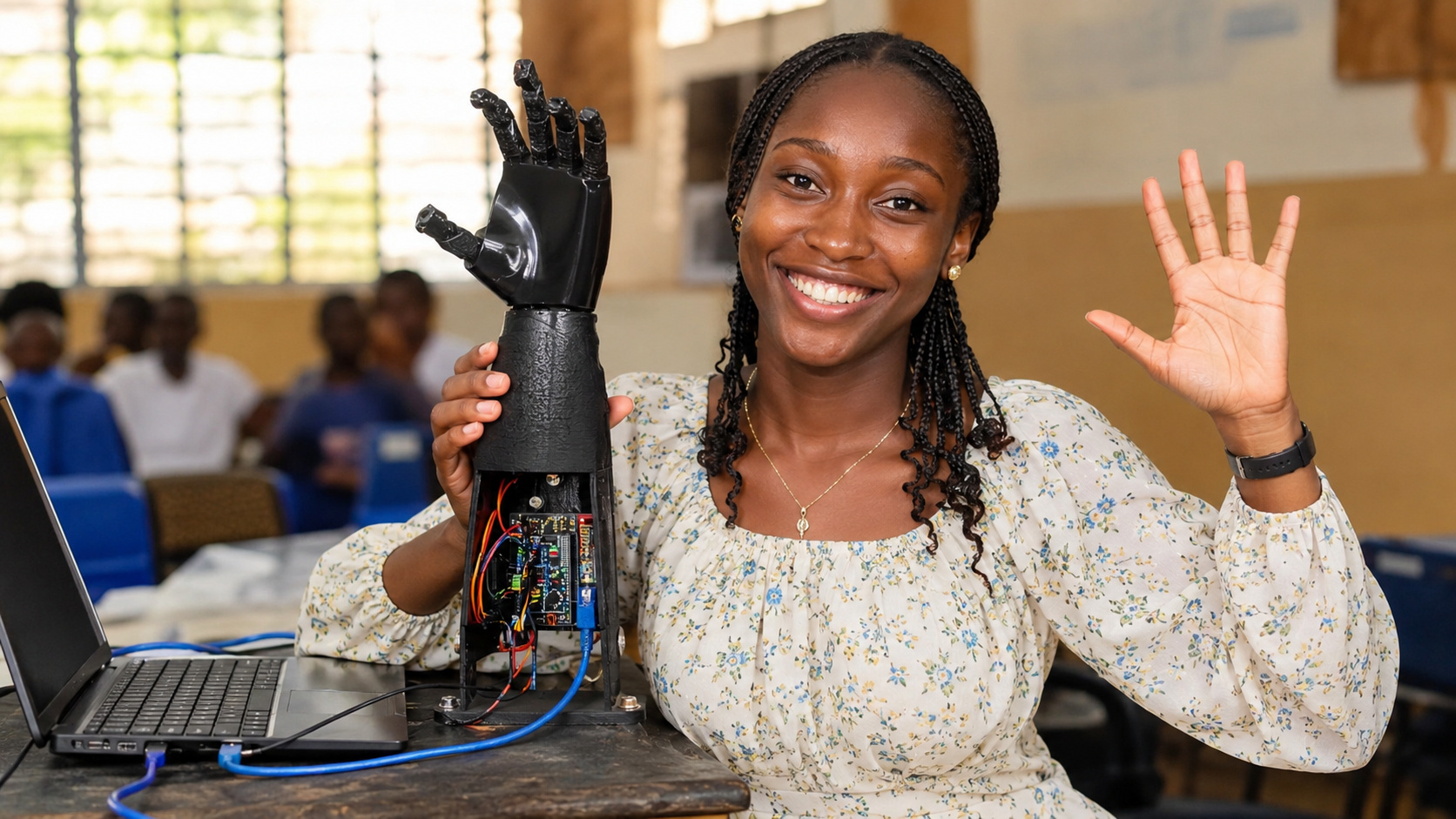

Zerobionic, a Kenyan startup, transforms recycled plastic into sign language robots and expands access for deaf students to STEM education.
The Kenyan startup Zerobionic is attempting to tackle two problems at once: the exclusion of deaf students from science, technology, engineering, and mathematics subjects and the disposal of plastic that could become raw material for new solutions. The company was presented by the World Summit Awards as a project created by Norah Kimathi and Maxwell Opondo, focusing on transforming plastic waste into assistive robotics aimed at inclusive education.
According to Zerobionic itself, their technology already reports 92% accuracy and claims to have conducted 150+ pilots on the African continent. The proposal is to bring into the classroom a system capable of converting speech and didactic content into signs, reducing a historical barrier for students with hearing impairments in STEM areas.
Assistive robotics attempts to break the sign language barrier in STEM education
According to the World Summit Awards, Zerobionic develops exoskeletons and robotic systems with artificial intelligence that transform classroom speech and text into sign language gestures in real-time.
-
What is the dark substance found in the sand of Ipanema Beach? Civil Police conduct an examination, collect samples of the material, and initiate an investigation to identify the composition, clarify the origin, and verify if there was an environmental crime.

-
The beer that was hidden for 3,000 years has returned to the world: scientists find yeast preserved in Ancient Egyptian vessels and recreate a pharaoh’s drink to discover the lost taste of an ancient civilization.
-
NASA spotted a giant “surfboard” crossing the Moon’s orbit at 11,500 km/h, and the truth behind the mysterious object required a 0.338 millisecond photo to be revealed.

-
Brazilian project based on nanotechnology transforms the recovery of degraded areas in the Amazon, receives international recognition, and uses research in 9 states to accelerate the growth of native species and increase carbon capture.




The central goal is to make technical content more accessible in subjects that often rely on specialized vocabulary and constant mediation.
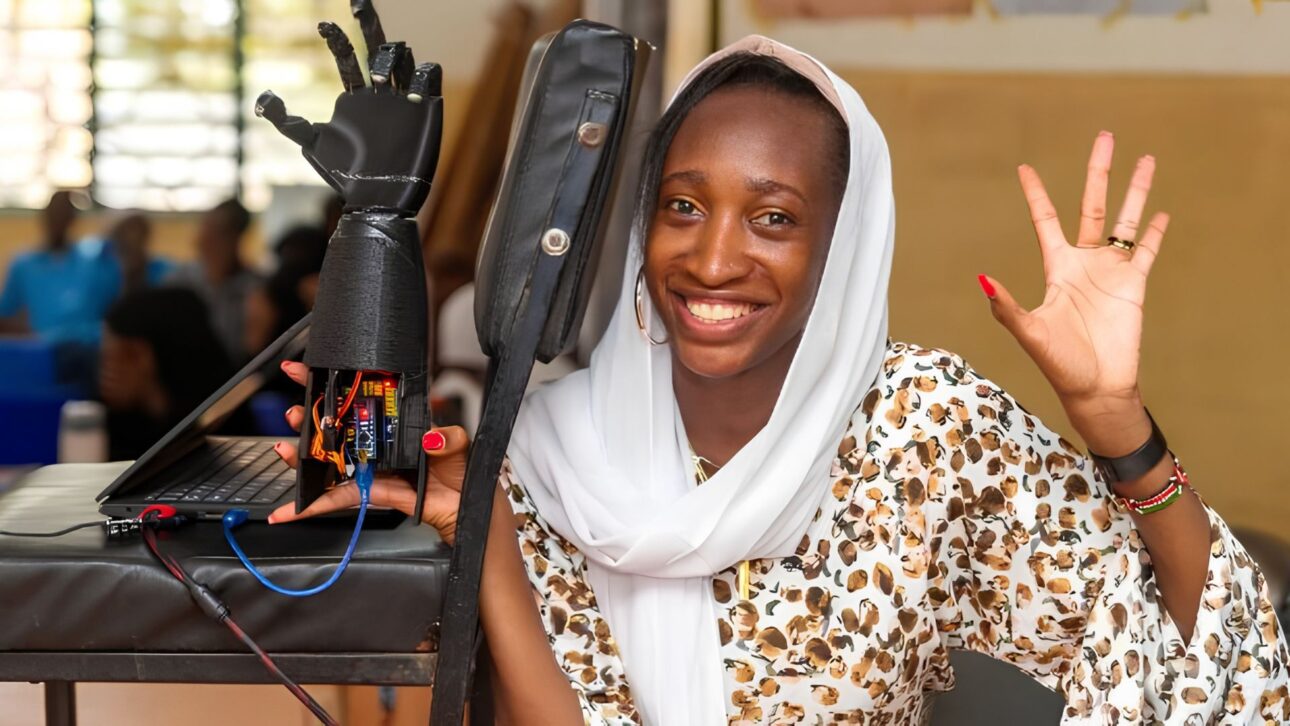
The startup itself summarizes the solution as a robotic arm that “signals what the teacher says” and “reads what the student signals.” This places the technology at a sensitive point in inclusive education: not only translating everyday communication but bringing interpretation to more complex academic content.
The IUCN reported in 2025 that Norah Kimathi helped develop a hybrid 4G to 2G architecture to allow the robots to function even in environments with limited connectivity.
Recycled plastic became the raw material for an inclusive educational technology
The environmental component is not an accessory in the project. The World Summit Awards states that Zerobionic was designed to use recycled materials and simultaneously tackle environmental pollution and educational exclusion by converting discarded plastic into a structure for its robotic devices.
The IUCN adds that Norah Kimathi’s work is rooted in circular economy practices and that more than 5,000 kilograms of plastic have already been recycled and repurposed into impactful solutions.
Instead of separating sustainability and accessibility into distinct fronts, the startup tries to unite both agendas into a single product.


According to Zerobionic’s official description, this model also seeks to make technology more financially accessible by locally producing part of the robotic structure with repurposed material.
The logic is simple: reduce dependence on expensive inputs and transform waste into a tool for educational inclusion.
International recognition expanded Zerobionic’s visibility
The startup’s progress began to gain more weight outside Kenya in 2025, when the World Summit Awards granted Zerobionic the Young Innovators Award.
On the official award page, the project appears as a solution that combines quality education, inequality reduction, innovation, and responsible consumption.
In the same year, the IUCN highlighted Norah Kimathi among the examples of young entrepreneurship focused on conservation and inclusion. The profile published by the entity describes the co-founder as an innovator who applies engineering to sustainability challenges and accessible education, using sign language robots made from recycled plastic.

These recognitions helped consolidate Zerobionic as a social and environmental impact initiative that goes beyond the startup discourse. The project began to circulate in international environments related to innovation, youth, sustainability, and accessibility, expanding its institutional legitimacy.
Kenyan technology exposes a structural problem in education for deaf students
The strength of Zerobionic lies in the problem it attempts to solve. In many classrooms, deaf students remain distanced from mathematics, physics, computing and other technical subjects because sign language mediation does not match the complexity of the curriculum. The startup was created precisely to bridge this gap with a locally developed solution.

By transforming recycled plastic into assistive robotics, the company also repositions the debate on African innovation.
Instead of relying solely on imported technologies, the proposal demonstrates an attempt to develop educational tools within the regional context itself, focusing on accessibility, cost, and operation in real environments.
If it manages to expand its pilots and maintain the performance reported by the company itself, Zerobionic could establish itself as one of the most original examples of the new generation of African educational technology: a solution that uses AI, robotics, and recycling to open the doors of science to those who have historically been excluded from it.