Portuguese
  Spanish


The FAA reopened discussion on supersonic aircraft above Mach 1 in the United States, but noise, Concorde, and public acceptance remain at the center of the proposal. The return of flights over land depends on sound limits, quiet technology, and cost capable of sustaining a new commercial generation on future continental routes.
Passenger supersonic aircraft have returned to the agenda in the United States after the FAA proposed ending the ban created in 1973 for civil flights above Mach 1 over land, in a discussion marked by noise, the memory of Concorde, and new quiet technologies.
The proposal, reported on July 1, 2026, by Interesting Engineering, involves regulators, aerospace manufacturers, airlines, and communities under potential flight routes. The debate takes place in the United States and depends on proving that the new supersonic generation can reduce the nuisance that made the topic unpopular in the past.
The ban was born from the sonic boom
The block on civil supersonic flights over land in the United States did not arise by chance. Aircraft that exceed Mach 1 generate sonic booms, strong shock waves that reach the ground as abrupt and annoying noises. In the 1960s, military supersonic flights caused complaints, damage to windows, cracks in walls, and concern in various communities.
-
China Overhauls Universities, Cuts 12,200 Outdated Courses to Focus on AI, Robotics, and Chips as 12.7 Million Young People Enter Workforce

-
Goodbye Wireless Earbuds: Gen Z Brings Back Wired Headphones as a Trend in 2026

-
Living Robots Made from Human Cells Crawl on Their Own in Lab, Help Heal Neuron “Wounds” and Turn Human Tissue into Microscopic Biological Machines
-
Xlinks Project to Lay 3,800 Kilometers of Cable Across the Atlantic to Export Solar Energy from Morocco Directly to UK Outlets Without Using a Single Turbine




This history led the American government to prohibit civil supersonic travel over land in 1973. The problem was never just the speed, but the impact of that speed on those on the ground. Now, the FAA claims that new aircraft designs and noise reduction technologies can change the equation that sustained the restriction for 53 years.
FAA sees technology capable of changing the debate
The FAA’s proposal is based on the idea that aerospace engineering has advanced since the 1970s. Materials, aircraft designs, operational concepts, and noise reduction techniques can allow supersonic planes to fly above the speed of sound without repeating the same level of disturbance associated with the old booms.
The agency also announced plans to propose another regulation later this year, aimed at noise standards for landings and takeoffs of future supersonic aircraft. This shows that the discussion does not end with allowing or prohibiting; it involves creating technical limits that manufacturers will have to meet before putting new models into operation.
Mach 1 remains a technical and social frontier
Flying above Mach 1 means surpassing the speed of sound. For the passenger, this promises to reduce travel time. For engineers and regulators, however, it means dealing with shock waves, consumption, structural design, noise, and operational safety at a much more demanding standard.
Therefore, the new phase of supersonic planes does not depend solely on building fast jets. It requires demonstrating that extreme speed can coexist with cities, airports, and land routes. The sound barrier has ceased to be just a physical limit; it has also become a regulatory, economic, and urban barrier.
X-59 attempts to prove that supersonic can be quieter
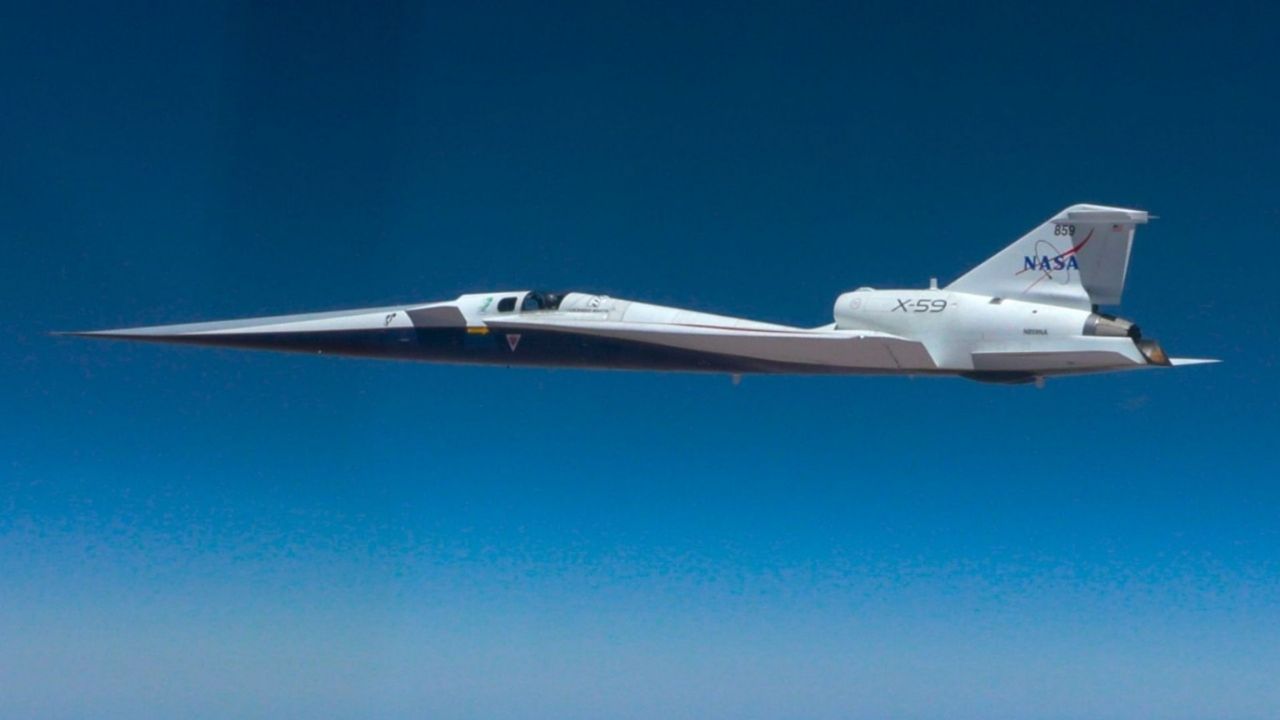
One of the most important projects in this debate is the X-59, an experimental NASA aircraft designed to fly at Mach 1.4 at an altitude of 55,000 feet, producing much less noise on the ground. The space agency has been collecting public feedback in community tests to assess people’s reactions to the reduced sound.
The X-59 is not presented as a commercial passenger plane, but as a research piece to measure acceptance and acoustic impact. If the technology can transform the boom into a more tolerable noise, it may provide a basis for new rules and for a generation of faster civil aircraft.
Boom Supersonic bets on a new generation commercial jet
In addition to NASA’s tests, private companies are also pushing for a new stage of high-speed flights. Boom Supersonic, based in Colorado, is developing the Overture, a plane designed to carry 60 to 80 passengers at supersonic speeds.
The company seeks to reduce or eliminate the effects of the sonic boom during flights over land, although there is still a speed limit just above Mach 1 that cannot be exceeded with current designs. This detail reveals that the new supersonic race is not just about going faster, but about going fast within limits that regulators and communities accept.
The Mach Cut Technique Attempts to Avoid Ground Noise
Boom CEO Blake Scholl advocates a technique known as Mach cut. The idea, according to him, is that when an aircraft breaks the sound barrier at a sufficiently high altitude, the boom can refract in the atmosphere and curve upwards, without perceptibly hitting the ground.
The proposal is relevant because it tries to address the issue that hindered public acceptance of supersonic flights over land. Still, it needs to be validated in real conditions and converted into clear rules. For the FAA, it is not enough for the concept to work in theory; measurable noise standards must be established.
Operation Bongo II Left a Mark Hard to Erase
The current debate also carries the weight of past experiences. In 1964, the US Air Force and the FAA conducted Operation Bongo II in Oklahoma City to measure public tolerance to repeated sonic booms. Military aircraft flew over the city and generated thousands of booms.
The experiment resulted in about 15,000 formal complaints and 4,629 claims for property damage. Research from the time indicated that about 40% of residents believed their homes had suffered some type of damage. This history helps explain why public acceptance remains as important as technical innovation.
The Concorde Showed Speed, but Also Economic Limit
The Concorde remains the most well-known symbol of commercial supersonic aviation. Operated between 1976 and 2003, it reduced the journey between London and New York to about three hours. Most routes crossed the Atlantic Ocean, avoiding populated areas where the sonic boom would be a problem.
But the plane also exposed another obstacle: cost. In 2003, a round-trip ticket on the Concorde cost about $12,000, equivalent to over $22,100 today, considering the inflation mentioned in the source. The lesson is clear: supersonic planes can impress with speed, but they only gain a broad market if they make economic sense.
Airlines Observe the New Race
Boom Supersonic has already attracted interest from major airlines, including American Airlines, United Airlines, and Japan Airlines. This interest shows that there is still an appetite for drastically reducing travel time on specific routes, especially between major centers.
However, commercial interest alone does not solve the challenges. Companies still need to prove performance, safety, acceptable noise, operational cost, and sufficient demand. The new supersonic generation will have to convince both regulators and passengers who do not want to pay a fortune for a few hours less on the journey.
Extreme speed needs to fit in the city
The most sensitive point of the FAA’s proposal is that it deals with flights over land. Over oceans, the sonic boom affects fewer communities. Over continental areas, any excessive noise can generate public rejection, lawsuits, local restrictions, and political pressure.
Therefore, supersonic planes need to prove that the new technology will not repeat the problems of the past. The speed may be attractive to those inside the aircraft, but the impact needs to be acceptable to those underneath the route. The future of Mach 1 depends on a simple question: will cities accept living under this new type of flight?
New supersonic era is not yet guaranteed
The FAA’s proposal represents an important step, but it does not mean the immediate return of supersonic passenger flights over land. Before that, it will be necessary to define standards, prove noise reduction, validate technologies, and show that the market can sustain commercial operations.
The scenario combines innovation, historical memory, and economic calculation. If the new projects manage to reduce noise and lower costs, supersonic planes may once again occupy space in civil aviation. If they fail in these points, the sector may repeat part of the fate of the Concorde: admired for its speed, but limited by price, noise, and scale.
Is the return of supersonic planes worth the risk?
The possible reopening of the United States to civil supersonic flights over land marks a significant change in air transport. After 53 years, the technology is trying to prove that it can fly above Mach 1 without turning speed into a nuisance for entire communities.
But the question remains open: do you think silent supersonic planes can become a new real phase of commercial aviation, or will this type of flight remain restricted to a few passengers, expensive routes, and difficult promises to fulfill? Leave your opinion in the comments.