






 Portuguese
  Spanish
  4 min of reading
  0 comments


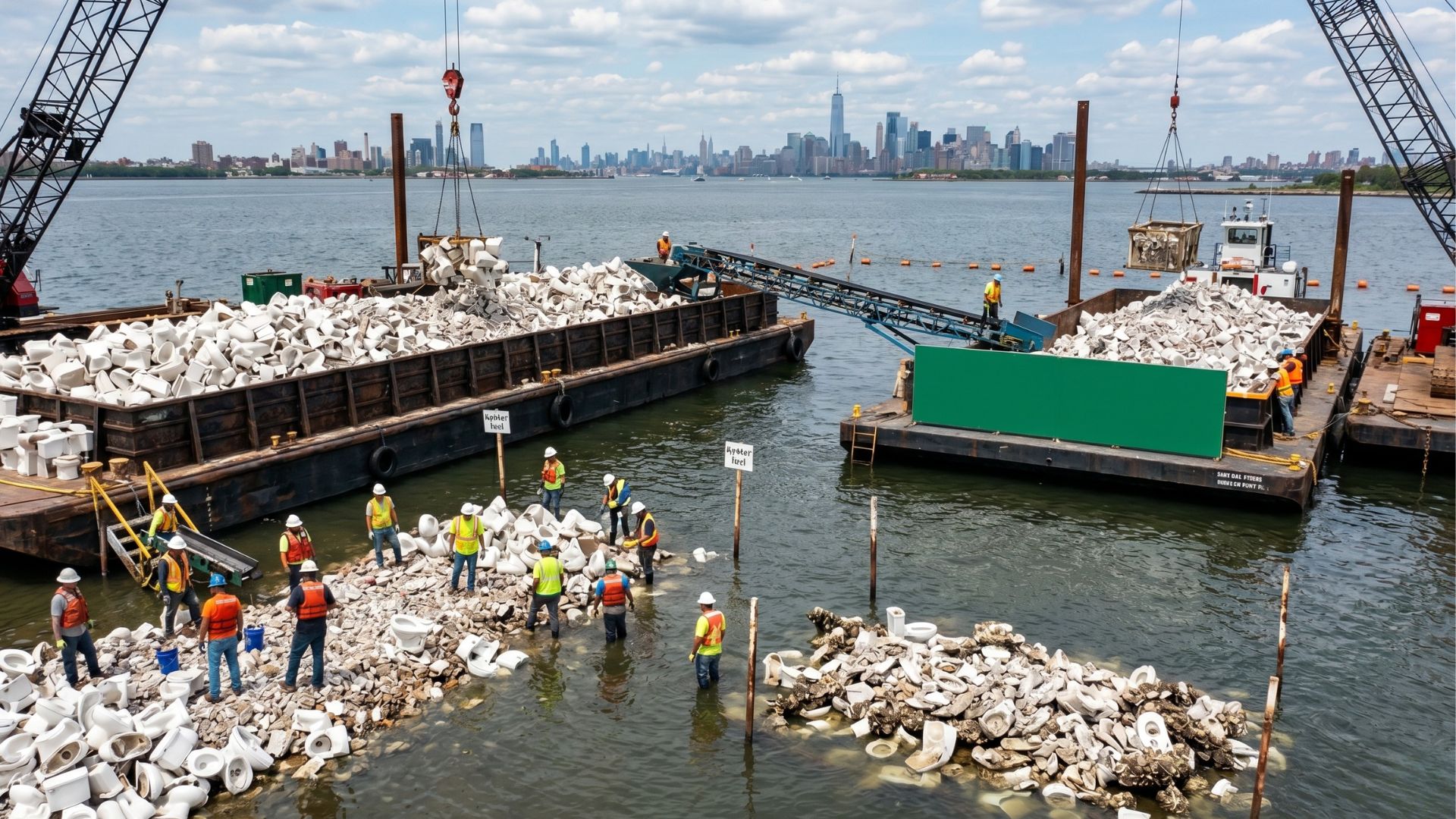
New York transformed about 5,000 recycled toilets into artificial reefs in Jamaica Bay, converting discarded porcelain into sustainable coastal infrastructure.
New York turned an unlikely idea into an environmental restoration experiment: nearly 5,000 old toilets were broken, crushed, and used as a base for oyster reefs in Jamaica Bay, one of the city’s most important coastal areas.
The project repurposed discarded porcelain from public school bathrooms, material that would have gone to landfills, and mixed it with oyster and clam shells to create beds where new oysters could attach. The initiative was announced in 2016 by the New York City Department of Environmental Protection in partnership with the Billion Oyster Project.
Old toilets became structures for oyster reefs
The origin of the material is as curious as the project. New York replaced thousands of old and less efficient toilets in public schools to save water.
-
Helicopter Drops 180 Tons of Sand and Gravel on Swedish River to Revive Ecosystem Damaged by Decades of Exploitation

-
Brazilian Company Launches Retro Smartphone with 48 MP Camera, T9 Keyboard, and Privacy Features for Social Media-Free Use

-
Self-Taught Chinese Farmer Builds 5-Ton Submarine from Scrap, Launches It in Anhui River
-
Invisible Induction Technology Enables Wireless Power for Blenders, Coffee Makers, and Air Fryers, Reducing Countertop Cables





Instead of sending all the porcelain to common disposal, the city broke about 5,000 toilets into smaller pieces and used the material as substrate at the bottom of Jamaica Bay.


The function of the porcelain was to serve as an attachment point for young oysters, along with natural shells. Oysters need hard surfaces to attach, grow, and form reefs.
Project placed 50,000 oysters in “beds” made with porcelain and shells
According to reports from the time, the project placed about 50,000 oysters in Jamaica Bay using beds formed by recycled toilet porcelain, oyster shells, and clam shells.
The material was used to form four smaller artificial reefs, designed to test ecological restoration in a highly altered urban environment.
The logic is simple and powerful: transform urban waste into a physical base to rebuild marine habitat.
Oysters filter water, create habitat, and help protect shores
Oysters are important because they function as ecosystem engineers. They filter water, form rigid structures, attract other species, and can help reduce wave energy in coastal areas.

In the project announcement, New York authorities highlighted that the reef would protect wetlands against erosion, naturally filter the water, and create habitat for marine life.
This point turns the agenda into something more than curiosity. It wasn’t just about throwing old toilets into the sea. It was about using discarded porcelain as ecological infrastructure.
Jamaica Bay was once an oyster ecosystem before urban pollution
The restoration has historical significance. The New York Harbor once hosted enormous populations of oysters, but the combination of overfishing, sewage, and pollution destroyed much of these reefs throughout the 20th century.

Fox 5 New York recalled that the harbor saw an abundance of oysters around 1900, before pollution and human pressure eliminated practically all this water-filtering life.
The Billion Oyster Project was born precisely with the goal of restoring 1 billion oysters in New York Harbor by 2035, connecting environmental restoration, education, and citizen science.
Project was also part of a trade-off for water savings
The toilet experiment did not arise in isolation. It was connected to a larger program of replacing inefficient toilets in New York school buildings.
The idea was twofold: save water in schools and repurpose the porcelain from old toilets in environmental projects, including oyster reefs and urban drainage structures known as bioswales.
This makes the case even more interesting: the same piece that wasted water inside buildings began to help rebuild ecosystems outside them.
Discarded porcelain shows how urban waste can become ecological reconstruction
The story of Jamaica Bay is a rare example of reuse with direct environmental impact. The waste did not just become decoration, crafts, or construction aggregate. It was physically taken to a degraded ecosystem to help rebuild a lost natural function.
The porcelain served as the “skeleton” for the reef. The oysters entered as a living organism. And the bay’s bottom became an environmental restoration laboratory in one of the largest cities on the planet.
In the end, the image is hard to ignore: toilets that were headed for landfills were broken, thrown into the sea, and transformed into a cradle for oysters that can filter water, shelter marine life, and defend shores against erosion.





Be the first to react!