Portuguese
  Spanish


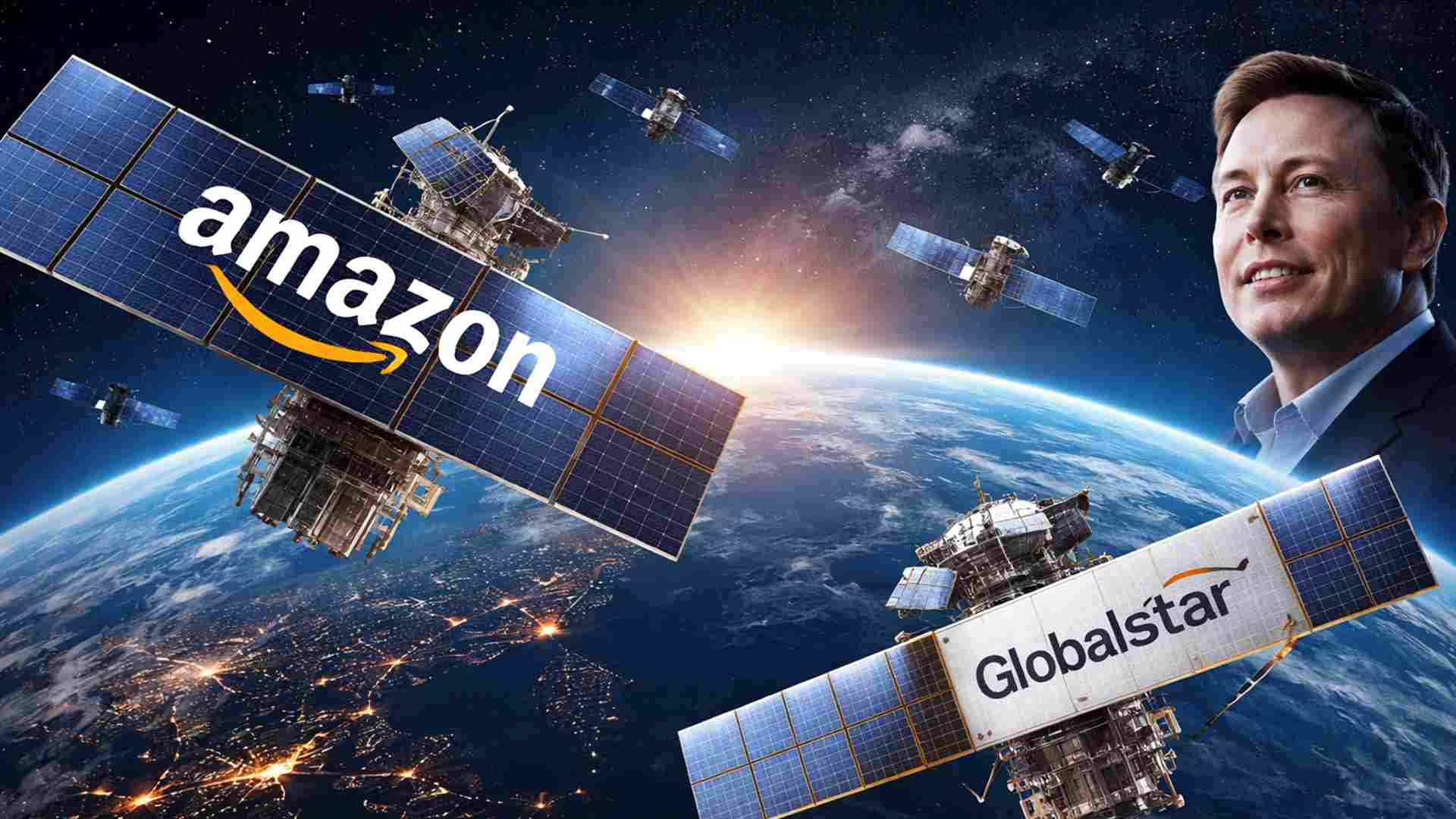

Amazon prepares an offensive of US$ 11.57 billion to buy Globalstar and strengthen its satellite operation in a direct dispute with Elon Musk’s Starlink in a market where scale, coverage, and direct connection with mobile devices have defined the new commercial space race
According to Reuters, Amazon announced on Tuesday the purchase of Globalstar for US$ 11.57 billion, in a move to strengthen its satellite operation and compete with Elon Musk’s Starlink. The deal expands Amazon’s presence in a billion-dollar satellite connectivity market and adds two dozen Globalstar satellites to the structure the company already maintains in orbit.
Amazon accelerates dispute in the satellite market
The operation occurs amid the advance of technology giants into the satellite internet sector, considered lucrative and increasingly strategic. Nevertheless, the challenge for Amazon is significant given the scale already achieved by Starlink, which operates a network of 10,000 units.
With the acquisition, Amazon strengthens a business still in its early stages within its space strategy. The company already has more than 200 satellites in its network and is working to increase that number in the coming years.
-
Pennsylvania Mine Creates Ice in Summer Heat and Melts in Winter, Turning a Mountain Crevice into a Reverse Natural Refrigerator

-
China Accelerates Global Expansion of Robotics: From Smart Vacuums to Industrial and Humanoid Machines, Millions Exported to Over 150 Markets
-
Polar Air Mass to Hit Brazil: Temperatures to Plummet in Nine States, Near Freezing in the South with Frost Risk Until Monday
-
Chinese “dark factories” produce electric cars 24/7 with minimal human intervention, as Zeekr assembles 800 units daily, raising concerns in Brazil.





Network expansion and regulatory goal
Amazon plans to deploy about 3,200 satellites in low Earth orbit by 2029. Approximately half of them should be operational by the regulatory deadline in July, while the company is also preparing to launch its satellite internet services later this year.
This timeline shows that Amazon is trying to accelerate its effective entry into the sector while also seeking to close the gap with Elon Musk’s competitor. The purchase of Globalstar also adds a technological front aimed at direct connection with mobile devices.
Globalstar expands bet on D2D service
The Globalstar network was designed for reliable and low-data consumption connections directly to cell phones and other mobile devices. This model, known as D2D, eliminates the need for connection to terrestrial towers and gains relevance in emergency services and in areas with limited cellular coverage.
The companies stated that the agreement will help Amazon implement D2D starting in 2028. For Armand Musey, president and founder of Summit Ridge Group, the acquisition allows Amazon to catch up in the D2D spectrum and advance in the deployment of this type of service.
Market reaction after the announcement
While Amazon tries to gain ground, Starlink already serves more than 9 million users worldwide and is also developing D2D services in partnership with operators like T-Mobile. The SpaceX unit offers high-speed broadband through user terminals.
After the news, shares of Globalstar, based in Louisiana, rose more than 10%, after already accumulating a rise of over 6% in the previous two weeks. Amazon’s shares advanced 3%, and MDA Space, the main contractor for Globalstar’s next-generation constellation, recorded a gain of 9%.