






 Portuguese
  Spanish


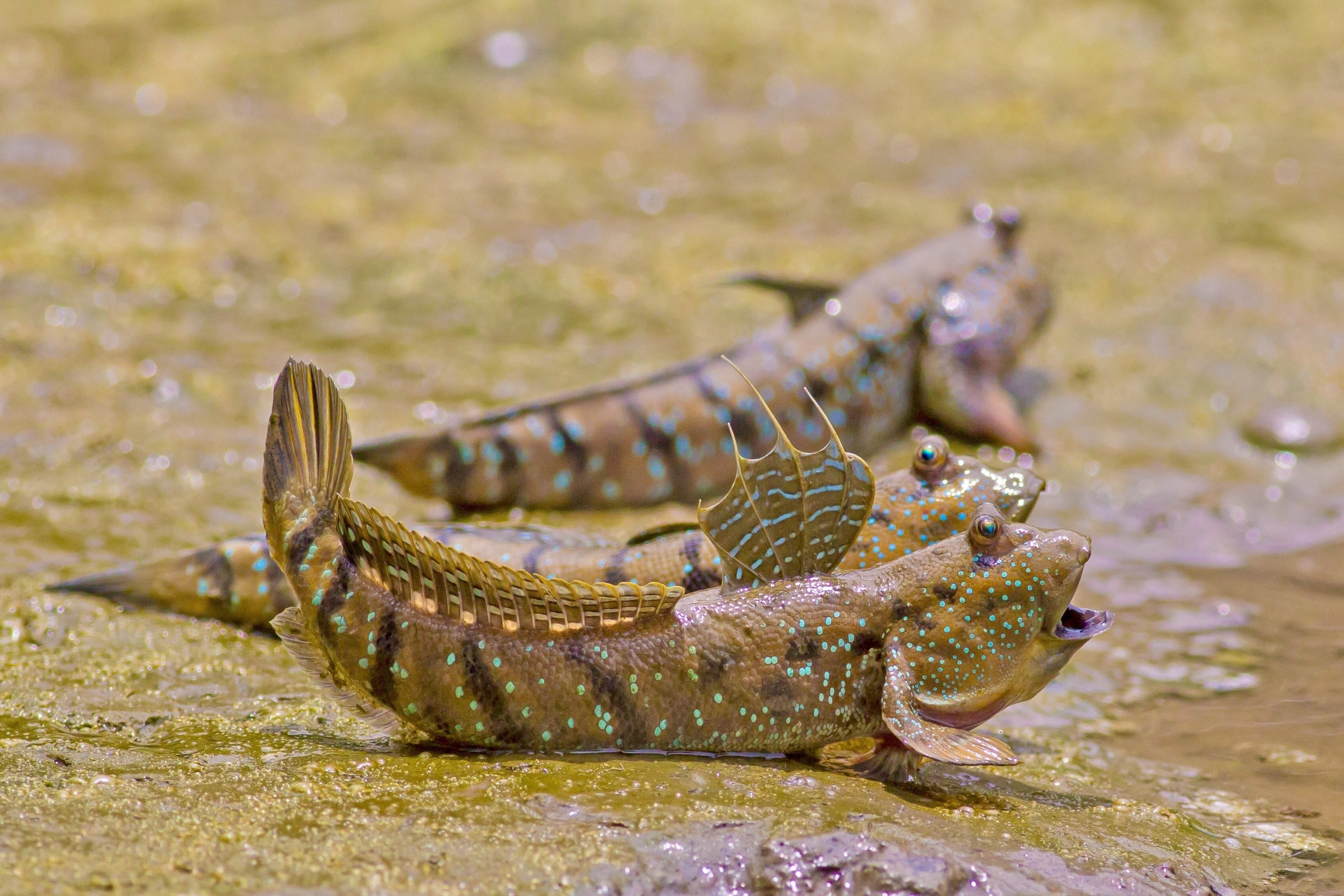


Mudskipper Fish Bets on Terrestrial Locomotion to Invade Mangroves, Attack Bird Nests, and Alter Food Chains in Asia and Australia.
The mudskipper fish is one of those cases where the word “fish” seems inadequate. Found mainly in the wetlands of Southeast Asia and northern Australia, it occupies brackish mangroves and muddy shores, where water and land mix. Up to that point, there is nothing remarkable, were it not for the fact that it abandon the water for long periods, walks on the mud, climbs exposed roots, and invades coastal bird nests in search of eggs and chicks, altering trophic chains in ecosystems that were previously dominated by crustaceans, insects, and reptiles.
This behavior has caught the attention of researchers studying mangrove ecology, as the mudskipper has become an unexpected predator precisely in areas where the role of land consumer was not traditionally occupied by fish. Papers published in the Journal of Experimental Marine Biology and Ecology and reports from CSIRO document terrestrial locomotion and its impact on coastal bird nests, especially in dense mangroves rich in organic matter and abundant in invertebrates.
A Fish with Improvised “Limbs” and a Nonexistent Lung
The obvious question is how a fish can do this. The answer lies in the combination of morphology, respiration, and behavior.
-
Chinese Student Builds Humanoid Robot for $2,100 at Age 20, Now Leads Robotics Startup in China

-
Sumatran Rhino: The Rare “Prehistoric Survivor” with Fewer Than 50 Left and a Fascinating Natural History

-
Chinese Humanoid Robots Transition from Labs to Real Factories to Assemble Tablets: AgiBot Deploys G2 Machines at Longcheer, Aiming for 100 Robots in Electronics, Cars, Chips, and Energy by 2026

-
Shopkeeper Buys Notebook at English Bazaar, Discovers Rare 1915 WWI Record Listing 900 Volunteers, 140 Fallen




The mudskipper has modified pectoral fins that are thick and muscular, capable of supporting its body outside water and allowing true terrestrial locomotion. It does not “crawl”; it walks, pushing its body forward in small hops, which is what led to the popular name it has become known by.


To avoid dying out of water, it relies on a set of physiological adaptations that include cutaneous and buccopharyngeal respiration, as well as the ability to retain water and mucus on its gills, preventing the collapse of respiratory lamellae.
There are no true lungs, but the interior of the mouth and pharynx functions as a temporary respiratory chamber. This set of adaptations allows it to spend hours away from water without collapsing, as long as the surface is moist enough to prevent dehydration.
Nest Invader: The Unlikely Predator Changing Food Chains
The predatory behavior is the part that most surprises ecologists. Many coastal birds, especially those that nest directly on the ground, utilize mangroves and muddy banks to lay their eggs.
What was not anticipated is that a fish would be capable of climbing up to the base of the roots, penetrating dry areas, and devouring eggs, chicks, and insects associated with the nests.
In ecological terms, this means that the mudskipper can occupy a niche that was previously filled by lizards, snakes, land crabs, or rodents. The result is an unexpected trophic competition that increases predatory pressure on bird species already suffering from habitat loss, increased coastal urbanization, and changes in tidal regimes.

Researchers monitoring mangroves in Indonesia, Malaysia, Thailand, and northern Australia report localized declines in successful nests in areas where dense populations of mudskippers coexist with small coastal birds.
A Fish That Sees Out of Water and Hunts Like an Amphibian
Another factor contributing to this behavior is aerial vision. The mudskipper has bulging eyes positioned on top of its head, resembling frogs and some amphibians. They stay moist thanks to quick blinks, allowing for excellent acuity in observing prey outside of water.
This set of characteristics makes the mudskipper behave like a functional hybrid between fish, frog, and lizard.
It hunts insects, worms, small crustaceans, and when possible, invades nests to consume nutrient-rich eggs, which represents a significant energy advantage for a small animal.
Mangroves as a Living Evolutionary Laboratory
Mangroves are among the most unlikely ecosystems on Earth: brackish water, low soil oxygenation, abrupt tidal changes, extreme heat, and high mineral content create an environment where only very specialized organisms thrive.
It is in this environment that the mudskipper has transformed an adverse condition into an ecological paradise, taking advantage of spaces that common fish would never reach.
By walking on land, it reduces competition for food with aquatic species and finds resources that other fish cannot access. This scenario is a classic example of selective pressure leading to biological innovation.
Human Impact: Urban Expansion, Fish Farming, and Environmental Changes
The presence of the mudskipper is also expanding due to human influence. Coastal urbanization and the drainage of muddy areas create new microenvironments where the fish can thrive.
Additionally, changes in tidal regimes and rising average temperatures extend the time it can remain active on land.
Research suggests that while it is not classified as a global pest, its ecological impacts are underestimated, as most surveys on nest predation focus on reptiles, mammals, and birds, leaving out an unlikely predator: the fish.
A Reminder That Biology Still Holds Surprises
The mudskipper is a clear reminder that classic biological categories — fish, amphibian, reptile — do not always help to understand the real behavior of animals.
The question is not only how it walks, breathes, or hunts out of water, but what its existence means for coastal ecosystems, especially in a rapidly changing world.
If a few decades ago this species seemed merely an evolutionary curiosity, today it is the subject of studies on adaptability, biological innovation, and ecological impact, showing that nature is well ahead of our intuition.







Na Amazônia, no Estado do Acre, existe o Taboatá, peixe que faz proezas semelhantes!
This is awesome information. Ive always found them to be the goofy beach goers…just hanging out. But they are found out to be the ones who rob your car while your out taking a swim. Little brazen thiefs that the law has just found out and need to be investigated. I would like to know how long they have been doing this? Forever or just the last few years?
I absolutely ❤️❤️❤️ this evolutionary and great story.