Portuguese
  Spanish


Diver located the Phoenix, a vessel of the East India Company that sank in 1680, and donated historical artifacts to the Isles of Scilly Museum, in England.
A historical discovery at the bottom of the sea revealed gold coins, jewelry, and personal items linked to the ship Phoenix, which sank in 1680.
The vessel belonged to the East India Company and was returning from a trip to China when it encountered bad weather, struck submerged rocks, and sank.
Part of the cargo was recovered in the 17th century. However, several items remained submerged for almost 350 years.
-
Furong: The 2,000-Year-Old Chinese City Built on a 60-Meter Waterfall Becomes a Global Tourist Phenomenon

-
YouTube Inventor Dubbed “Real-Life Tony Stark” Builds Robotic Legs for Father’s Day, Creating a Wheelchair That Conquers Stairs and Rough Terrain

-
Brazilian Scrap Dealer Processes 3,000 Tons of Ferrous Scrap Monthly, Paying $0.09 to $0.70 per Pound, Reveals Why a Hidden Cylinder Costs 1,500 kg Discount

-
Alabama Family Converts Giant Grain Silos into a 1,750 sq ft Rustic Home, Spending $100,000 to Prove the Impossible





The location was confirmed by diver Todd Stevens, after years of searching and analysis of a map preserved at the National Maritime Museum, in Greenwich, in the United Kingdom.
Old map helped find the Phoenix
For decades, experts tried to identify the exact point of the shipwreck.
The search advanced when Stevens consulted a historical map related to the accident.
Based on this document, he delimited the area where the Phoenix would have sunk.
Then, he dived between 5 and 40 meters deep.
In this process, he found the characteristic ballast of the ship, confirming the discovery.
Ship was returning from China with valuable cargo
The Phoenix was on a trade route of great importance for the time.
The vessel was returning from China loaded with spices, silks, fabrics, and other valuable products.
During the journey, the ship faced poor weather conditions.
As a result, it struck submerged rocks and ended up sinking in 1680.
At the time, much of the main cargo was removed from the sea.
Even so, smaller objects remained forgotten on the ocean floor.

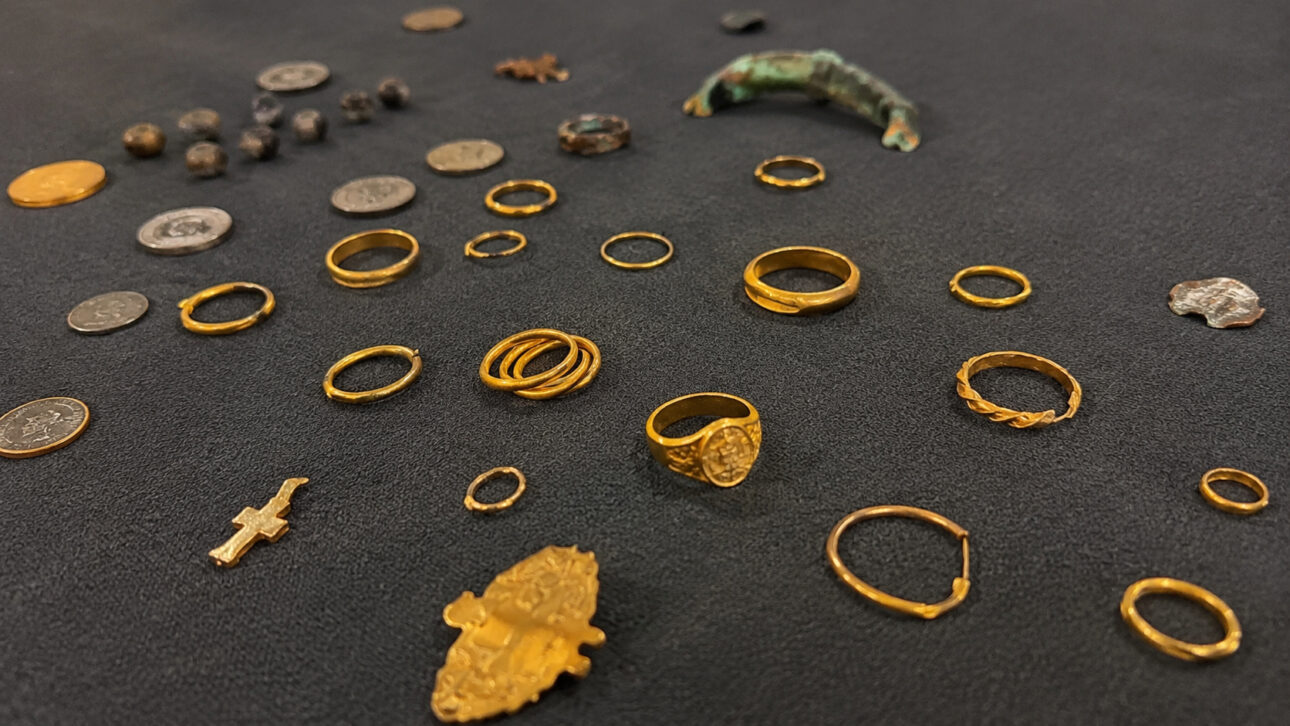
Jewels, coins, and personal items were found
The underwater investigation revealed items of high historical value.
Among the materials recovered were:
- Gold coins;
- Ancient jewels;
- Navigation equipment;
- Sword fragments;
- Crew’s personal items;
- Possible belongings of the captain.
After recovery, the artifacts were donated to the Museum of the Isles of Scilly, in England.
Now, the items will be preserved and displayed to the public.
Museum highlights the historical value of the donation
According to curator Xavier Duffy, in a statement to the British portal Divernet, it is hard to believe that these objects remained at the bottom of the sea for almost 350 years.
He also emphasized that the donation ensures the preservation of the material for future generations.
Thus, the discovery expands the historical collection of the Isles of Scilly and helps to tell part of the 17th-century British navigation.
What do you find most impressive about this discovery: the map that led to the ship or the objects that remained almost 350 years at the bottom of the sea? Share your opinion!