






 Portuguese
  Spanish


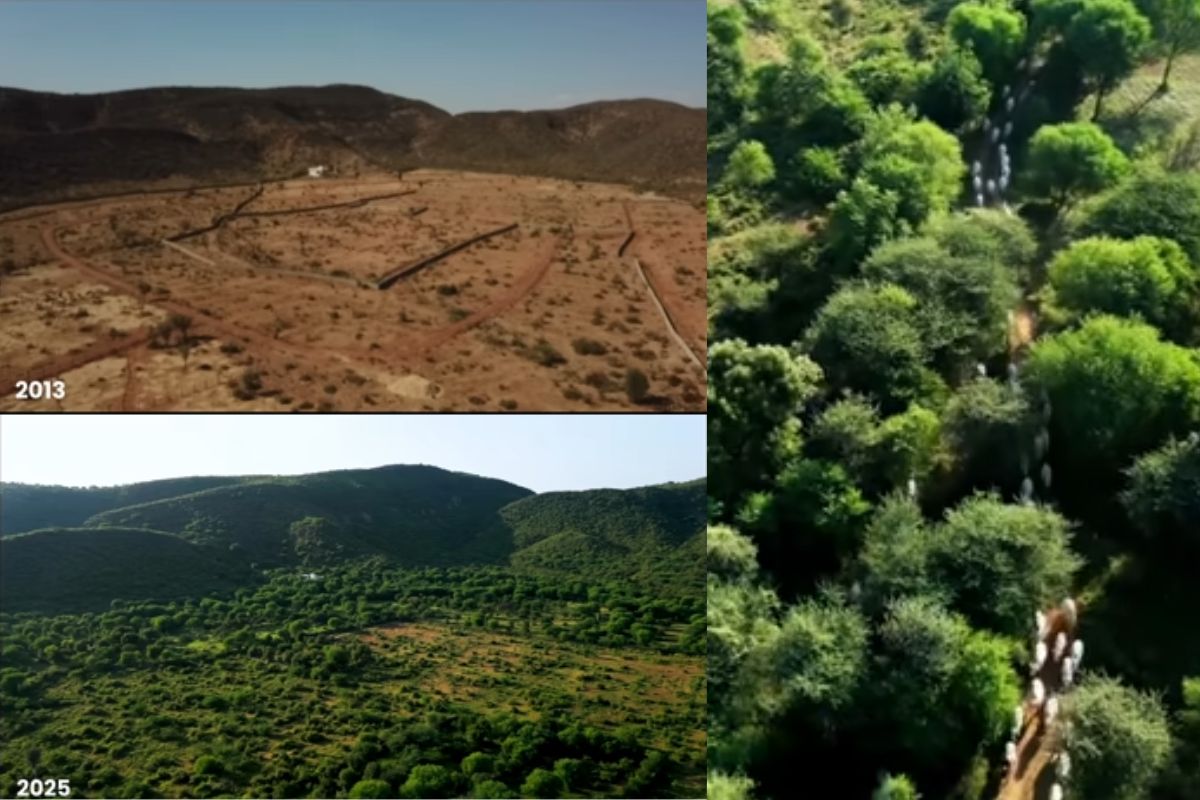


Understand How a Regenerative Farm in Arid Climate Uses Planned Grazing, Healthy Soil, Grazing Cows, and Local Foods to Rebuild a Desert of Stones.
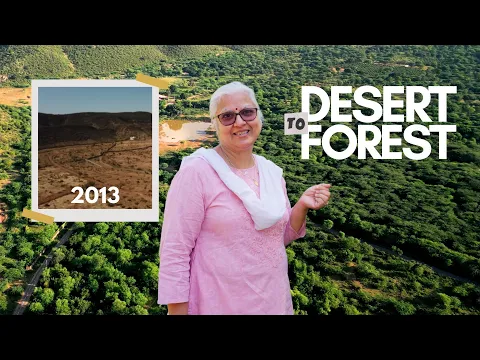
On a piece of arid land covered in stones, in the dry climate of Jaipur, a 63-year-old botanist decided to restart her life and create a regenerative farm where everything begins with the soil. On 100 acres that seemed doomed to desertification, she integrated 180 grazing cows, let manure fall directly onto the ground, waited for the beetles to work, and saw around 200 types of local food grow there.
Over 15 years, this living experiment of regenerative farming has practically shown that it is not the land that is poor; it is the management that is often wrong. When the soil is treated as a living organism again, water infiltrates, organic matter accumulates, biodiversity multiplies, and from something that seemed useless, a green, productive, and food-secure landscape emerges.
From Desert of Stones to Regenerative Farm

When she decided to leave the United States and return to India, she had a simple yet profound desire: to return to the land and have her own regenerative farm.
-
California’s Almond Industry Consumes Over 4 Trillion Liters of Water Annually Amid Drought, Relies on Trucked-In Bees for Pollination

-
India’s Sugar Export Cuts and Ethanol Shift Amid El Niño Threat Could Impact Global Prices and Stocks

-
Quarantine Pest Threatening Palm Trees Puts Brazilian Authorities on Alert, Prompts Monitoring at University of Taubaté and Potential Control Measures Across São Paulo
-
Global Alert: Report Finds 159 Pesticides in Coffee Beans Sold in Europe, Posing Serious Risks to Millions of Farm Workers



The chosen place, Chandawaji, did not seem promising. It was about 100 acres almost entirely of stone, in an arid climate with rains concentrated in three or four months of monsoon.
Instead of being frightened, the botanist saw there a living laboratory. With a scientific background and direct influence from Allan Savory’s method, she connected the pieces that were loose: soil, plants, water, animals, insects, and people.
The regenerative farm was born from this systemic vision, where each element has an ecological function and nothing exists in isolation.
Looking at that harsh scenario, the conclusion was clear: everything needed to start with the reconstruction of the soil. If the soil is not healthy, the plant is not healthy, the animal is not healthy, and the human is not healthy. The regenerative farm was entirely structured from this logic.
180 Grazing Cows: The Heart of the Regenerative Farm

For this type of environment, one decision was central: cows would be the main tool of the regenerative farm. Not as static animals, but as part of a carefully planned grazing system.
She sought indigenous cows adapted to the region, like the Tharparkar breed, heavy-bodied animals accustomed to walking in arid climates and consuming local grasses.
Instead of letting them roam at random, she keeps about 180 cows in a tightly packed herd, “stuck” to each other, like wild herds defending themselves from predators.
This arrangement is not aesthetic; it is functional. When the herd moves as a block, they stomp, eat, urinate, and defecate in a small area for just a few hours, concentrating impact and fertility there before moving on. Some rules guide the management:
- The cows do not stay more than 12 hours in the same piece of land.
- The manure and urine stay where they fall; they are never collected.
- The “stomped” area rests for about three months, until it regenerates.
Only then does the herd return. The result is a pulse of life: manure feeds microorganisms, beetles, and earthworms; plants regrow stronger; roots deepen; organic matter grows. Instead of degrading, grazing begins to build soil, exactly as a regenerative farm should.
The Power of Manure: Beetles as Soil Engineers

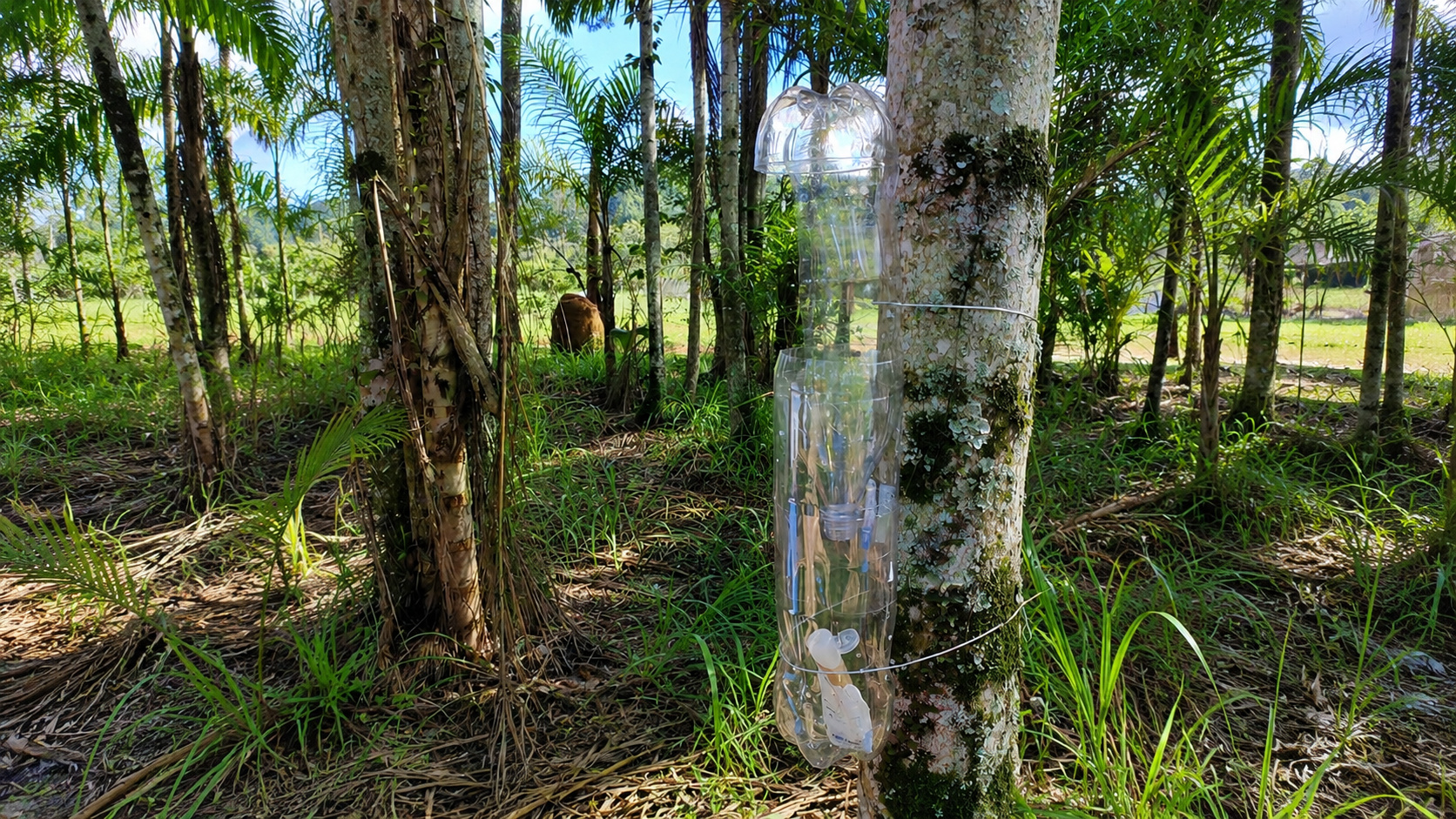
In Chandawaji, every “clump” of manure on the ground is treated as a small biodiversity power plant. On a single pile of manure, a complete theater of life forms: beetles of different sizes, larvae, flies, birds that come to hunt, microorganisms invisible to the naked eye.
Ball-rolling beetles pick up fresh manure, make balls, bury this material, and dig deep tunnels. In the process, they bring soil from below to the top, increase porosity, and create channels for air and water.
In a simple hole, one can see clay transforming into aggregated structure, with roots weaving through and space for infiltration.
When this soil is placed in water for testing, the clump does not disintegrate immediately. It maintains its shape, indicating the presence of stable aggregates. This is a sign of soil that does not break down with rain, does not wash away in erosion, and does not turn into sludge that pollutes rivers.
Instead of flooding and inundation, the sponge-like soil absorbs water, reduces flood peaks, and decreases the impact of droughts.
In this regenerative farm, the question that defines fertility is simple: how many dung beetles and how many earthworms can you find per meter of soil? The more life, the more structured, porous, and resilient the system becomes.
Four Ecological Processes That Sustain the Regenerative Farm
After studying different approaches, the botanist mentally reorganized the regenerative farm around four major ecological processes that need to function together:
- Flow of Solar Light Through Plants
The light should not hit bare soil. It needs to be intercepted by leaves of different heights, shapes, and architectures. Thus, the regenerative farm uses light to produce biomass and prevent the soil from drying out and “frying” in the sun. - Well-Adjusted Water Cycle
Instead of water running over the surface and causing erosion, the goal is for rain to infiltrate the soil, recharging underground reserves. With porous and covered soil, the water that falls from the sky enters the ground, not escaping through runoff. - Mineral Cycle Through Composting and Manure
The role of the land is to compost. Leaves, dead roots, manure, crop residues: everything becomes food for microorganisms, which return nutrients in a form that plants can utilize. The regenerative farm ensures this cycle keeps turning all the time, especially with the help of cows. - Biodiversity at All Levels
Microbes, fungi, insects, small plants, large mammals, and humans form one single system. Monoculture equals sick land. Diversity is what “connects” the soil, plants, and animals in a functional network, where even insect excrement becomes inputs for crops, like bananas.
The regenerative farm, therefore, is not just a beautiful place. It is the materialization of these four processes working simultaneously.
200 Types of Local Foods: The Abundance of Diversity

Today, this regenerative farm produces between 200 and 250 different types of food throughout the year. Not just a long list, but a collection of flavors, textures, and nutrients deeply connected to the territory.
Among the examples are:
- Cacti like the Thor, resistant to Jaipur’s arid climate, used in local preparations.
- Forage plants like Dhaansra, which feed goats and cows.
- Common vegetables and others rarely seen on supermarket shelves: eggplant, okra, Aarya cucumber, wild melon Kaachri.
- Non-obvious parts of food, like tender pumpkin sprouts, used as greens.
- Medicinal and functional plants, such as Bhoomi Amla, valued for liver benefits.
- Multipurpose species like Rosella, whose leaves are made into vegetables and chutneys.
- The climbing plant Butterfly Pea, a nitrogen-fixing legume with blue flowers rich in antioxidants, used for intense-colored teas.
The regenerative farm does not merely rely on selling what is “perfect” aesthetically. On the contrary, the strange and varied shapes are precisely the ones that carry more minerals.
While the conventional market “whitens” and standardizes vegetables, this regenerative farm bets on real diversity as a source of health.
What the family and workers consume comes from there. The surplus goes to a local farmers market, reaching people who want more lively and territory-connected food.
Only 20% Planted: The Rest is Forest and Living Pasture
One point that undermines the idea that producing a lot requires occupying everything with cultivation is the distribution of land use. On this regenerative farm, only 15% to 20% of the 100 acres are actually planted with crops.
The rest is maintained as forest or pasture for the cows. This choice is not romanticism; it is strategy. Forest and healthy pasture:
- protect the soil from direct radiation
- feed water infiltration
- are a constant source of organic matter
- ensure habitat for insects, birds, small mammals, and natural predators
Instead of squeezing every square meter to extract more of the same, the regenerative farm prefers to create a mosaic: cultivation areas interspersed with areas of ecological support. It is this foundation that sustains the production of 200 to 250 types of food.
Wealth That Doesn’t Fit in the Bank: What It Means to Be Truly Prosperous
Looking at the farm today, the botanist openly discusses the difference between money and wealth. For her, wealth is feeling nourished, secure, energetic, and at peace within one’s own life system.
The food from the regenerative farm cooks quickly, requires less oil and seasoning, and is described by her and the team as “living food.”
The sensation is not just one of satiety but of vitality throughout the day. This is not something that can be bought anywhere, no matter how much money one has.
This concrete abundance on the plate generates a feeling of security among the managers and workers on the farm.
The perception is that the soil, being more alive and stable, ensures long-term sustenance, regardless of market fluctuations.
In the end, the message is clear: when we choose where to put our fork, we choose the kind of farm we’re going to finance.
Everyone who buys from a regenerative farm strengthens this model. Each person who ignores where the food comes from ends up reinforcing degrading systems.
The botanist herself believes that for us to have truly healthy food, some people will need to return to the land, either by supporting local producers or creating their own initiatives. If health is not good, the first place to investigate is the food that enters the plate.
And you, looking at the story of this regenerative farm that was born from 100 acres of stones, would you consider supporting or even participating in such an initiative to transform degraded soil into a real source of food and wealth?


