






 Portuguese
  Spanish
  6 min of reading
  0 comments


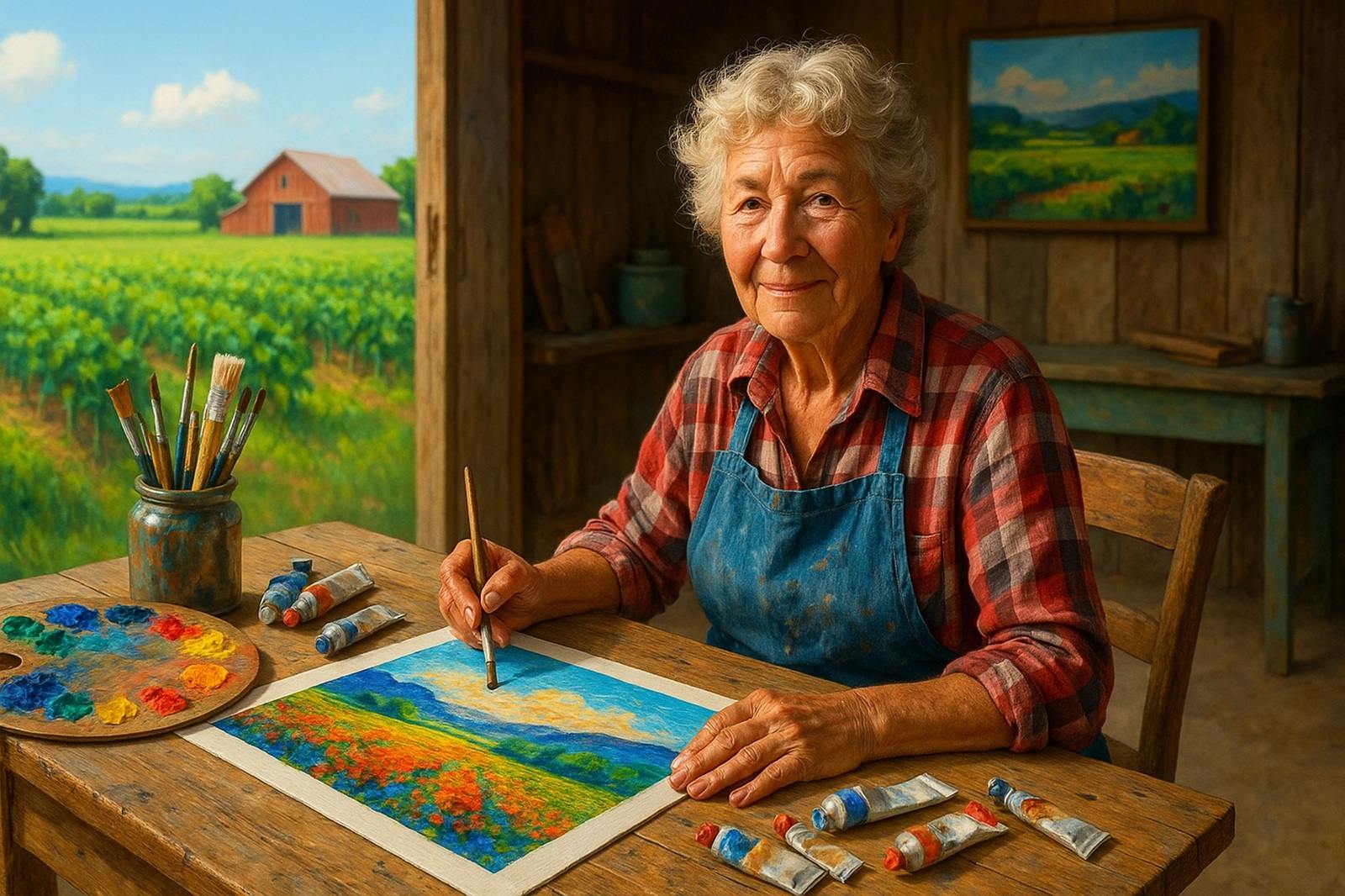
The Surprising Journey of a Farmer Who Found in Painting Her New Career After 70 and Took Rural Scenes to Galleries in New York, Becoming One of the Most Emblematic Names in Modern American Art.
The story of a retired farmer, Anna Mary Robertson Moses, traverses a path that defies expectations and alters the perception of who can occupy a significant place in art.
At 70, when arthritis interrupted her sewing habit, she found in painting a way to continue creating. This simple gesture of the retired farmer, started at a farmhouse table, ultimately led to one of the most remarkable second acts in the arts in the United States.
Her rural life scenes, initially created without pretension, began to occupy space in galleries in New York. In 1940, the New York Herald Tribune mentioned the nickname by which she was being called in her community, Grandma Moses, a name that would remain associated with the artist to this day.
-
Brazilian mechanic invented a lamp made from a PET bottle during the 2001 blackout, the idea turned into an NGO present in 30 countries and has already illuminated 40,000 people in 200 communities without electricity in Brazil.

-
Centuries-old mystery gains new chapters in Greece after excavations reveal a possible lost temple of Poseidon, hidden among ancient lagoons, monumental remains, ritual objects, and an architectural plan that surprised even the experts.

-
2-month-old baby says “I love you” to parents and the video froze the internet: doctors say most babies only speak after the first year of life
-
At 98 years old, Priscilla Sitienei returned to school in uniform, sits next to children, and has a new dream: to become a doctor, after decades of working as a midwife in rural Kenya.



A Retrospective That Repositions the Artist
The new exhibition at the Smithsonian American Art Museum presents Moses comprehensively, highlighting her role not as a picturesque figure, but as an essential character in the history of art. Titled “Grandma Moses: A Good Day’s Work”, on display from November 25 to July 12, 2026, the exhibition brings together almost 90 works.
The collection highlights how the artist developed a keen eye for broad and cinematic compositions, where small occurrences unfold simultaneously and each character occupies a defined role within the represented daily life.
The Trajectory of the Retired Farmer
Moses’s personal journey carries deep marks of an extensive rural life marked by intense labor. She was born in 1860, a year before the beginning of Abraham Lincoln’s presidency, and lived until 1961, traversing historical periods ranging from the Civil War to the early Kennedy era.
In her childhood, she grew up on a small farm in Greenwich, New York, as one of ten children in the family. She participated in household chores and attended school irregularly. As a girl, she created drawings with available materials: old paint saved in the house, carpenter’s chalk, and even fruit juice.
At 12, she began working as a helper on nearby farms, an activity she maintained for a long time. In 1887, at 27 years old, she married Thomas Moses, also a farm helper. The couple lived nearly two decades as tenants in the Shenandoah Valley, Virginia, while raising five children.
After this period, the family settled in a farmhouse in Eagle Bridge, New York. There, the rhythm of life was marked by farm tasks, cattle care, butter production, and fruit preservation for winter.
Only when age diminished her dexterity did Moses begin to paint the seasons that marked her daily life.
The oldest painting attributed to her, “Untitled (Hearth Panel)”, was created in 1918, when she was nearing 60. The work emerged after she ran out of wallpaper and decided to decorate the hearth panel with a landscape of loose brushstrokes. The dark palette used during that phase would later be abandoned. Her frequent dedication to painting only gained strength when she was nearing 80.
The Discovery of Her Talent
Before being recognized as a painter, Moses won prizes for her preserves and sold jams and fruits at rural fairs. Amid these products, she discreetly hung some of her paintings, which remained almost invisible to the public.
The scenario changed in 1938, when engineer and art collector Louis Caldor saw some works in a local pharmacy window and bought them all. Intrigued, he visited her home and acquired almost everything he found.
Caldor took the paintings to Manhattan, but initially faced resistance from gallery owners, who hesitated due to the artist’s advanced age. In 1940, he convinced Otto Kallir to organize a solo exhibition at Galerie St. Etienne, titled
“What a Farm Woman Painted.” Kallir became a decisive advocate for Moses’s career and, in 1951, created Grandma Moses Properties, responsible for expanding her presence in the public imagination through licensing contracts and international projection.
The Evolution of Visual Language
Throughout her life, Moses created over 1,500 works, with greater diversity than is generally attributed to her. In “Bringing in the Maple Sugar”, from around 1940, compositions and color choices influenced by magazine illustrations and prints she used as reference appear.
In 1942, with “Black Horses”, her style acquires particular contours. She starts working in square formats and uses pastel tones, distributing uniform attention to each part of the landscape, as if the scenes were assembled in a patchwork quilt.
In 1955, with “Halloween”, she developed an aerial view that gathers indoor and outdoor activities in a single frame. In this work, the artist’s gaze combines movement, details, and the simultaneous coexistence of different actions.
The Construction of a Record of Rural Life
With paint, Moses recorded a way of life that was disappearing. Commenting on her dedication, she stated that if she hadn’t started painting, she would have raised chickens.
Her work gained great popularity over the decades, appearing on curtains, tea sets, and greeting cards. However, this reach ultimately harmed her reputation in specialized environments.
According to Leslie Umberger, senior curator at the Smithsonian American Art Museum, the accessible style and narrative images attracted millions of people but caused the art world to marginalize her, reinforcing prejudices based on her age, her status as a woman, and the lack of formal artistic training.
In 1952, she participated in the first color broadcast of the CBS program “See It Now”, being interviewed by Edward R. Murrow in the same episode in which Louis Armstrong appeared.
A year later, she would grace the cover of Time magazine, which recorded the sale of 48 million greeting cards produced by Hallmark featuring her paintings. By that time, her work had already been presented in over 160 exhibitions in the United States and in five solo shows abroad.
A Traditional Artist in Times of Rupture
While names linked to abstract expressionism sought the new with paint launches and radical experiments, Moses returned to what she knew. This opposition reveals the strength of her traditionalism.
In the mid-20th century, when aesthetic ruptures seemed inevitable, she insisted on continuity. Her work, based on direct experience, depicted routines, harvests, seasons, and festivities. In her autobiography, published in 1952, she wrote that she painted what she saw and what she remembered, avoiding portraying dreams.
Curator Randall Griffey notes that both Moses and abstract expressionists were supported by the U.S. government in international exhibitions during the Cold War to represent values considered American.
The Power of Memory in Images
Curators emphasize that her paintings serve as records of personal memory and also of national memory during a period of profound changes in American demographics.
Many inhabitants had left the countryside to live in cities, but still preserved memories of rural life. Moses’s art found an audience that recognized these images and attributed emotional significance to them.
Behind the tranquil scenes, there is a rigorous attention to details, from vignettes to precise representations of rural communities.
Snow, farmers at work, children skating, and vibrant skies create environments that seem lively. This vitality helps explain why her work remains relevant even after the almost total disappearance of the rural world she knew.
The Consolidated Legacy
The exhibition at the Smithsonian highlights the multifaceted dimension of the artist, who brought to painting knowledge acquired in a life dedicated to agriculture.
Even at 90, Moses still painted almost daily, reducing her pace only in the last year of her life. In her autobiography, she wrote that she viewed her journey as a good day’s work completed, an expression that synthesizes the relationship between her life and her work.


-

-

-

-

-

-

25 people reacted to this.