Portuguese
  Spanish


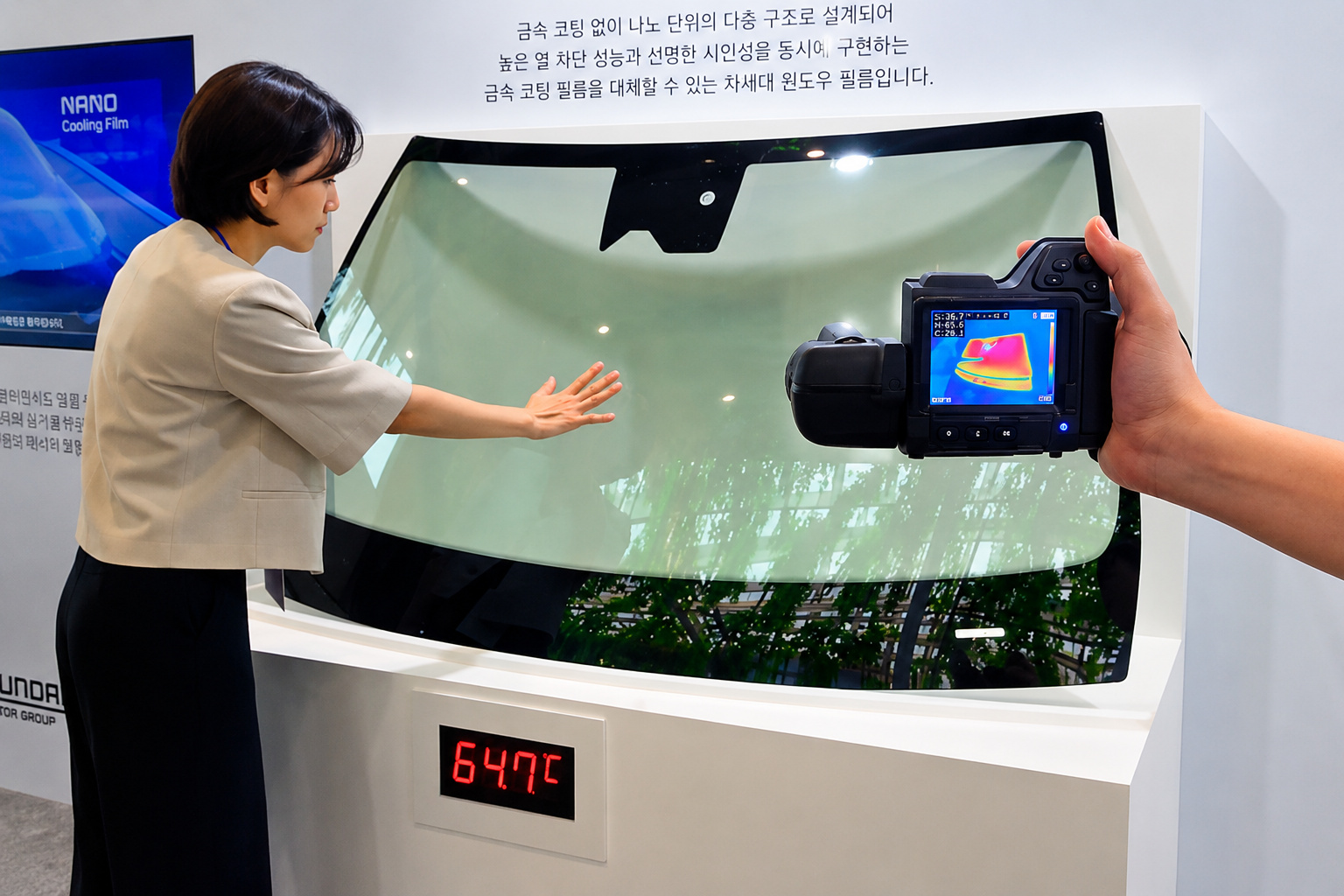


The Nano Cooling Film reorganizes thermal comfort inside vehicles by reflecting solar radiation and releasing accumulated heat in the cabin
An automotive innovation focused on thermal comfort was presented by Hyundai and caught attention for its promise to tackle heat inside cars. The smart film, called Nano Cooling Film, recently emerged and underwent tests in Lahore, Pakistan, where temperatures can exceed 50 °C. The technology uses nanotechnology to reflect part of the solar radiation and release the heat accumulated inside the vehicle. This operation allows reducing the internal temperature by up to 10 °C, without compromising the driver’s visibility.
Smart technology goes beyond traditional films
The change proposed by Hyundai is not limited to darkening the windows and, therefore, differs from conventional films used in the automotive market. After all, while traditional models only reduce light entry, the Nano Cooling Film acts directly on the thermal sensation of the cabin. Moreover, the solution was developed to offer more comfort to occupants and reduce the constant need for air conditioning. This set positions the film as a technological alternative for drivers facing intense heat daily.
Film reduces heat and helps with vehicle economy
Controlling the internal temperature can directly influence the use of air conditioning during trips on hot days. With less dependence on this system, the vehicle tends to require less effort to keep the cabin pleasant. Additionally, reducing the constant use of air conditioning can contribute to fuel savings. This benefit reinforces Hyundai’s proposal to combine comfort, efficiency, and practical application in a solution aimed at everyday use.
-
Workshop Converts Giant Tractor Tire Tricycle into a Three-Wheel Drive Hybrid with 36,000-Watt Electric Motor Capable of Climbing Hills

-
Sales of Brazil’s Cheapest Electric Car Halted Before First Deliveries: E-Motors Suspends Emova Easy Due to Import Tax Increase and Rising Freight Costs

-
Nissan Discontinues Qashqai SUV Amid Cost-Cutting, Chinese Competition, and Product Line Review

-
BYD Patents Revolutionary System Using Computer Vision to Detect Animals Under Cars Before Starting, Preventing Tragedies







UV protection expands benefits for occupants and finish
The smart film also offers protection against ultraviolet rays, which enhances its function within the vehicle. In addition to helping protect the occupants, the technology contributes to preventing the premature wear of seats, panels, and interior finishes. This effect is important in regions with strong sun exposure, where heat and radiation accelerate damage inside cars. Thus, the Nano Cooling Film combines thermal comfort, protection, and preservation of materials.
Expansion to new markets still depends on adaptations
Hyundai plans to expand the application of the film to different markets, but this advancement still depends on adjustments. Before reaching new consumers, the technology will need to meet local regulations and specific needs of each region. This process will be necessary because rules about automotive films vary according to the market. Therefore, the arrival of the Nano Cooling Film on a large scale still goes through technical and legal stages.
The future of thermal comfort inside cars
Hyundai’s proposal shows how smart accessories can gain more space in the automotive sector. The smart film emerges as a solution to reduce heat, protect against UV rays, and decrease air conditioning use without impairing visibility. Meanwhile, drivers facing extreme temperatures follow an innovation that can change the in-car experience.
Will technologies like the Nano Cooling Film become common in vehicles sold to regions of intense heat?