






 Portuguese
  Spanish
  4 min of reading
  0 comments


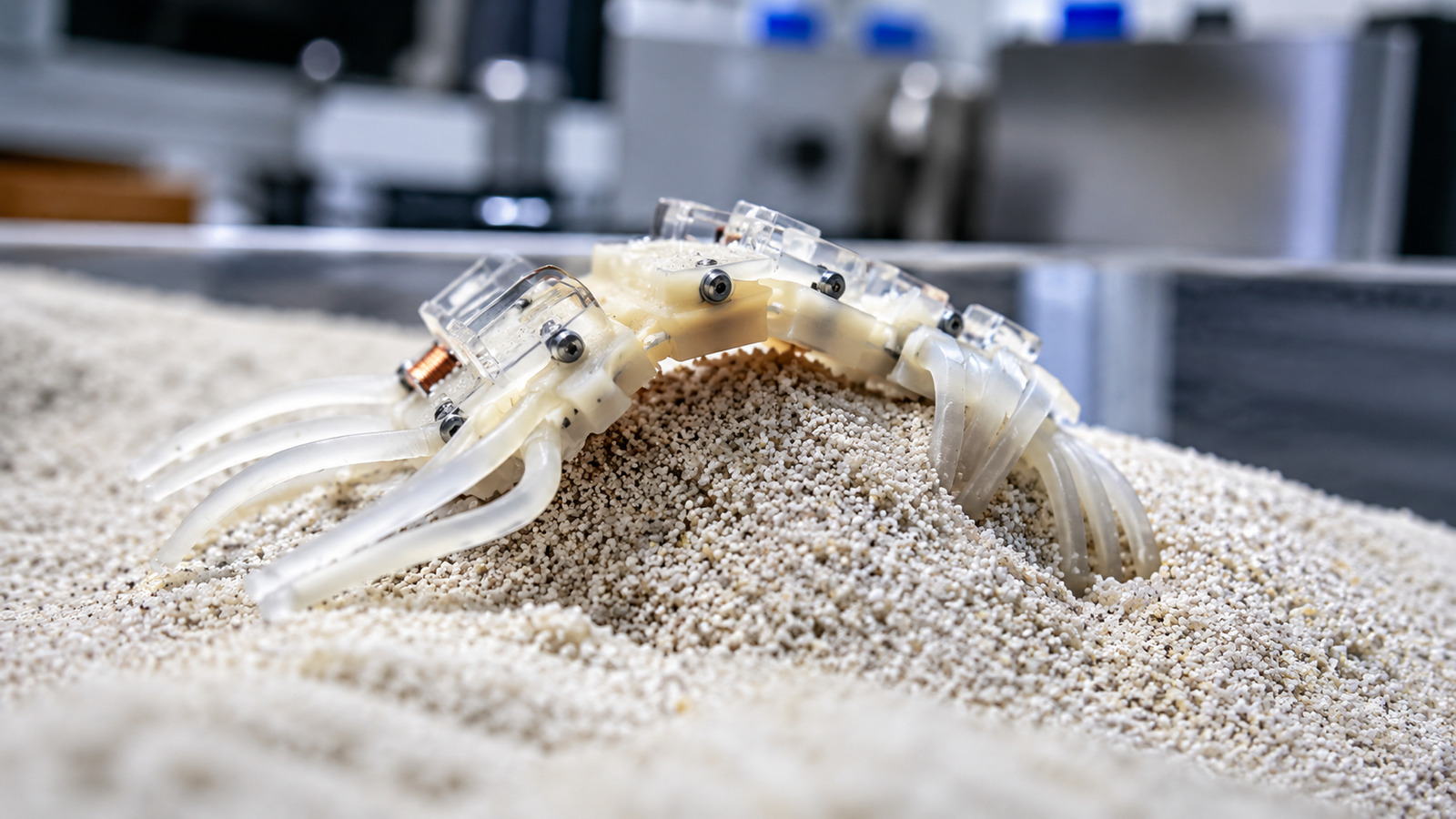
Synthetic structures linked to microscopic micromotors transform internal energy into autonomous movement, mimic living tissues, and can pave the way for advances in flexible robotics, precision medicine, rescue, and space exploration
Researchers have developed synthetic structures linked to microscopic micromotors that can react to external forces, crawl, and even dig autonomously. The study explores the so-called active matter, an area that creates mechanical systems capable of transforming internal energy into movement, mimicking behaviors seen in living organisms.
Active matter uses internal energy to generate movement
Active matter represents an important shift in how artificial components can be designed.
Instead of rigid, static, and predictable parts, these structures are formed by small elastic rods connected to microscopic micromotors.
-
SpaceX receives investment grade for the first time, sees Starlink become a cash engine, and reaches a valuation exceeding 2 trillion dollars.

-
Germany and Japan expand defense amid tensions with China, Russia, and doubts about the US

-
OpenAI accelerates the race for the post-cellular future with several acquisitions in the first few months of 2026 and bets $6.5 billion on the startup of the former iPhone designer to create the device that could challenge the reign of smartphones.

-
Goodbye traditional washing machine: LG surprises and launches a version with up to 18kg capacity that detects dirt with AI, eliminates 99.9% of bacteria, washes giant comforters, and completes full cycles in just 39 minutes without taking up more space.




These micromotors provide energy to the assembly and cause the rods to respond dynamically to physical stimuli.
The result is a system that not only withstands external forces but also uses these forces to produce movement.
The main difference lies in the non-reciprocal behavior. When pressure comes from one side, the reaction of the structure is not the same as the response observed when the force comes from the opposite side. This asymmetry changes the functioning of the assembly.
With this, the internal energy inserted by the micromotors can be converted into continuous movements, such as crawling, walking, or digging.
The structure ceases to be just a passive material and starts to act as a responsive mechanical system.

Synthetic structures mimic living tissues without being organisms
The operation of these pieces resembles some principles used by living beings to move. In nature, organisms use chemical energy to generate adaptation, contraction, displacement, and response to the environment.
In the laboratory, scientists replaced biological cells with artificial elements, such as synthetic elastics, flexible rods, and small articulated actuators.
Even without life, the assembly can reproduce behaviors associated with moving biological tissues.
This similarity appears when the structure accumulates force, deforms, and releases energy in the form of displacement.
The material bends, stores tension, and then transforms this tension into a step, crawl, or digging action.
The advancement does not mean that these pieces are alive. The relevance lies in the fact that simple mechanical components can execute autonomous responses without relying on a traditional rigid structure or conventional commands for each movement.

Asymmetric reaction challenges expected mechanical behavior
Classical mechanics works with the idea that an action generates an equal and opposite reaction. In the structures described by the study, this behavior does not occur traditionally because the interactions are asymmetric.
This characteristic allows the system to operate at a point of controlled instability. What would normally cause failure, breakage, or loss of control becomes part of the locomotion mechanism.
The so-called exceptional critical point transforms the extreme accumulation of elastic force into directed movement.
The tension does not destroy the internal parts but feeds a cycle of tensioning and release that moves the structure.
In practice, the behavior observed in individual pieces does not fully explain the final result. When connected, they create a larger movement pattern, capable of changing how artificial materials can be used.

Flexible robotics could be one of the most impacted areas
The applications mentioned for these structures are mainly related to flexible robotics. As the systems can bend, adapt, and move on uneven terrain, they can be useful in environments where rigid machines face limitations.
The material can aid in the development of small soft robots for dangerous locations, unstable surfaces, or regions with obstacles. The ability to crawl and dig expands possibilities in rescue and exploration areas.
Another mentioned application is in precision medicine. Devices based on this logic could move through organic fluids, using more adaptable structures than conventional mechanical equipment.
Extreme space exploration also appears among the possible fields. Hostile, irregular, and unpredictable environments require machines capable of responding to the terrain, rather than just following fixed movements or relying on rigid structures.


Miniaturization and efficiency are still challenges
Current studies aim to improve the energy efficiency of these systems and further reduce the size of the base components. These two points are central to expanding the practical use of active matter.
Miniaturization can allow for lighter devices capable of accessing smaller spaces. Meanwhile, efficiency gains would help maintain autonomous movements for longer, with better utilization of the energy provided by micromotors.
The expectation presented in the material is that static structures will gradually give way to more interactive and responsive blocks. This path brings together materials engineering, flexible robotics, and systems inspired by biology.
This article was prepared based on information from the provided base material, with data, numbers, and statements preserved as per the consulted material.









-

1 person reacted to this.