Portuguese
  Spanish


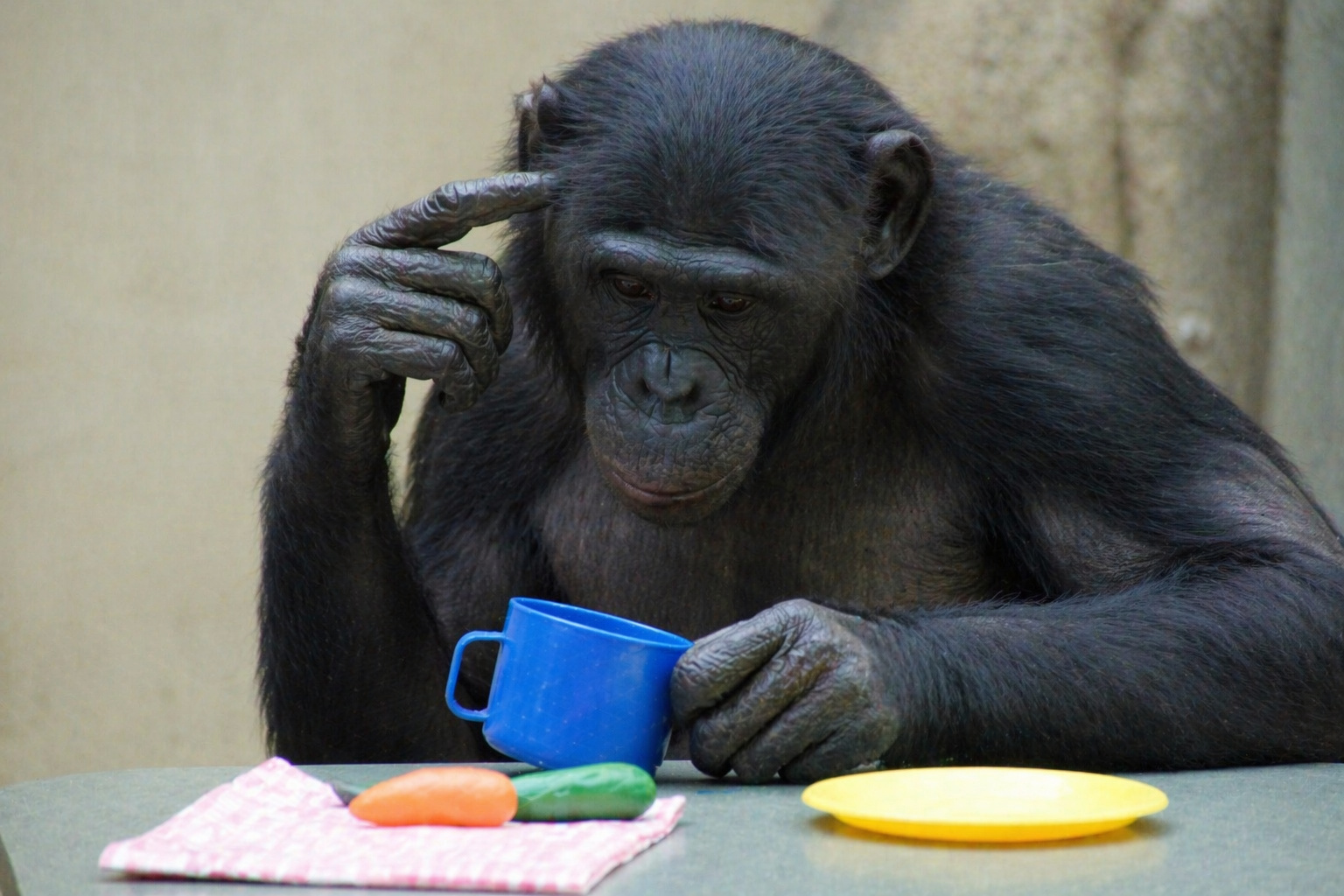

A recent study revealed that monkeys are also capable of playing “make-believe,” a behavior previously considered exclusive to humans. The discovery was made from experiments with a bonobo named Kanzi, who demonstrated advanced cognitive skills when dealing with imaginary situations.
This result, in turn, reinforces the idea that the differences between humans and other primates may be smaller than previously thought, especially regarding reasoning and imagination.
Experiment with bonobo challenges traditional concept
The study, published in a high-impact scientific journal, analyzed Kanzi’s behavior in controlled “make-believe” situations.
During the tests, the bonobo was exposed to scenarios involving imaginary objects, such as non-existent drinks or food. Still, he was able to correctly interpret the situations and respond coherently.
-
Brazilian Senate Approves Bill to Automate Child Support Payments Directly from Debtors’ Accounts

-
Brazilian Student in the U.S. Helps Provide Clean Water to 50 Families in São Paulo Slum, Launches Year-Long Volunteer Project with National Expansion Plans
-
Daughter of Farmers from Brazil Uses Social Media to Highlight Rural Life and Promote Agriculture
-
Free Willy’s Orca, Captured as a Calf, Became a Global Star in a Mexican Tank and Was Part of the Most Controversial Attempt to Return a Captive Whale to the Wild


In one of the experiments, for example, Kanzi participated in a kind of “imaginary tea party,” dealing with items that were not physically present.
Moreover, the results showed that he not only recognized the difference between the real and the imaginary but also was able to act according to that distinction.
Capacity to imagine is not exclusive to humans
Traditionally, the ability to create imaginary scenarios — known as “symbolic representation” — was considered a unique characteristic of the human species.
However, the results of the study indicate that this capacity may have much older evolutionary origins.
According to the researchers, the behavior observed in Kanzi suggests that the ability to deal with the imaginary may date back to the common ancestor between humans and other great primates, who lived millions of years ago.
Thus, the study directly challenges the idea that only humans possess complex imagination.
Kanzi’s performance impresses researchers
The results obtained with Kanzi caught the attention of the scientific community.
During the experiments, the bonobo got about 68% of the answers correct in tasks involving imaginary situations, demonstrating consistency and understanding of the proposed context.
Furthermore, he was already known for his advanced cognitive skills, including the ability to understand human language and use symbols to communicate.
These characteristics make Kanzi one of the most studied primates in history, frequently cited in research on animal intelligence.
What does this change in science
The discovery has important implications for various fields of knowledge, such as psychology, evolutionary biology, and neuroscience.
This is because, by demonstrating that other primates also possess the capacity for imagination, the study broadens the understanding of the evolution of the human mind.
Moreover, the results suggest that skills considered “complex,” such as:
- symbolic thinking
- language
- abstract reasoning
may have developed gradually over evolution, rather than emerging exclusively in humans.

The difference between humans and primates may be smaller
Although there are still important differences between humans and other primates, the study reinforces that these distinctions are more about degree than type.
In other words, humans do not necessarily possess completely unique abilities, but rather more developed versions of capacities that already exist in other animals.
In this context, imagination is no longer seen as a human exclusivity and begins to be understood as a shared skill within the lineage of great primates.
Limitations and caution in interpretation
Despite the promising results, the researchers themselves warn of the need for caution.
This is because the study was conducted with a limited number of individuals, which may restrict the generalization of the results.
Furthermore, factors such as prior training and interaction with humans can influence the performance of animals in tests of this type.
Even so, the data are considered robust enough to open new lines of investigation.
What to expect from future research
Following this discovery, scientists should expand studies to other primates to verify if the behavior observed in Kanzi also occurs in different species.
Additionally, new research may explore:
- how imagination develops in primates
- which brain areas are involved
- how these abilities relate to language
Thus, the field of study on animal cognition is expected to advance significantly in the coming years.
What’s at stake
More than a scientific curiosity, the discovery raises profound questions about what it means to be human.
If other primates are also capable of imagining, interpreting, and interacting with hypothetical situations, then the line separating humans and animals becomes even thinner.
On one hand, this expands respect for the complexity of animal life. On the other, it challenges traditional concepts of intelligence and consciousness.
Thus, the study with Kanzi not only reveals new capacities of primates but also invites us to rethink the place of humans in the animal kingdom.