






 Portuguese
  Spanish


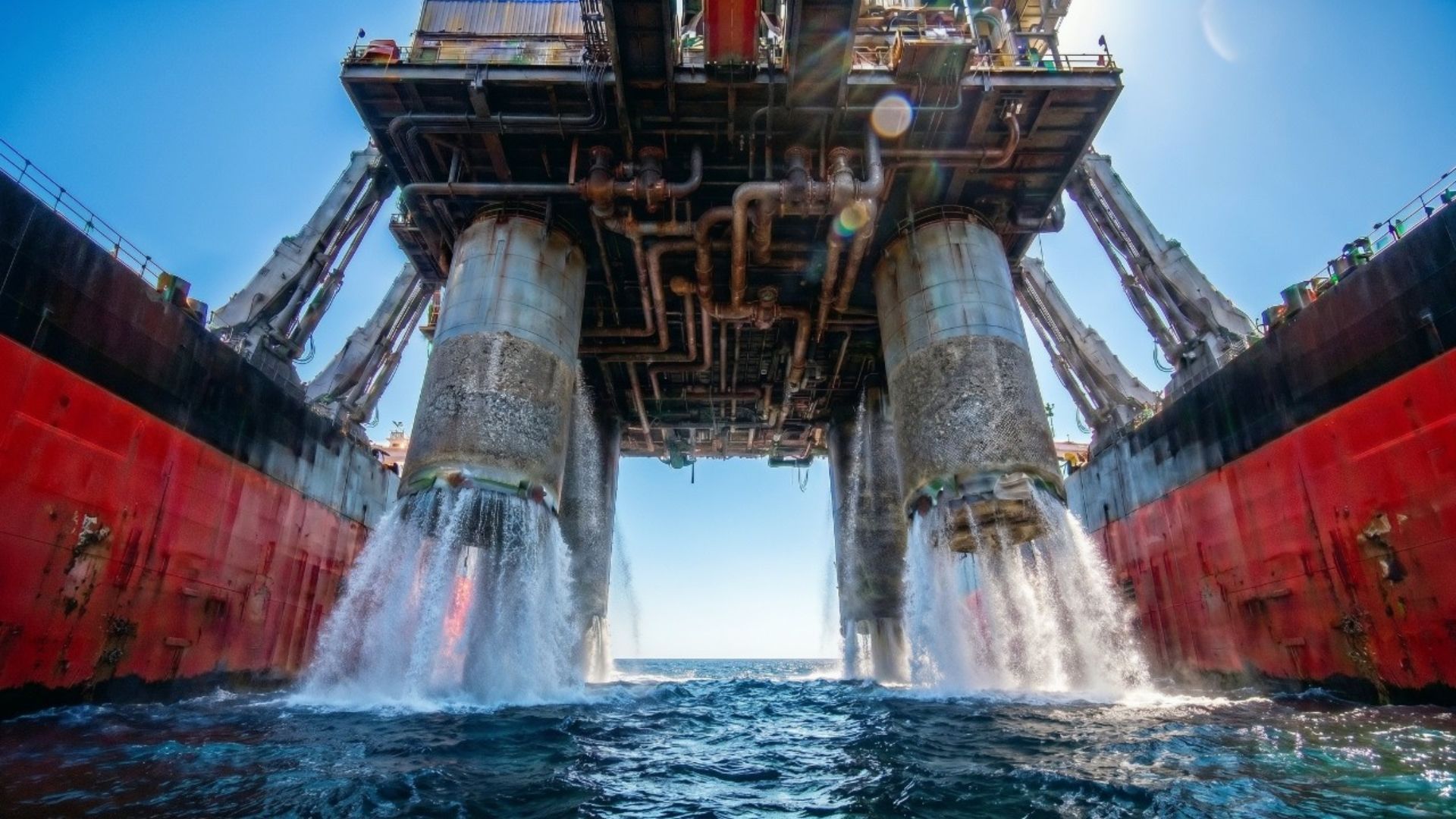


It cost about US$ 3 billion, houses 571 people, and has a bow gap wide enough to embrace an entire platform. The secret lies in hydraulic beams that lift structures of tens of thousands of tons in a few seconds, precisely in the interval between two waves, when the sea stands still for a moment.
Weighing at full load almost as much as nine nuclear aircraft carriers, the Pioneering Spirit is the largest ship ever built by man and was made for a task that no other machine in the world can perform: removing entire oil platforms from the seabed in a single operation. Instead of cutting the structures into pieces, as has always been done, this giant ship slides under the top of the platform and lifts it all at once, a feat that seemed impossible until recently.
Operated by the Swiss company Allseas, the ship is a response to a billion-dollar problem: dismantling the hundreds of old platforms in the North Sea, many already decades beyond their expected lifespan. International maritime law requires that, once production ends, the entire structure be removed, and the oil companies bear 100% of this cost. That’s where the Pioneering Spirit comes in, designed to make this removal faster, safer, and cheaper than the traditional method.
Why the world’s largest ship was built

The North Sea has been producing oil since the early 1970s and, at its peak, had hundreds of active platforms in the waters of the United Kingdom, Norway, the Netherlands, and Denmark. Most were designed to last 25 to 30 years, and many continue to operate well beyond that period. Now, with the depletion of the fields, the bill comes due: more than 600 structures need to be removed from the North Sea alone before 2040, and over 7,500 worldwide.
-
Brazilian Architect Transforms Waste into Sustainable Homes with Solar Power and Rainwater Systems for 40 Years

-
Security Guard Becomes Doctor at Louisiana Hospital Where He Once Worked, Studied Chemistry Between Shifts

-
Woman Rescued from Luxury Complex in Brazil Worked Without Pay for 55 Years, May Be Entitled to Over $300,000

-
Brazilians in Portugal Face Increased Police Checks as Consulate Advises Carrying Documents; Long-term Resident and Tourist Report Heightened Scrutiny in Porto.





The old method was laborious and risky: taking a fleet of crane ships to the site, cutting the platform into dozens of sections, and transporting each piece back to shore, which used to require 18 to 24 months of offshore work. Each day of offshore operation in the North Sea costs hundreds of thousands of dollars, and cutting a half-century-old corroded structure poses real risks of collapse. A radically different solution was needed, and it was this need that led to the creation of this ship.
An idea that waited 20 years to become reality
The concept behind the ship was born at Allseas back in 1987: instead of dismantling the platforms at sea, build a vessel large enough to pass under the top part and remove it whole. The first version of the idea even envisioned joining two supertankers side by side, but their hulls would never withstand that type of structural effort and would break apart. The project was restarted from scratch in 2004, now with a custom-made catamaran.
The construction contract was signed in 2010 with the South Korean shipyard Daewoo Shipbuilding and Marine Engineering, DSME, and the ship was built between 2011 and 2014, at a cost of about 3 billion dollars. There is a delicate chapter in this story: the vessel was originally named Pieter Schelte, but the name generated strong controversy when it was discovered that Pieter Schelte Heerema, father of the founder of Allseas, had served in the Waffen-SS during World War II. In response to the backlash, the ship was renamed Pioneering Spirit in February 2015.
The impressive size of the ship


The numbers of the Pioneering Spirit are hard to imagine. At about 382 meters in length and nearly 124 meters in width, it is the largest ship in the world in gross tonnage, width, and displacement. At full load, its displacement reaches about 900,000 tons, approximately nine times that of a Nimitz-class nuclear aircraft carrier, which displaces about 100,000 tons, making it the heaviest vehicle ever constructed.
Its shape is that of a catamaran, with two parallel hulls joined by a massive structure. At the bow, there is a huge slot, about 122 meters long by 59 meters wide, wide enough to embrace an entire platform. The ship accommodates 571 people in rotating shifts, and its engines practically never stop because restarting them cold is too costly to justify a shutdown during sea operations.
How the ship lifts a platform in seconds
Here is an important clarification to understand the feat without exaggeration. The lifting itself, the moment when the platform detaches from the base, is extremely fast, lasting about nine seconds. But the complete operation, from positioning the ship around the structure to finishing everything, takes several hours. In other words, what happens in seconds is the instant detachment, not the entire removal.
The secret lies in eight sets of lifting beams that function as gigantic hydraulic dampers. The big challenge is that the ship floats and moves with the waves, while the platform is fixed to the seabed. To solve this, the system uses banks of pressurized nitrogen and laser sensors that read the distance between the ship and the platform ten times per second, canceling out the wave movement. The lifting is triggered in the so-called trough between two waves, the brief moment of 8 to 15 seconds when the sea is relatively calm.
The historic feat of the Brent Delta platform
The big real test took place on April 28, 2017, in the Brent field, about 186 kilometers northeast of the Shetland Islands. There, the ship removed in one piece the top part of the Brent Delta platform, a structure of about 24,000 tons that rested on three concrete columns at a depth of 140 meters. It was the heaviest offshore lift ever done until then, a world record.
Before the ship’s arrival, underwater vehicles pre-cut the concrete columns almost to the end, leaving room for the final detachment. On the day, the bow slot passed around the platform’s legs with just over 5 meters of clearance on each side, while the thrusters made continuous micro-corrections. When the system triggered in the wave trough, the top part separated from the columns in seconds, and the Brent Delta was no longer connected to the seabed for the first time in 41 years. The complete operation crowned about five years of planning.
The current record and the dismantling of the Brent field
The Pioneering Spirit ended up removing all four platforms from the Brent field over the years: Delta in 2017, Bravo in 2019, Alpha in 2020, and Charlie in 2024. In total, about 100,000 tons of structures were transported to a decommissioning yard in northeast England, where more than 97% of the materials are recycled, giving the operation a relevant environmental character.
The highlight came on July 9, 2024, when the ship removed the top part of the Brent Charlie, about 31,000 tons, in the heaviest offshore lift ever performed, surpassing its own 2017 record. Each of these operations represents years of engineering and preparation, and consolidated the Pioneering Spirit as a game-changing machine in platform dismantling, reducing the most critical work at sea from almost two years to a few hours.
The ship that dismantles oil now installs the future
There is an interesting twist in the trajectory of the Pioneering Spirit. Although it was conceived to end the oil era in the North Sea, the ship is versatile: besides removing platforms, it also installs them and lays submarine pipelines at a record pace. In 2025, for example, it installed a platform of about 25,000 tons in a field in Canada, the most significant heavy lifting ever done in North American waters.
Even more symbolic is its new role in the energy transition. Since 2024, the ship has been installing substations and structures for offshore wind energy parks, whose weights already exceed what common vessels can handle. In other words, the same machine created to dismantle oil infrastructure is now helping to erect wind infrastructure, a perfect link between the end of one energy cycle and the beginning of another.
The Pioneering Spirit is more than the largest ship ever built: it is proof of how engineering can solve problems that seemed impossible, like pulling an entire platform from the sea in seconds. From an idea kept for 20 years to successive world records, the vessel has become a key piece both in dismantling old oil and building new energy. And, in a sector where what matters is doing what no one else can, it remains without competition at its level.
Have you ever heard of the largest ship in the world, capable of lifting an entire oil platform at once? Did you find the engineering of dismantling more impressive or the fact that it now helps install wind energy? Leave your comment, tell us what you think about these megastructures, and share the article with those interested in oil, engineering, and innovation.


