Portuguese
  Spanish


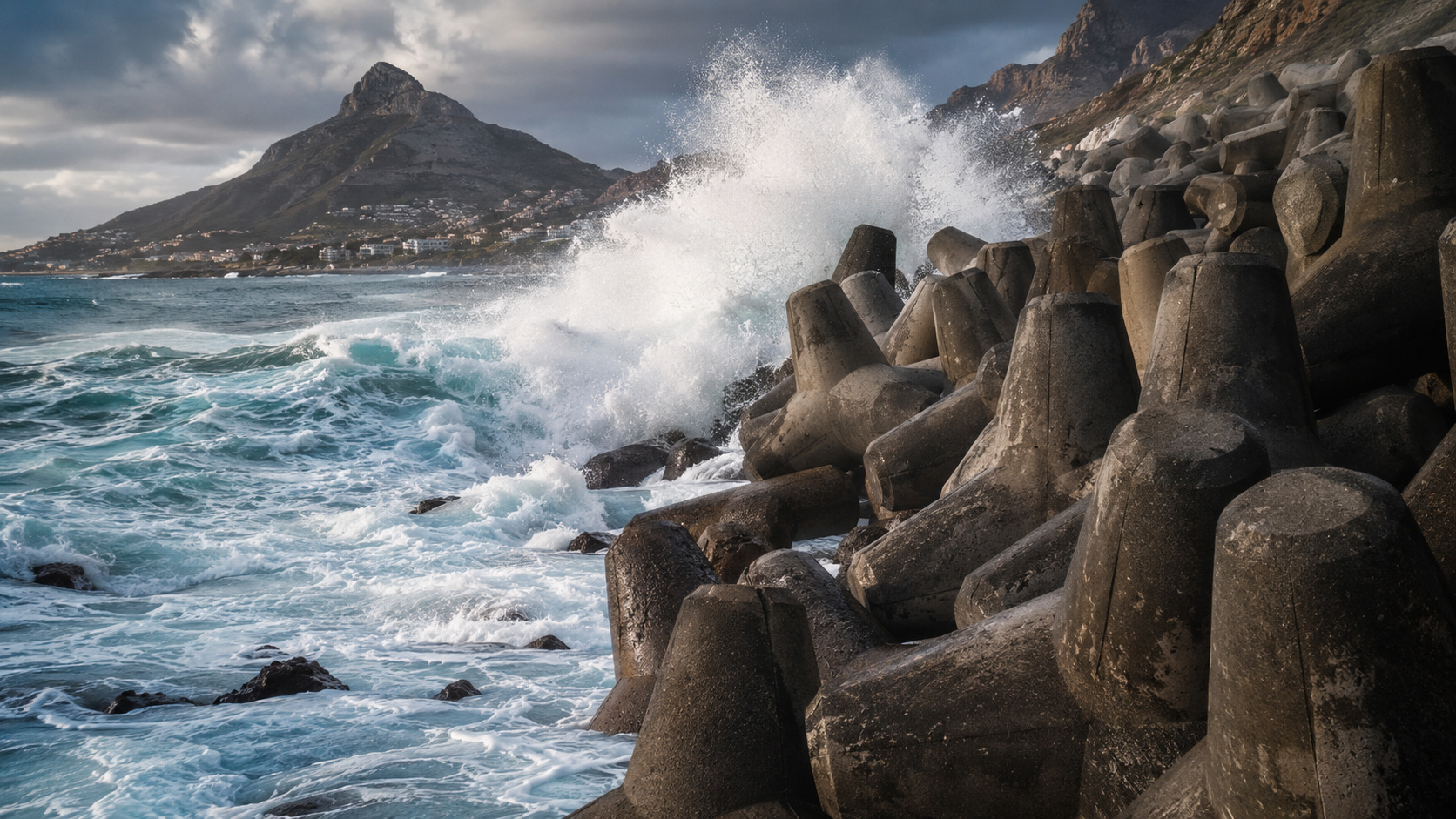

Dolosse created in South Africa have become one of the most used weapons in the world against waves, erosion, and coastal destruction.
The ocean has been destroying ports, dislodging stones from breakwaters, and eroding entire coasts for centuries. But an invention created in South Africa in 1963 changed global coastal engineering using an apparently simple idea: huge twisted “H”-shaped concrete blocks capable of dissipating the force of the waves instead of just trying to block them. These structures became known as dolosse, singular “dolos”, and today they are found scattered across ports, breakwaters, and maritime works on various continents. Depending on the project, the blocks can weigh up to 30 tons and form gigantic walls against the sea.
The system was born after a strong storm hit the port of East London, on the South African coast, in 1963, destroying part of the city’s maritime protection. From there, engineers began to seek a structure that was cheap, resistant, and difficult to displace by the waves.
Dolosse were born after a storm destroyed a South African breakwater and forced engineers to reinvent coastal defense
Before dolosse, ports and breakwaters relied mainly on giant rocks and simple concrete blocks. The problem was that very strong waves could move, displace, or destroy these structures over time.
-
Giant 3,600-ton Crane Breaks Two World Records by Installing World’s Largest Single-Piece Forged and Welded Hydrogenation Reactor, Weighing 3,037 Tons, in Chinese Petrochemical Plant in Just Six Days

-
$80 Million Bridge in Brazil Cuts Travel Time from 30 Minutes to 1 Minute, but Audit Reveals Major Flaws
-
Man Builds Stone Bed with Granite Rocks and Hand-Sawn Cedar Beams, Home Extension Garners Over 437,000 Views on Bonus Bolts Channel

-
Brazilian Researcher Develops Color-Changing Roof Tile to Reduce Air Conditioning Use by Up to 15%





According to historical records and technical documents, the port of East London suffered severe damage after a storm in 1963. Engineer Eric Merrifield was looking for a solution that could absorb the energy of the waves without requiring extremely precise fitting or overly massive structures.
It was in this context that the unusual shape of the dolosse emerged. The structure uses crossed arms and irregular geometry to create a locking effect between the blocks. Instead of forming a solid wall, the dolosse create a porous barrier that reduces and dissipates the energy of the waves.
Giant concrete blocks work because they dissipate the force of the ocean instead of facing it directly
The physical principle of dolosse is different from a conventional wall. They do not attempt to completely stop the sea. The idea is to break, scatter, and reduce the energy of the waves before it reaches the main structure of the port or the coast.

According to technical and historical descriptions, the blocks are partially interlocked and move slightly over time, creating a flexible and interlocked system. This reduces the direct impact of the waves and makes it difficult for the water to tear away the entire structure at once.
Dolosse are usually produced with unreinforced concrete and molded in steel. Some projects use metal fibers for additional reinforcement. Depending on the location, thousands of these pieces may be necessary to protect a few kilometers of coast.
Structures reached 30 tons and began to protect giant ports around the world
With the advancement of coastal engineering, dolosse quickly grew in size. In some modern projects, the units reached about 30 tons, becoming structures comparable to the size of small trucks.

The Port of Ngqura, also in South Africa, became one of the most extreme examples of this use. According to information from the port project itself, the breakwater used approximately 26,500 dolosse of 30 tons, forming a colossal barrier against the waves of the Indian Ocean.
The blocks needed to be positioned by enormous cranes with GPS assistance, because each unit has a gigantic volume and must comply with specific maritime stability calculations.
South African invention spread across the planet and became a worldwide reference in maritime engineering
The dolosse have ceased to be a regional solution and have become part of coastal projects worldwide. Today, structures derived from or inspired by the concept appear in countries in Europe, Asia, the Americas, and Africa.
The idea was so influential that it helped inspire other generations of maritime blocks, such as Accropode, Xbloc, Core-Loc, and different modern coastal protection systems.
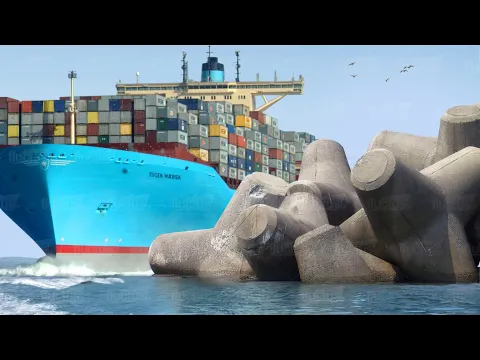
In many places, the dolosse have also started to act against beach erosion, sea advancement, shoreline wear, and port channel protection. Some projects even use these structures to create artificial reefs and marine habitats.
Dispute over the invention’s authorship still generates debate decades later
The authorship of the dolosse remains surrounded by historical controversy. For many years, the main credit was given to engineer Eric Merrifield, responsible for the works at the East London port.
However, several South African publications have started to highlight the role of technical draftsman Aubrey Kruger, who allegedly developed the initial design using broomstick pieces assembled at home after discussing the port’s problem.
Both versions appear in historical records, and there is no absolute consensus on who should receive full credit for the creation. What is documented is that the invention emerged within the South African port structure after the 1963 crisis.
Concrete structures show how the world began to fight against an increasingly aggressive ocean
The dolosse were born to solve a specific problem of a South African port. Decades later, they became a global symbol of the human attempt to control the ocean’s force.
Today, these giant pieces appear in ports, urban coasts, industrial areas, and regions threatened by maritime erosion. In some places, they help entire cities remain protected against storms and wave advancement.
The most impressive thing is that an improvised invention in 1963, made to prevent the sea from destroying an African breakwater, ended up becoming one of the most recognized coastal structures in modern engineering.