






 Portuguese
  Spanish



The Drop In Ethanol Prices Is Already Being Felt At The Fuel Station Pumps And Therefore Makes The Consumer Question: Is It More Advantageous To Fill Up With Alcohol Or Gasoline?
The price of ethanol has decreased by 6% over the last thirty days. According to the National Agency of Petroleum, the regulatory body for the activities of the oil and alcohol fuel industry, distribution, and resale, the national average for the liter of fuel has dropped from R$ 5.10 to R$ 4.79. And further reductions in these prices are expected with the increase in sugarcane harvests in Brazil. Meanwhile, gasoline prices are related to fluctuations in the dollar.
See Also
- Oil Prices May Soar To 150 Dollars Per Barrel And Gasoline Prices Could Rise Even More If Russian Crude Oil Exports Are Impacted By Tensions With Ukraine
- Distributors Reduce Ethanol Purchase Volume After Losing Competitiveness Against Gasoline. Mills Are Lowering Prices To Try To Reduce Stock Levels
The price of gasoline also fell, but less significantly. The most used fuel in Brazil saw its average decrease from R$ 6.67 to R$ 6.61 over the span of a month.
Now, to determine which is the best choice for the consumer’s wallet regarding ethanol and gasoline, it is necessary to calculate the price of both fuels.
-
At 14 years old, she worked in a factory in Hong Kong, studied economics abroad, and then entered the Chinese real estate market, which helped change the landscape of Beijing.

-
While NATO secured more than $10 billion in missiles and space surveillance at a single forum, Brazil still spends 1.1% of its GDP on defense and is stalling its own anti-aircraft system.

-
Corn ethanol attracts R$ 23 billion in 21 new plants and prepares for a nearly 50% jump in Brazilian production by 2027, even with high interest rates.
-
A newly opened terminal in the middle of the Amazon has begun transporting soy and corn through Amapá, eyeing the queue of ships that is congesting the ports in the South.


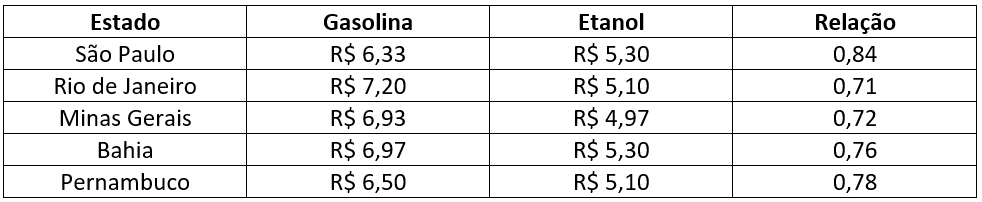
Ethanol has 70% of the efficiency of gasoline, so what needs to happen is to divide its price by that of gasoline. If the result is greater than 0.7, it means that alcohol is costing more than 70% of the value of gasoline. Therefore, it is not worth it. However, if the result of the division is less than 0.7, then it is more advantageous to consume ethanol.
Considering the average price of ethanol and gasoline, the latter appears to be more advantageous. See in the table below the average prices from five states, already calculated based on the 70% rule.
Sugarcane Harvest Should Recover In 2022 And Thus Help Further Reduce Ethanol Prices
Sugarcane production, the raw material for ethanol fuel, should recover in 2022/2023. The sugarcane harvest begins on the first of April this year.
The projection is from the Center for Advanced Studies in Applied Economics (Cepea), anticipating a positive outlook for more favorable weather and greater productivity in Brazilian sugarcane fields, compared to the 2021/2022 season, which ends on March 31.
Therefore, if the expectations for favorable climatic conditions in early 2022 materialize, there will be an increase in sugar and especially ethanol production, resulting in more supply.
According to the Luiz de Queiroz College of Agriculture at the University of São Paulo, the 22/23 sugarcane harvest is expected to reach values between 530 million and 578 million.
In the last harvest, sugarcane production ranged between 516 million and 520 million tons, as reported by the National Supply Company (CONAB) and the Union of the Sugarcane Industry (ÚNICA).
The Relationship Between Gasoline Prices And The Dollar
As we have seen above, gasoline prices have dropped in some states. However, the price remains at a high level, following several adjustments in recent months. All of this is related to the price of the dollar.
Understanding the relationship between the American currency and gasoline prices here in Brazil is straightforward. Since 2016, Petrobras has adopted the so-called Import Parity Pricing Policy (PPI), which sets the price of a barrel of oil in dollars.
So, when the dollar is high, the price of a barrel of oil also rises. And this is directly felt by the consumer at the pump of fuel stations.








