






 Portuguese
  Spanish


Included as a Priority in the New PAC, the Project That Would End the Historical Isolation of Amapá Continues Without Visible Progress on the Site in 2025, Feeding Skepticism of More Than Two Decades.
The promise of connecting Amapá, the only Brazilian state still isolated by land, to the rest of the country faces a chapter of uncertainty in July 2025. The awaited bridge over the Jari River in the Brazilian Amazon, spanning 406 meters, was included as a strategic project in the New Growth Acceleration Program (PAC). However, the reality on-site contrasts with the planning: the construction site remains idle, and the question that has echoed in the region for over 20 years gains strength: will the project actually leave the paper?
Does Amapá Leave Behind a ‘Land’ Island?
Even in 2025, geography still imposes on Amapá the harsh reality of an island. Surrounded by water barriers such as the Jari River to the south and the colossal mouth of the Amazon to the east, the state maintains its almost total dependence on air and river transport — slower, more expensive, and less efficient.
This precarious logistics perpetuates the so-called “Amapá cost,” a daily burden that inflates food and supply prices for the entire population. To make matters worse, the main internal artery, BR-156, still has unpaved sections. It is in this scenario that the bridge over the Jari River stops being just a project and becomes the symbol of the solution. The paralysis of the project in 2025, therefore, is not just a delay but the daily persistence of an isolation that engineering has already promised to overcome.
-
Concrete-filled PVC homes could be cheaper than traditional masonry, UPF research finds; with ready modular panels, less waste, and faster construction, the Concrete-PVC system aims to cut costs and transform affordable housing in Brazil.

-
Brazilian House Built with 32.8 Tons of Construction Debris Offers Affordable Housing Solution
-
Americans Build Entire Homes in a Day Using Compact Sand Foundations and Pre-Made Wooden Trusses, Reducing Construction Costs

-
China’s Largest Floating LNG Plant, NGUYA, Sets Sail for Congo: 2.4 Million Tons Annually for Italy’s Eni


A History of Delays and Embezzlements
The trajectory of the bridge is long and troubled. Begun between 2001 and 2002, the project suffered from governance failures and numerous halts. The initial responsibility lay with the City Hall of Laranjal do Jari (AP), which had limited technical and financial capacity for a project of this magnitude.
The history includes serious indications of corruption. In 2016, the Federal Public Prosecutor’s Office (MPF) denounced the embezzlement of over R$ 15 million. Before that, in 2009, the Office of the Comptroller General (CGU) had already pointed out irregularities. After more than two decades and the consumption of R$ 21 million, surprisingly only 39% of the work was completed. The result is abandoned and deteriorated concrete pillars in the middle of the Jari River.
The Resumption by the New PAC
The inclusion of the bridge in the New PAC represents a change in strategy. The responsibility for the project was centralized in the Federal Government, under the management of the Ministry of Transport and the National Department of Transport Infrastructure (DNIT). This measure aims to overcome the barriers that have paralyzed the project for so long.
The project is part of a larger plan, the “Integration Route 01 for Amapá”, which foresees R$ 28.6 billion in investments in the state. The federal government’s schedule is ambitious, with an expected completion of the bridge and the entire route by the end of 2026.
What Changes for More Than 500 Thousand People?
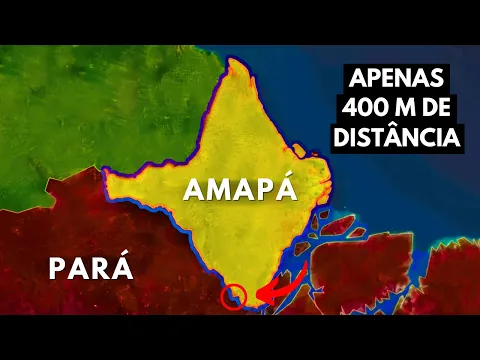

The completion of the bridge is seen as the “backbone” for the development of Amapá. It will create the first land outlet for the flow of products like açaí and Brazil nuts, reducing freight costs and making local production more competitive. For the population, the project will facilitate access to health and education services in other states.
Progress, however, brings challenges. The new structure will render the ferry and “catraias” service, which currently crosses the river, obsolete. This poses a direct threat to the livelihood of dozens of families. It is essential to create transition policies for these workers, preventing the development of many from happening at the expense of a few.
Environmental Challenges in the Brazilian Amazon
The construction occurs in a fluvial ecosystem of the Brazilian Amazon that is already under pressure from large projects, such as the Santo Antônio do Jari Hydroelectric Plant. The environmental risks of the bridge project include riverbank erosion, sedimentation of the riverbed, and water contamination.
As it is a project on a federal highway at the border of two states, environmental licensing must be conducted by IBAMA. The process requires an Environmental Impact Study (EIA) and its respective Report (RIMA). The main challenge is to ensure that political pressure to meet the 2026 deadline does not lead to rushed licensing, ignoring real impacts and necessary mitigation measures.





Quando é que vão finalmente construir a ponte sobre o Rio Jari, que unirá Amapá ao resto do Brasil, de meros 406 metros de extensão ?
Vamos do Amapá à Guiana Francesa pela linda ponte Ponte Binacional Franco-Brasileira, que liga as cidades de Oiapoque (Amapá, Brasil) e São Jorge do Oiapoque (Guiana Francesa) através do Rio Oiapoque, constituindo a única fronteira terrestre entre o Brasil e o território francês (inaugurada em 2017), mas não vamos do Amapá ao Pará e, consequentemente, ao resto do Brasil.
Vai entender este ministério dos transportes brasileiro !?!?!?!?!?!?!?!?