Portuguese
  Spanish


The piece works like a giant clay pot: water evaporates through the porous ceramic and takes the heat away, pushed by a solar-powered fan. The idea is to relieve the hottest spots in the city, where people wait and suffer. For now, however, it is an award-winning prototype that still needs to be tested on the street.
In the midst of a heat wave, a bus stop can turn into an oven, but a simple invention promises to ease this discomfort. Two Swiss students created a 3D-printed terracotta brick that cools bus stops and squares by up to 9 degrees Celsius using only water, clay, and solar energy, without using electricity from the grid, in a project that reuses an ancient technique against the extreme heat of cities.
The project, named bloc, was created by Andrin Stocker and Luc Schweizer, industrial design students at the Zurich University of the Arts in Switzerland, as a graduation project, and was among the national finalists of the 2025 James Dyson Award. It is worth mentioning that it is an award-winning prototype, not a product already available on the streets, and that the cooling of up to 9 degrees was measured in tests. Next, we explain how the brick works, what tradition it is inspired by, and what its limitations are.
How the cooling brick works
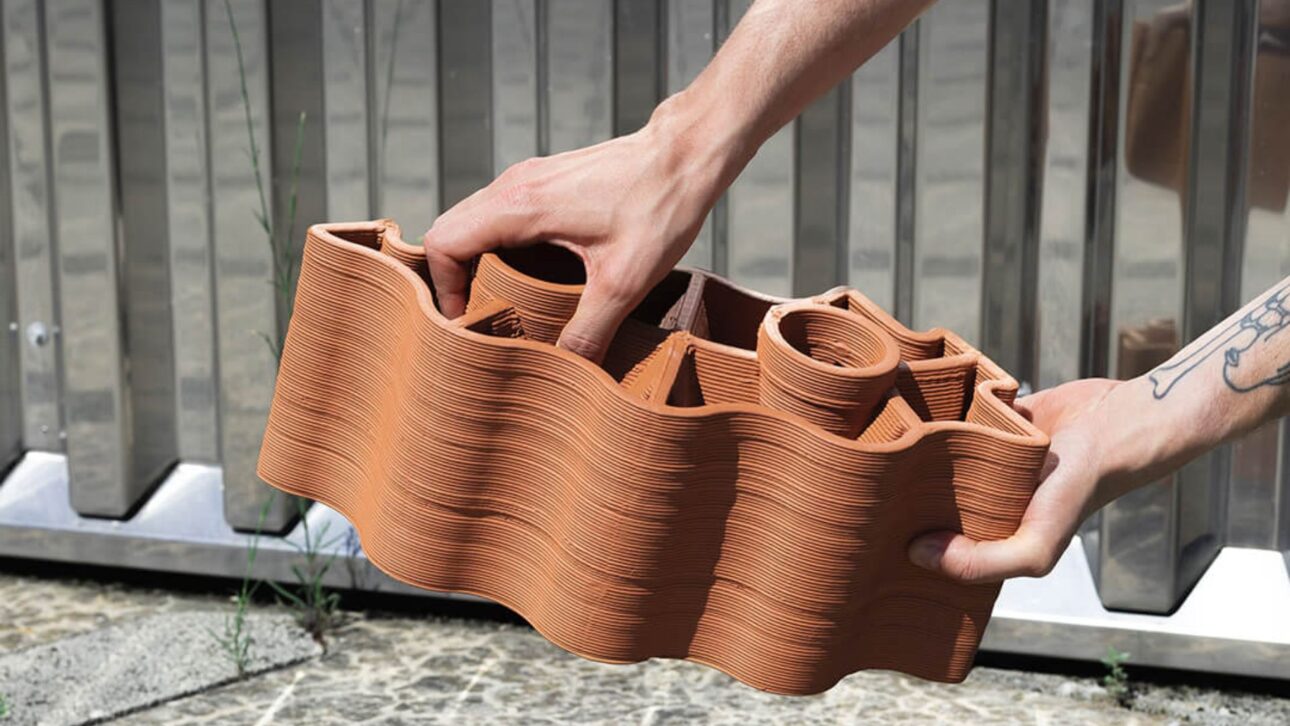
The brick is made of terracotta, a porous material capable of absorbing and retaining water, and works by the so-called evaporative cooling, where hot air passes through the moist clay, part of this water evaporates and takes the heat away, leaving the air that comes out on the other side cooler, the same principle that makes sweat cool the skin.
-
Brazilian Fishing Couple Spends 4 Years Building Solar-Powered Floating Home on the Paraguay River, Now a Navy-Approved Vessel with Leisure Area and Tour Demand

-
While the World Opens New Airports and High-Speed Trains, Brazil Rushes to Complete Projects Stalled for 40 Years
-
Brazil Invests in Massive Waterway to Transport Soybeans by Barge, Reducing Costly Truck Reliance
-
Bridge Rebuilt in Just One Year Reconnects Two Brazilian States


Each unit is a 3D-printed terracotta brick, with internal chambers that store water and conduct air.
A small solar panel powers a fan and a pump that keep the ceramic moist, without needing energy from the electrical grid.
According to the official project description, on days with temperatures above 30 degrees, a complete installation uses about 56 liters of water, which can come from the network or rain collected at the top of the funnel-shaped structure.
An ancient technique in a new format
The great insight was to reuse the knowledge of ancient civilizations.
The project is inspired by passive cooling methods used for centuries, such as clay pots that keep water fresh, Persian wind towers, and even natural patterns found in termite mounds and cacti, structures that regulate temperature without any complex technology, just with shade, air circulation, and evaporation.
This same principle is what makes evaporative coolers work, which cool the environment by making the air pass through a dampened material.
It is worth noting an important limitation of this technique: it works better in hot and dry climates and loses efficiency when the air is already very humid, as evaporation becomes more difficult.
Therefore, the performance of the brick tends to vary according to the climate of each city.
Why city heat is so intense
The invention addresses an increasingly serious problem in urban centers.
The phenomenon known as the urban heat island occurs because dark roofs, asphalt, and concrete absorb the sun during the day and release this heat at night, causing some areas of cities to become much hotter than neighboring rural areas, sometimes by several degrees, according to satellite measurements cited by the European Commission.
And extreme heat is not just discomfort.
According to the World Health Organization, studies point to about 489,000 heat-related deaths per year between 2000 and 2019, and the trend is worsening with climate change.
In this scenario, the idea of bringing thermal relief exactly to the points where people suffer the most, such as those waiting for a bus or a child at the school exit, gains relevance.
Designed for the street, with clear limits
Despite the enthusiasm, the creators themselves are realistic about the reach of the invention.
The brick was designed to cool small public hotspots of intense heat, not entire neighborhoods, functioning as a complementary tool that does not replace trees, shaded areas, reflective surfaces, or broader urban planning against heat, as the authors themselves acknowledge.
There is still the path of proof.
Laboratory studies with terracotta pipe systems have already shown temperature reductions, and a 2025 research published in the journal Applied Thermal Engineering highlights the potential of this type of material in hot and dry climates.
However, as the team itself points out, this does not guarantee the same performance on a busy sidewalk, subject to wind, dust, vandalism, and heavy use.
Therefore, the next step is precisely to test a full-scale prototype in urban environments.
Why the idea matters, even if modest
The value of the project lies in its simplicity and the audience it can serve.
By dispensing with the refrigerant gases used in many air conditioning units and by operating with solar energy instead of grid electricity, the brick can be useful in places where installing external cooling would be expensive or unfeasible, or where the cost of energy already weighs on family budgets, democratizing access to heat relief a bit.
The proposal, as the creators admit, is modest but significant.
A wall of bricks that releases cooler air will not, by itself, solve the problem of extreme heat in cities, but it can make waiting at a bus stop a little less unbearable during the hottest hours of the day.
It’s an example of how design and creativity, combined with ancient knowledge, can offer low-cost answers to challenges brought by climate change.
The terracotta brick created by Swiss students is a reminder that not every solution to big problems needs to be complex or expensive.
By combining 3D printing, solar energy, and a cooling technique from antiquity, the bloc project shows a possible path to making cities more livable in the face of rising heat, even if it is, for now, a promising proof of concept to be tested in practice.
More than a definitive answer, it is an invitation to rethink the role that even urban furniture can have in people’s comfort and health.
And you, what do you think of this idea of using a clay brick to cool the streets during heatwaves? Do you believe that simple solutions like this can help cities cope with extreme heat? Leave your comment, share your opinion, and help spread the article to those interested in innovation, sustainability, and architecture.