






 Portuguese
  Spanish


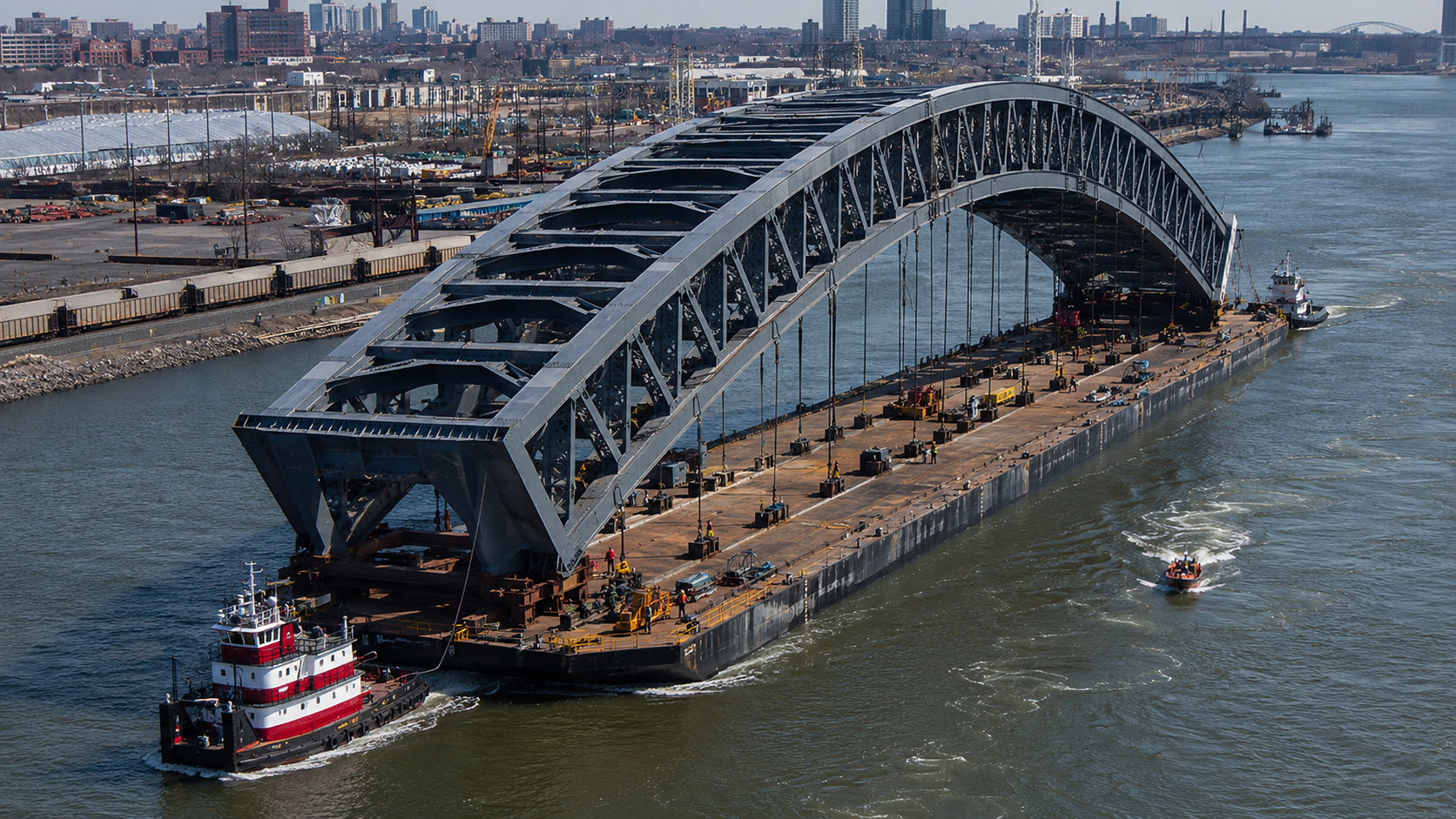

The Portal North Bridge brings together a large-scale railway project, with a metal arch transported via the Hudson River, a billion-dollar investment, and the replacement of a century-old bridge that limits the capacity and reliability of the busiest railway corridor in the United States, in an intervention that draws attention due to the size of the structure, the unusual logistics, and the direct impact on passenger transport.
In November 2024, a structure of 2,300 tons drew attention as it sailed on a barge along the Hudson River in the United States. The enormous metal arch had been assembled off-site and headed to New Jersey to become part of the new Portal North Bridge, a railway bridge created to replace a century-old structure.
The operation turned a railway project into one of the most impressive behind-the-scenes feats of recent infrastructure in the country. The giant piece crossed the river as if it were a steel building lying on the water, in a decisive step to modernize one of the busiest railway corridors in the United States.
The information was published by STV, an engineering company active in infrastructure. The project involves a main span of about 366 meters, formed by three metal arches, in addition to dozens of spans and a main contract cited at about US$ 1.56 billion.
-
While the World Opens New Airports and High-Speed Trains, Brazil Rushes to Complete Projects Stalled for 40 Years

-
Brazil Invests in Massive Waterway to Transport Soybeans by Barge, Reducing Costly Truck Reliance
-
Bridge Rebuilt in Just One Year Reconnects Two Brazilian States
-
Custom Furniture Costs in Brazil Expected to Range from $350 to Over $1,450 per Square Meter by 2026, with Kitchens, Closets, and Laundries Highlighting the Impact of Premium Features


Why the structure was assembled off-site from the railway bridge
Assembling an arch of this size away from the tracks helps reduce risks and gives more control to the project. The site is where the construction takes place, and working with such a large piece within an active railway corridor could make everything slower and more delicate.


By preparing the structure away from the final point, the team can better organize the assembly, test stages, and reduce interferences near the railway line. This makes a difference when the project needs to coexist with a route that already receives a large volume of trains.
In the case of the Portal North Bridge, this strategy also reinforces the most striking image of the project: a railway bridge emerging far from its final location and then traveling by water to the installation area.
How a 2.3 thousand-ton structure traveled by barge on the Hudson River
After being assembled in Coeymans, New York, the metal arch was placed on a barge, a vessel used to transport heavy loads. The journey on the Hudson River took the structure to New Jersey in an operation rare even by the standards of large projects.
The scene resembles a steel building lying on the water. This comparison helps to understand the visual effect of the transport, as the piece is enormous and was taken almost ready to the place where it would be installed.
STV, an engineering company active in infrastructure, detailed this movement as an important milestone of the project. The crossing shows that the logistics of the project were as challenging as the construction of the bridge itself.
The centennial bridge became a bottleneck in the busiest railway corridor in the United States
The old structure to be replaced is a centennial movable bridge. This type of bridge needs to open to allow the passage of vessels, and this mechanism can cause delays and failures on a route where any interruption has an immediate effect on train circulation.
When a movable bridge ages, the reliability of the system drops. The problem is no longer just the age of the structure and starts to affect the railway’s capacity, travel speed, and service regularity.
That’s why the new bridge has strategic importance. The replacement is not just to renew an old structure. It aims to remove a critical point from a railway corridor that concentrates heavy traffic and depends on stable operation.
The numbers of the Portal North Bridge help explain the size of the project
The new railway bridge project brings together figures and dimensions that explain the interest around the intervention. The main span is about approximately 366 meters and will consist of three metal arches, in addition to dozens of spans along the structure.
Another impactful data point is the material used. The project involves millions of structural steel, indicating that it is not a simple renovation, but a heavy replacement on a vital route of the United States railway network.
The main contract is cited at about US$ 1.56 billion. The value helps to show the scale of the investment needed to replace an old bridge with a new structure designed to enhance the reliability of the operation.
What changes with the new railway bridge in New Jersey
The major change lies in the ability to reduce failures and improve the flow of trains on a heavily used section. A more modern bridge tends to offer more stable operation, fewer limitations, and better performance compared to the old structure.
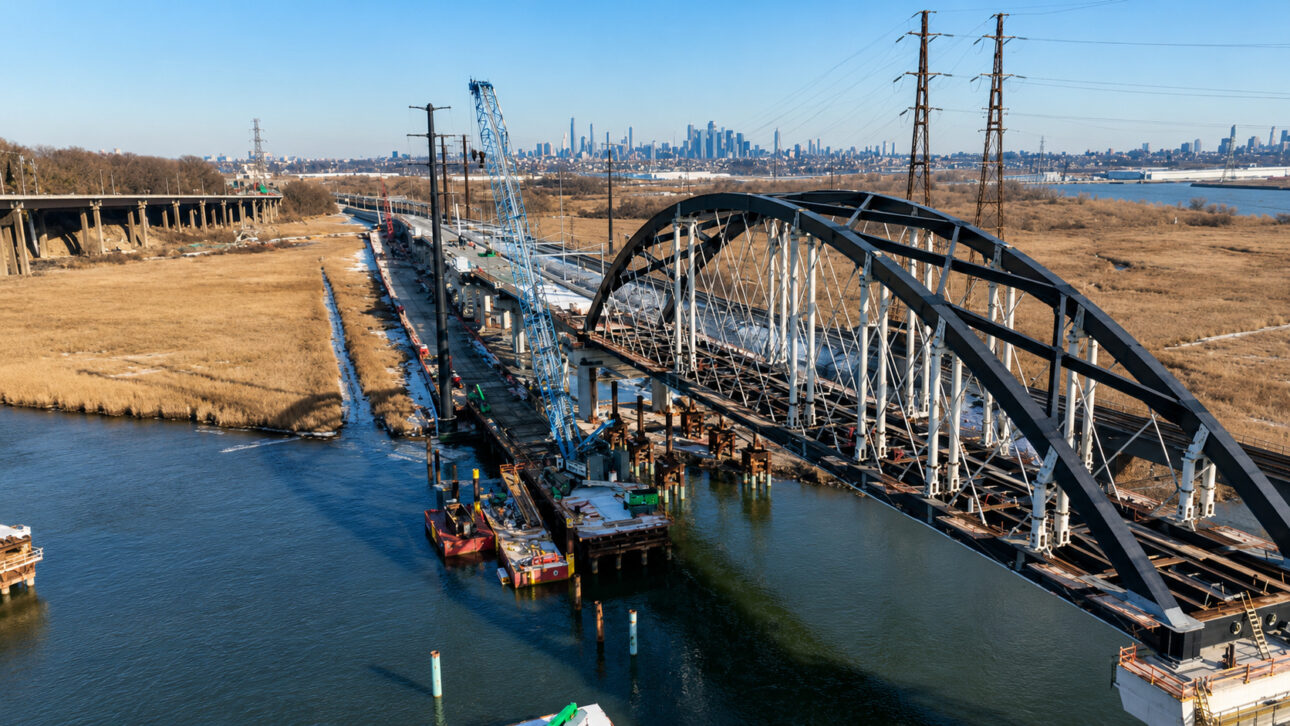
The Amtrak, the national railway operator of the United States, regards the Portal North Bridge as an essential project for the Northeast Corridor. This point helps to understand why the replacement of the old bridge has gained such relevance in the country.
In practice, the new structure represents more than just a new bridge. It is part of an effort to modernize a railway section that has long been plagued by the limitations of an old and overloaded infrastructure.
Why this project draws so much attention even outside the United States
Few infrastructure images manage to gather so many impactful elements at the same time. There is a giant bridge, a barge transport, a century-old structure being retired, and an intervention on one of the country’s most important railway routes.
This combination gives strength to the topic because it mixes heavy engineering with an easy-to-understand image. Even those who do not follow construction projects quickly perceive the size of the challenge when they see a metal arch of 2,300 tons being carried by a river to reach its final location.
There is also a practical point behind the impressive visual. When an old bridge stalls railway operations, the problem affects thousands of people. When a new bridge comes into play to eliminate this bottleneck, the infrastructure ceases to be something distant and starts to have a real effect on daily life.
The Portal North Bridge has become a symbol of this type of transformation. The project shows how planning, off-site assembly, and river transport can be used to solve a historical problem without losing sight of the scale of the intervention.
The replacement of the century-old bridge in New Jersey sums up this scenario well: a huge structure, carried by the Hudson River, to remove one of the most well-known bottlenecks in American railways and pave the way for more reliable operations.
In Brazil, which old bridge or railway most needs modernization of this scale to eliminate bottlenecks and improve transportation? Leave your opinion in the comments and share the post.


