Portuguese
  Spanish


China’s plan to build a city on the Moon already has defined phases. Robots will transform lunar soil into bricks and print 3D habitats in the shape of an egg shell, with nuclear energy to power everything. The goal is to have astronauts living there in the 2030s.
It may seem like science fiction, but it’s turning into an engineering project: China wants to build a city on the Moon. The plan involves using autonomous robots to transform the lunar soil into bricks and erect 3D printed habitats in the shape of an egg shell, capable of protecting future inhabitants from the hostile space environment.
According to presentations by Chinese authorities and plans from the International Lunar Research Station, the city on the Moon would be located at the south pole and initially built only by machines, with nuclear energy on the horizon. The ambitious goal is to have Chinese astronauts living on the surface by the end of the next decade, in an effort that places China in the race for occupying our satellite.
Why building a city on the Moon is so difficult
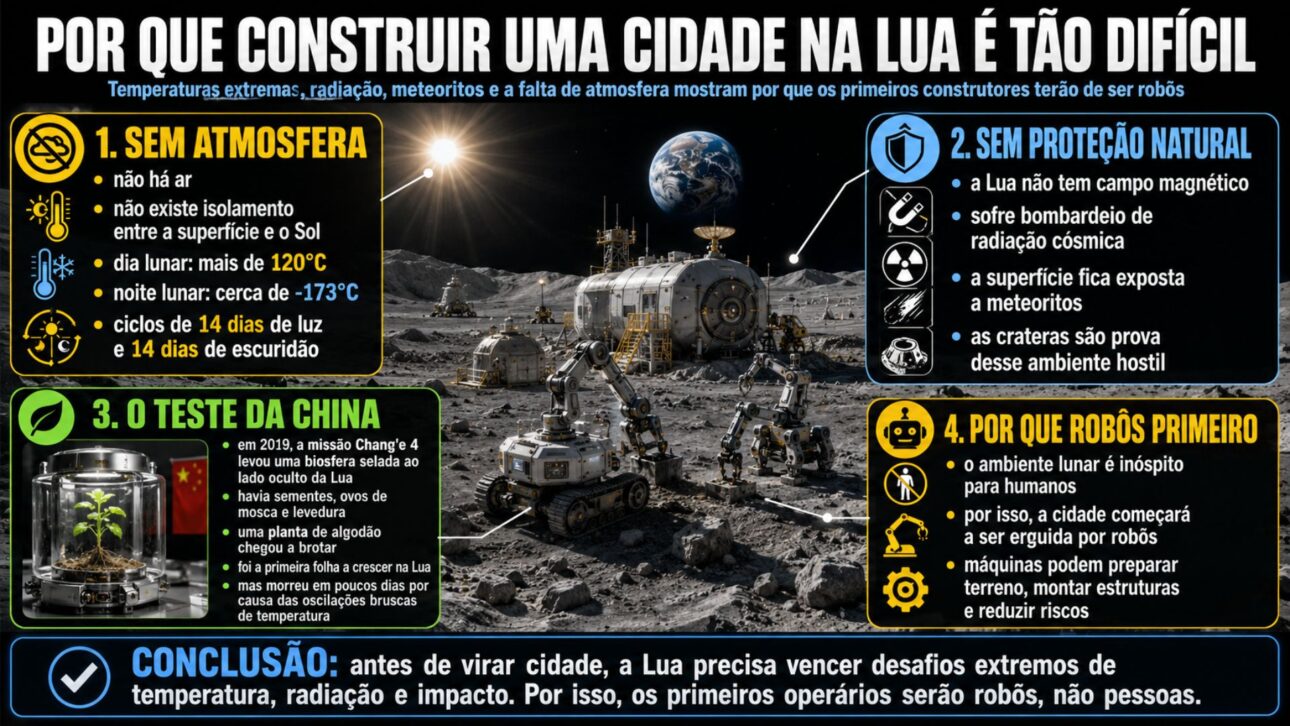
Before the bricks, come the obstacles. The Moon has no atmosphere, which means no air and no insulation between the surface and the Sun.
-
Brazilian Fishing Couple Spends 4 Years Building Solar-Powered Floating Home on the Paraguay River, Now a Navy-Approved Vessel with Leisure Area and Tour Demand

-
While the World Opens New Airports and High-Speed Trains, Brazil Rushes to Complete Projects Stalled for 40 Years
-
Brazil Invests in Massive Waterway to Transport Soybeans by Barge, Reducing Costly Truck Reliance
-
Bridge Rebuilt in Just One Year Reconnects Two Brazilian States


The result is extreme temperatures, rising above 120°C during the day and dropping to about -173°C at night, in cycles of 14 days of light followed by 14 days of darkness.
Without a magnetic field, the Moon is also bombarded by cosmic radiation, and the lack of atmosphere leaves the surface exposed to meteorites, the same ones that create the craters visible from Earth.
China itself has already had a taste of this difficulty. In 2019, the Chang’e 4 mission took a small sealed biosphere with seeds, fly eggs, and yeast to the far side of the Moon.
A cotton plant managed to sprout, the first leaf to grow on the Moon, but the abrupt temperature fluctuations killed the experiment in a few days.
It was proof of how inhospitable the environment is and the reason why the city on the Moon will begin to be built by robots, not by people.
Robots transforming lunar soil into bricks
The big bet for construction is to use what already exists there, a technique called in-situ resource utilization. The Chang’e 8 mission, scheduled for 2028, will test precisely the transformation of lunar soil into bricks.
According to the plan, an autonomous robot collects the lunar soil, compacts the material into molds, and takes it to a furnace, where it is baked at high temperature until it becomes pieces in shapes like rectangles, cubes, and arches.
Then, another robot stacks the bricks and applies mortar to the joints, raising low structures. The same blocks can also form roads and landing platforms, offering protection against radiation, meteorite impacts, and temperature variations.
There is, however, a limitation: the rectangular shape does not hold internal pressure well. Since the Moon has no atmosphere, it is necessary to create a pressurized environment inside the habitat, which requires something more rounded inside the brick construction.
3D printed habitats in the shape of an eggshell
This is where the more futuristic idea of the project comes in: a 3D printed habitat, nicknamed the lunar vase. Instead of laying bricks, autonomous machines first pour a slab of concrete-like material, made from lunar soil, which serves as a base and helps absorb the vibration of moonquakes.
Then, the printer melts the soil, mixes it with an adhesive brought from Earth, and deposits the material in circular layers.
The design mimics the natural strength of an eggshell and uses three layers: an outer, an inner, and a structure of triangular ribs in the middle, providing firmness.
With this, it is possible to pressurize the environment without needing extra coating, maintaining protection against lunar hazards.
3D printing also makes it easier to erect taller structures, something that makes sense on the Moon, where low gravity aids locomotion and there is no wind or weather to interfere.
Nuclear energy, lava tubes, and the race with the United States


None of this works without energy, and this is where China targets the atom. In 2025, the Chinese space agency and the Russian Roscosmos announced a partnership to install a nuclear power plant on the Moon by 2035, intended to supply the base.
The choice makes sense: the Russian state company Rosatom is one of the world leaders in reactors, and the Moon even facilitates the use of nuclear power, since the reactor can be cooled in the shadow of a crater and radioactive waste is less problematic in an environment already saturated with radiation. Still, there are also plans to use solar energy.
China’s gaze goes beyond the surface. The country is studying lava tubes, underground tunnels formed by ancient volcanism, which offer natural protection against meteors, radiation, and heat, and the Chang’e 7 mission, in 2026, is expected to map this underground in the south pole.
The construction of the base is planned for the 2030s, with five major landings between 2031 and 2035, each installing a part of the structure, from the command center to lunar astronomy.
It is worth remembering that this is an ambitious plan still in testing, and that China is not alone: the United States is running the Artemis program, which turns the city on the Moon into another chapter of the new space race.
A city on the Moon made of lunar dust bricks and egg-shaped habitats, powered by nuclear energy, is the kind of plan that divides those who believe and those who doubt.
Tell us in the comments if you think China will really have astronauts living on the Moon by the end of the next decade.