






 Portuguese
  Spanish


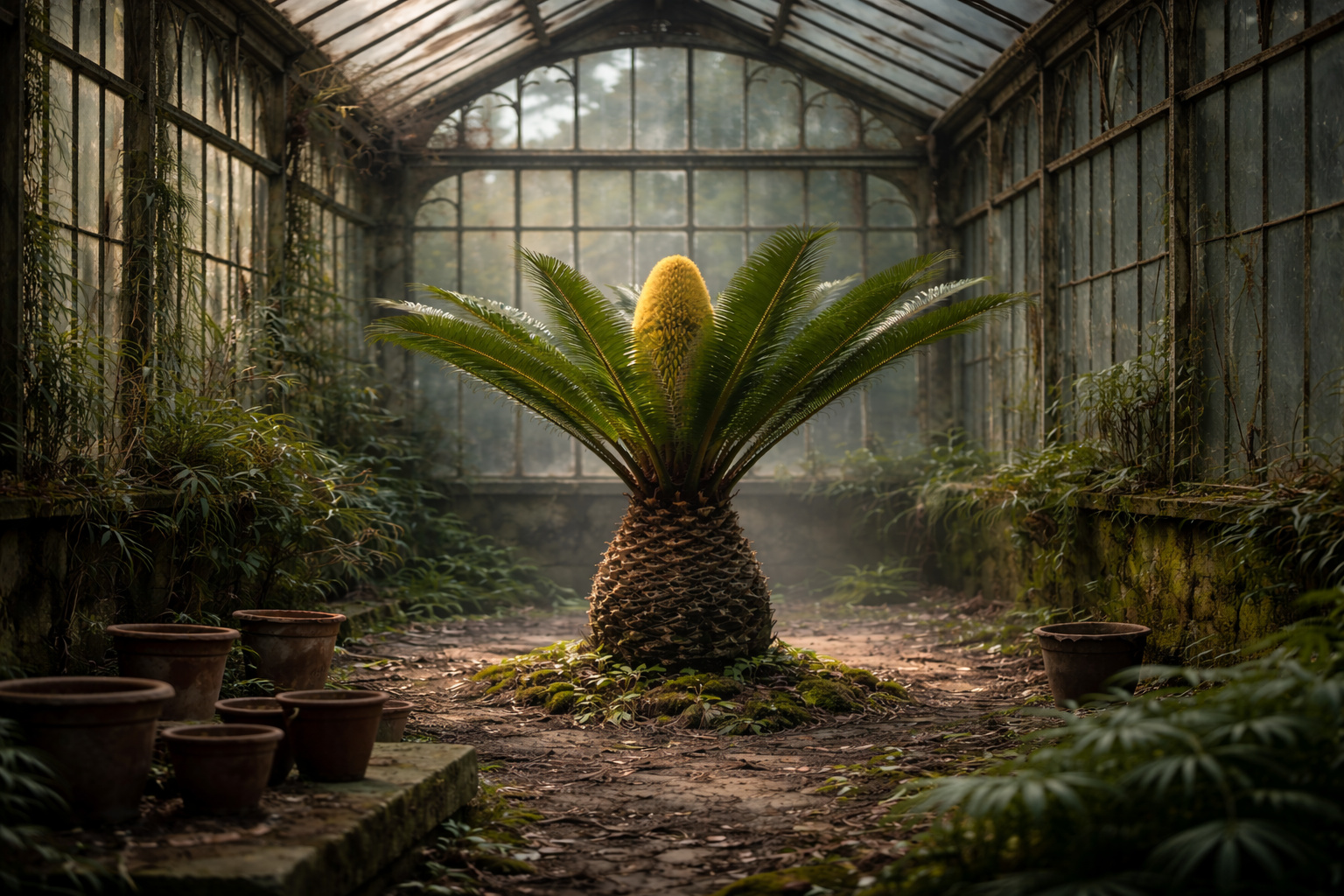


Prehistoric Species Kept in Greenhouse in the United Kingdom Continues Without Chance of Natural Reproduction and Raises Alerts About Functional Extinction
A rare and silent botanical story draws the attention of the international scientific community. Encephalartos woodii, considered the most solitary plant in the world, has lived isolated for over 100 years, with no known possibility for natural reproduction. Currently, the only true specimen of the species is preserved in a greenhouse in the United Kingdom, under constant monitoring by researchers.
It is a cycad, an extremely ancient group of plants. More than 200 million years ago, these plants dominated the Earth’s landscape, coexisting with dinosaurs during the Jurassic period. In that context, the cycads represented about 20% of the planet’s vegetation, providing shelter and food for various prehistoric species.
However, with the advancement of geological eras, that scenario changed drastically. After going through at least five major ice ages, millions and thousands of years ago, cycads went into decline. As a result of this prolonged process, Encephalartos woodii has almost completely disappeared from nature, with only one known individual remaining.
-
Nigeria Dumps 120 Million Tons of Sand into Atlantic to Build Massive City with 8.4 km Sea Wall for Protection Against Ocean Waves and Erosion

-
German Engineer Developed Diesel Engine Running on Vegetable Oil Decades Before Electric Cars Became Popular; Can This Forgotten Idea Work in 2026?

-
James Webb Telescope Uncovers Unexpected Clues on Mysterious Moon, Potentially Redefining Planetary Origins

-
$1.5 Billion Sleipnir Vessel Transforms Ocean into Floating Construction Site with 12 Hybrid Engines and Capacity to Lift 20,000 Tons



Historic Discovery Marks the Beginning of Isolation
The only specimen of the species was identified in 1895, in southeastern Africa, more precisely on a slope of the former Zulu Kingdom. The discoverer was the botanist John Medley Wood, who was impressed by the palm-like shape and unusual characteristics of the plant.
At that time, Wood collected stems from the specimen and sent them to England, where they were replanted for scientific purposes. Since then, the plant has been cultivated and studied at the Royal Botanic Gardens, becoming an emblematic case in modern botany.
As decades passed, researchers deepened their analyses and identified the main obstacle to the species’ survival. Encephalartos woodii is a dioecious plant, meaning it requires individuals of opposite sexes to reproduce. However, all known specimens are male.
Impossible Reproduction Keeps Species in Critical Condition
Even under controlled conditions, the male specimen displays clear reproductive behaviors. At certain times of the year, it opens a cone full of pollen and emits heat, a natural mechanism to attract pollinators. Still, without the presence of a compatible female plant, fertilization never occurs.
According to botanical records from the Royal Botanic Gardens, Kew, this behavior has been observed for decades, reinforcing the functional extinction status of the species. Although it is alive, the plant cannot produce natural descendants, compromising its evolutionary continuity.
Cloning Preserves the Plant, but Does Not Save the Species
Technically, Encephalartos woodii does not exist in just one location. Throughout the 20th century, scientists performed vegetative cloning from the original specimen, distributing genetic copies to greenhouses in different countries. In this way, there are several individuals of the species spread across the world.
However, there is a crucial limitation. All these specimens are identical clones, lacking genetic diversity. Therefore, although they can cross with closely related species, they do not produce original descendants of Encephalartos woodii.
Meanwhile, scientific expeditions continue trying to locate a female plant in African forests, especially in South Africa. To date, however, no concrete evidence has been found. Thus, the last true specimen of the species continues to live in solitude, preserved in a greenhouse, as a rare living testimony of a prehistoric past.


Então. Essa planta só foi encontrada uma, porém essa na estufa não é a única do mundo. Diferentes partes da planta original foram distribuídas. Essa semana mesmo eu fotografei outro pedaço dela no Jardim botânico de Kirstenbosch, na África do sul, pais de origem dela. O repelente aqui é que só foi achada 1 na natureza, e não está mais lá. Mas existem diferentes pedaços em diferentes coleções e países.
En // Cephalo // artos , is a beautiful name. For a beautiful peace of fauna. I Miss the days, of megafauna, when the earth was younger, and more fair. The world has forgotten the Lorax, that speak for the trees. But anyone looking for a mate for a tree, need only ask its forrest friends, where to find …. others like it. Or Jack Dorsey, he was on a big tree planting kick a few years ago, Mais non?
I don’t think AI will ever be able to replicate the MAGIC of the natural order of the world, since everyone knows: King Phillip Came Over For Good Spaghetti! This is an **** kingdom, y’all. If you want to get a tree a girlfriend, might I recommend checking in with Daubentonia madagascariensis? Provided there are plenty of them left, to ask (I would hope!)
Dolly the sheep is a poor imitation, of real lambing.
There is only ONE of a kind chances, in the Wild. You cannot subvert, or control Mother Nature. You can’t cheat Gaia, or Rhea, or Me.
You cannot tame, what you cannot catch.
xoxox
Eu acho que no comdominio que eu moro,tem a femea dessa planta,como faço pra emviar uma foto?
Do you live in New Jersey, by chance?