Portuguese
  Spanish


In China, the 3,600-ton Zoomlion ZCC89000 crawler crane set 2 world records by installing in just 6 days the largest single-piece forged and welded hydrogenation reactor in the world, weighing 3,037 tons and measuring 67.57 meters, at a petrochemical plant of Zhejiang Petroleum & Chemical.
A machine the size of a building has just pushed the limits of heavy engineering. In China, the crawler crane ZCC89000, by Zoomlion, set 2 world records by lifting colossal pieces in a petrochemical complex, according to the manufacturer Zoomlion. It was a feat that combined brute strength and millimetric precision. According to the release distributed by Newswire, the 3,600-ton crane installed the largest single-piece forged and welded hydrogenation reactor in the world, weighing 3,037 tons and measuring 67.57 meters in height, between January 3 and 8. The 2 records were for the heaviest single lift and the fastest lifting speed.
The numbers are impressive from all angles. In total, there were three reactors totaling almost 10,000 tons, installed in just 6 days in China. The crane’s load moment reached 92,800 ton-meters, supported by 3,160 tons of counterweight, a set capable of moving the equivalent of thousands of cars at once. Next, see how the ZCC89000 crane broke the 2 world records, what a hydrogenation reactor is, why 3,037 tons in a single piece is so impressive, and what this feat in China has to do with Brazil.
The ZCC89000 crane and the 2 world records
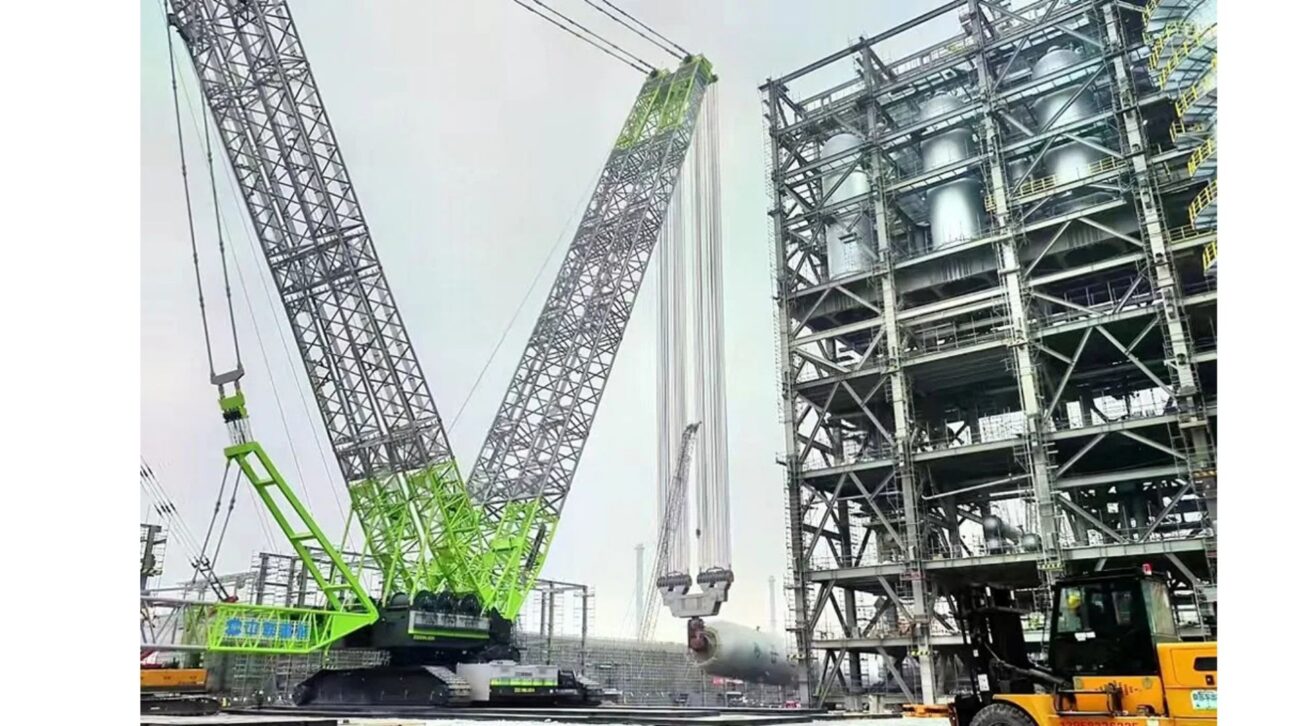
image:Zoomlion
The protagonist of this story is a superlative machine. The ZCC89000 is a crawler crane with a capacity of 3,600 tons, one of the largest on the planet, made for the heaviest industrial tasks. It is not a common construction equipment, but a tool for megaprojects.
-
$80 Million Bridge in Brazil Cuts Travel Time from 30 Minutes to 1 Minute, but Audit Reveals Major Flaws

-
Man Builds Stone Bed with Granite Rocks and Hand-Sawn Cedar Beams, Home Extension Garners Over 437,000 Views on Bonus Bolts Channel

-
Brazilian Researcher Develops Color-Changing Roof Tile to Reduce Air Conditioning Use by Up to 15%
-
21-Year-Old Moves Back to Parents’ Home in Arizona, Finds New Private Apartment in Converted Garage as Families Tackle U.S. Housing Pressures




The two records broken say it all about its power. One was for the heaviest weight lifted in a single hoist, and the other for the fastest hoisting speed for a load of this size. Together, they show that the crane is not only strong but also agile.
Behind this strength lies an impressive balancing system. To lift 3,037 tons without tipping over, the crane relied on 3,160 tons of counterweight, which acts as a weight on the opposite end of the scale. It is this arrangement that allows for stability during the maneuver.
The number that summarizes the capacity is the load moment. The crane ZCC89000 reached 92,800 ton-meters, a measure that combines the weight lifted with the arm’s distance. The higher this value, the farther and heavier the equipment can safely lift.
To give dimension, a crawler crane like this is assembled piece by piece at the construction site and occupies the area of several football fields when fully assembled. It is not the type of machine seen daily, but equipment reserved for exceptionally large projects.
What is a hydrogenation reactor and what is it used for
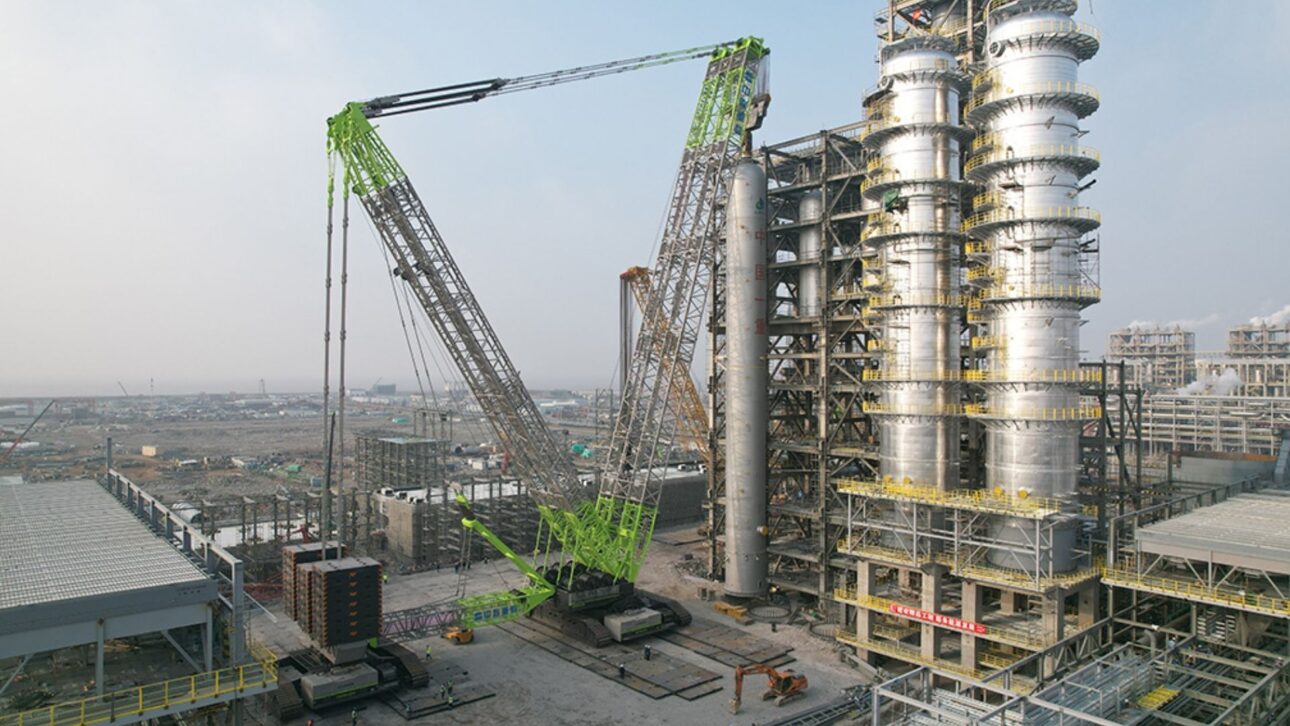
image:Zoomlion
To understand the feat, it’s necessary to know what was installed. A hydrogenation reactor is a huge pressure vessel used in refineries and petrochemical complexes, where chemical reactions transform heavy fractions of oil into lighter and more valuable products.
The name comes from the process that occurs inside. In hydrogenation, hydrogen is combined with oil under high temperature and pressure, with the help of catalysts. This removes impurities, like sulfur, and breaks down large molecules, producing cleaner and more refined fuels.
The installed model is even more specific. It is a slurry bed hydrogenation reactor designed to process the heaviest and most difficult part of refining, the residue that remains after extracting the lighter fractions from the barrel.
That is why the piece is so large. To withstand extreme pressures and temperatures for years, a hydrogenation reactor of this type needs thick walls and a robust structure, which explains the thousands of tons of steel concentrated in a single piece of equipment.
These reactors are the heart of a modern refinery. Without hydrogenation, much of the heavier oil would yield only low-value products, such as heavy fuel oil. With the hydrogenation reactor, this same residue turns into diesel, gasoline, and cleaner, more expensive petrochemical inputs.
Why 3,037 tons in a single piece are so impressive
The most technical detail of the record is in the words single piece. The hydrogenation reactor installed in China is the largest in the world among those manufactured as a single forged and welded piece, and not assembled in parts at the construction site. This changes everything in engineering.
Manufacturing such an entire piece of equipment is a huge challenge. It involves 3,037 tons of steel worked into a single structure 67.57 meters high, equivalent to a building of over 20 floors laid down, which needs to be transported and erected without failures.
The advantage of the single piece appears in operation. A hydrogenation reactor without field-made joints tends to be safer and more reliable, as it reduces weak points and less controlled welds. In exchange, transportation and installation become much more complex.
This is where the feat of the crane comes in. Lifting a 3,037-ton block at once and fitting it into the exact position, dozens of meters high, requires meticulous planning. Any error with such a load would have serious consequences, making the record even more remarkable.
The very manufacturing of such a block takes months. The steel needs to be forged, molded, and welded under controlled conditions, with rigorous inspections to ensure that the hydrogenation reactor withstands pressure and heat throughout its useful life. Only after this does the piece proceed to the construction site.
Installation in 6 days: three reactors and almost 10 thousand tons
The weight record was just part of the work. In the same operation, the crane ZCC89000 installed three reactors that, together, reached almost 10 thousand tons, all lifted in sequence within the petrochemical complex in China.
The pace is what is most surprising. This entire set was positioned in just 6 days, between January 3 and 8, a very short time frame for loads of this magnitude. Similar operations usually take weeks, if not months, to be safely completed.
This speed had a direct impact on the project’s schedule. By installing the reactors so quickly, the project gained momentum and advanced the timeline by about two months, representing a saving of time and money for a billion-dollar enterprise.
Behind agility is the combination of machine and method. A crane as powerful as the ZCC89000, combined with detailed planning of each lift, turned what would be a weeks-long marathon into a lightning operation of less than a week.
Such operations are timed to the extreme. Each lift has a scheduled time, a defined sequence, and teams positioned, because stopping halfway with a load of thousands of tons suspended is not an option. China has turned this type of maneuver into an almost industrial gear.
How does the crane lift 3,037 tons at once?
The answer begins with the physics of balance. To lift 3,037 tons, the crane needs a counterweight to match, and 3,160 tons were used precisely to prevent the machine from toppling when lifting the load. It’s a game of forces calculated to the millimeter.
The arm and the load moment complete the equation. With 92,800 ton-meters of maximum moment, the ZCC89000 can distribute the effort of lifting a massive weight at a good distance, without compromising the stability of the structure on the tracks.
The base of the crane is also crucial. By resting on wide tracks instead of tires, the machine spreads its own weight and that of the load over a larger area, reducing pressure on the ground and gaining firmness during the maneuver.
None of this works without preparation. Before lifting a hydrogenation reactor weighing thousands of tons, the team studies the terrain, assembles the crane with its counterweights, and simulates each movement, so that the actual lift is merely the execution of an exhaustively tested plan.
It is worth remembering that the crane itself needs to arrive at the site in parts. A 3,600-ton machine is transported disassembled, in dozens of trailers, and reassembled on-site, in a process that also takes days. Lifting the load is the climax of a long preparation.
The Zhejiang Petroleum & Chemical Project
The destination of these reactors is one of the major petrochemical hubs in China. The operation is part of a project by Zhejiang Petroleum & Chemical, one of the largest companies in the sector in the country, within the third phase of an ambitious new materials plan.
The role of the reactors is central in this complex. It is in them that the heavy residue of oil will be transformed into higher-value products, in a hydrogenation process that increases the utilization of each barrel and reduces the waste of raw material.
The scale of the enterprise helps to understand the investment. Petrochemical complexes like this involve billions of reais and are designed to operate for decades, which justifies the effort to install such large and expensive equipment with the utmost care.
Gaining two months in the schedule, in this context, is a huge advantage. The sooner the plant starts operating, the sooner it begins generating revenue, and that’s why the speed of the crane ZCC89000 has value that goes far beyond the technical record.
China has become a reference in this type of mega project. The country hosts some of the largest refining and petrochemical complexes in the world and seeks to produce fuels and materials domestically that it previously imported. Projects like Zhejiang Petroleum & Chemical are part of this self-sufficiency strategy.
Zoomlion and the race of the giant cranes
The achievement also reinforces Zoomlion’s position in the market. A Chinese manufacturer of heavy machinery, the company competes with global giants for leadership in the production of high-capacity cranes, used in refineries, plants, wind farms, and platforms.
The ZCC89000 is the showcase of this ambition. By delivering a crane capable of breaking 2 world records at once, Zoomlion shows that it can compete in the most demanding projects, those where few pieces of equipment in the world can handle the job.
This category of machine has become a key piece of modern industry. Without cranes of this size, it would be almost impossible to install increasingly larger reactors, towers, and modules, which engineering prefers to assemble entirely in the factory to gain quality and safety.
The trend is for these machines to become even larger. As refineries and petrochemical complexes grow, so does the demand for cranes capable of lifting colossal loads, and records like that of the ZCC89000 are likely to be surpassed in the coming years.
Each new model pushes the bar a little higher. Zoomlion and its competitors compete for contracts where lifting a few meters higher or a few more tons defines who wins the project. It’s a silent but decisive technological race for the energy industry.
What this has to do with Brazil
Even from afar, China’s achievement directly relates to Brazil. The country has a significant refining park and has been investing in the modernization of refineries, projects that depend on equipment like hydrogenation reactors and large cranes to be installed.
Hydrogenation is precisely what ensures cleaner fuel. Hydrotreating units are responsible for reducing sulfur in diesel and gasoline in Brazil, following the same chemical logic as the giant hydrogenation reactor installed in China.
The logistical challenge is also familiar here. Large energy projects in Brazil, from refineries to wind farms and platforms, have already required the arrival of high-capacity cranes, including models from Zoomlion itself, to lift heavy structures.
Finally, there is a lesson about competitiveness. Seeing China shorten deadlines with a record-breaking crane shows the value of investing in technology and planning, something Brazil can leverage to make its own energy projects faster and more efficient.
The timing is opportune for the country. With the resumption of works in refineries and the expansion of pre-salt production, Brazil is likely to increasingly demand heavy equipment and high-capacity cranes. Keeping up with advances like those in China helps plan for this future.
Mastering this engineering also has strategic value. Relying less on importing equipment and fuels provides more security for the country, and each refinery modernized with an efficient hydrogenation reactor brings Brazil closer to this goal.
And you, did you imagine a crane lifting 3,037 tons at once?
The operation in China shows how far heavy engineering has come. With the crane ZCC89000, Zoomlion broke 2 world records, lifted a 3,037-ton hydrogenation reactor in a single piece, and installed three reactors of almost 10,000 tons in just 6 days.
More than a display of strength, the achievement has a clear purpose. Each record served to accelerate the construction of a petrochemical complex by two months, proving that powerful machinery and good planning translate into shorter deadlines and cheaper projects, in a sector where each day of delay can cost millions.
And you, did you imagine that a single crane could lift 3,037 tons at once, the weight of an entire hydrogenation reactor, over 67 meters high? Do you think Brazil should invest more in machines and technology of this scale? Share your opinion in the comments and share with those who enjoy heavy engineering.