Portuguese
  Spanish


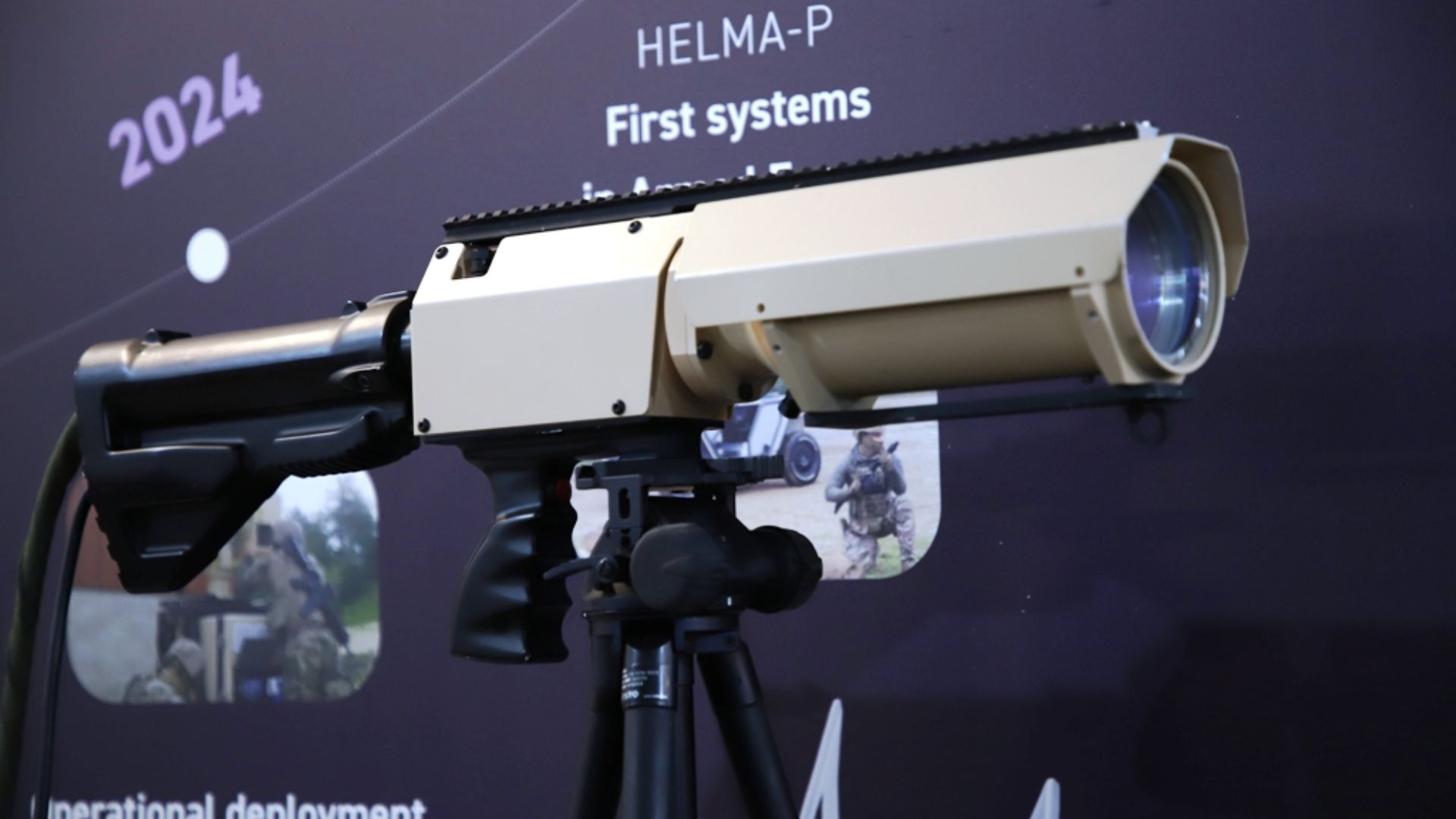


Portable System Based on Real Military Technology Unveiled at SOFINS 2025 and Derives from HELMA-P, Laser Used to Protect French Airspace During Major International Events, Including the Olympics
After years of development and operational testing, France officially presented a portable laser rifle capable of neutralizing electronic equipment and incapacitating drones at considerable distances. The system, named HELMA-LP, was revealed during the international fair SOFINS 2025 and immediately drew attention for its futuristic design, reminiscent of energy weapons seen in science fiction productions like Star Wars.
However, despite its cinematic appearance, it is a real, functional weapon already based on technology employed in high-level security operations. The HELMA-LP is a portable version of the HELMA-P system, developed by the French company CILAS, which was used in 2024 to protect Paris airspace against drone threats during major events, including the Olympic Games.
The information was initially disclosed by the portal European Defense Review and reinforced by technical analyses published by Defense Express, which detailed the operation and effects of the laser on real targets tested in a controlled environment.
-
The large jar blender has a rival: Oster Ultra Power bets on 1,000 W, six stainless steel blades, and two portable cups with leak-proof lids.

-
Tesla injected an additional $250 million into the German factory, doubled the battery cell target, and opened its own production line for startups.

-
No more TV stuck on the wall: Samsung The Freestyle+, the new projector with over 400 lumens projects on walls, floors, and ceilings, bringing cinema to any corner of the house.
-
A Japanese governor single-handedly stalled the construction of the world’s fastest train for nine years, and only now has he agreed to allow a tunnel excavated at a depth of 1,400 meters.



Real Operation and Effects of the Laser on Drones and Sensors

Unlike conventional weapons, the HELMA-LP does not rely on physical ammunition. Its operating principle is the emission of a concentrated laser beam, designed to cause direct damage to optical sensors, electronic equipment, and sensitive surfaces. The system was primarily designed to engage static targets, such as tarps, surveillance equipment, optronic sensors, and cameras.
Although the manufacturer does not explicitly state that the HELMA-LP is capable of downing moving drones, experts point out that even brief exposures are sufficient to neutralize these aircraft. In documented tests, the laser was able to completely blind the camera of a DJI Mavic drone, as well as deform or melt the protective glass of the sensor, usually made of plastic.
This same effect had previously been observed in demonstrations of the Gökberk system, developed by the Turkish company Aselsan, where low-cost commercial drones became inoperable after only a few seconds of exposure to the laser beam, even without complete physical destruction of the aircraft.
Range, Power, and Technical Features of the HELMA-LP
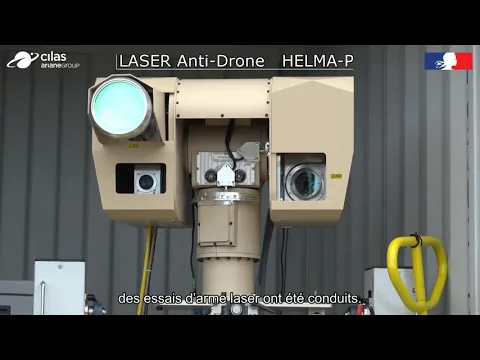

The HELMA-LP has effective engagement capability between 300 and 500 meters, with a typical action time ranging from 5 to 15 seconds per target. Although the exact power of the portable laser has not been disclosed, it is significantly lower than that of the stationary HELMA-P version, which is expected due to the energy limitations of a transportable system.
For comparison, the larger HELMA-P can destroy targets at distances of up to 1,000 meters and cause optical lens fogging — sufficient to blind drones — at ranges of up to 3,000 meters, operating with a declared power of approximately 2 kW, which is considered relatively modest within the category of directed energy weapons.
The beam of the HELMA-LP has a diameter of about 20 millimeters at a distance of 500 meters, and the maximum continuous operation time of the laser is 60 seconds, which imposes clear tactical limits, yet remains compatible with precision neutralization missions.
Portable Design and Adaptation to Modern Combat
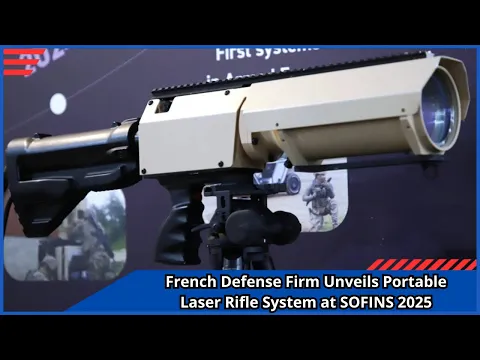
The portable set of the HELMA-LP consists of the weapon itself, two connection cables, and a backpack containing the batteries, totaling approximately 15 kilograms. Curiously, the design of the rifle is based on the AR-15 platform, allowing the use of standard rails and mounts for optical sights and accessories, facilitating adaptation by military operators or security forces.
When used in a prone position, the operator can rest the battery backpack on the ground, which contributes to greater stability and accuracy during the laser beam firing. This configuration indicates that the system was designed not just as a technological prototype, but as a real tool for operations protecting critical infrastructure, mass events, and sensitive urban scenarios.
The emergence of the HELMA-LP reinforces a clear trend: directed energy weapons are moving out of the experimental field and gradually becoming integrated into modern arsenals, especially in drone defense missions, where cost-effectiveness and precision are decisive factors.