






 Portuguese
  Spanish
  5 min of reading
  0 comments


Combining Cutting-Edge Technology And Clean Energy, Saudi Arabia Installs Laser Beacons In Remote Desert Areas To Guide Travelers To Water Sources, In One Of The Boldest Environmental Innovations In The Middle East
Saudi Arabia has initiated a bold and innovative project by installing solar-powered laser beacons in the desert, aimed at guiding lost travelers to water sources. The concept, initially implemented at 11 points in the Nafud desert, has already shown practical and promising results. The initiative will be expanded to 100 beacons, combining high technology with sustainability and safety.
Based on real data and testimonies, the action is already being regarded as a milestone in desert innovation in Saudi Arabia, capable of saving lives and serving as a model for other arid regions in the world.
The Constant Risk Of Getting Lost In The Saudi Desert
The Nafud desert is a vast region of dunes and extreme heat, with temperatures exceeding 45°C in the summer and homogeneous landscapes that easily disorient drivers, hikers, or nomadic herders.
-
Helicopter Drops 180 Tons of Sand and Gravel on Swedish River to Revive Ecosystem Damaged by Decades of Exploitation

-
Brazilian Company Launches Retro Smartphone with 48 MP Camera, T9 Keyboard, and Privacy Features for Social Media-Free Use

-
Self-Taught Chinese Farmer Builds 5-Ton Submarine from Scrap, Launches It in Anhui River
-
Invisible Induction Technology Enables Wireless Power for Blenders, Coffee Makers, and Air Fryers, Reducing Countertop Cables




According to the volunteer group Enjad, in just one year, 142 people were reported missing in this region. Of those, 100 were rescued alive, 14 were never found, and 28 died, mostly due to dehydration.
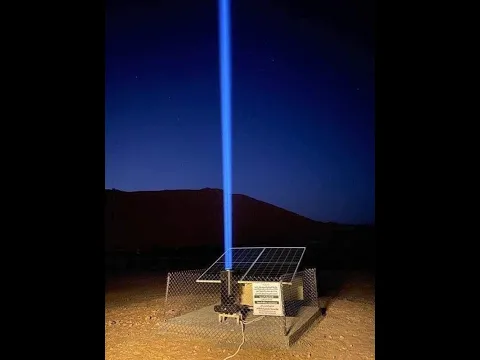

Cases like that of Dhuwaihi Hamoud Al-Ajaleen, who died of thirst just two kilometers from a water well, reinforced the need for an immediate response. The public outcry caused by his death was one of the triggers for the lighthouse project to come to fruition.
How Laser Beacons Work In The Desert
The beacons, positioned near underground wells, emit high-intensity laser beams visible for miles at night.
Powered by solar panels, they operate autonomously and continuously, serving as visual guides for lost travelers. The light indicates the exact location of a safe water source, even visible during sandstorms or low visibility.
The laser does not replace rescue systems but is a powerful ally in critical situations. The structure also includes long-lasting batteries that keep the system active throughout the night, even on overcast days or with low solar capture.
The Origin Of Technology In The Desert: From Tragedy To Solution
The proposal was created by Saudi explorer Mohammad Fohaid Al-Sohaiman, after observing various cases of disappearances and deaths in the desert. He designed the concept of the beacons and presented it to the Ministry of Environment, Water and Agriculture, which approved the pilot phase.
After the successful installation of the first 11 beacons, a local businessman pledged to fund the expansion to 100 units, spread across the regions of Hail and Jouf. The now consolidated project represents effective cooperation between government, private sector, and civil society.
Innovation In The Desert Of Saudi Arabia: Sustainability As A Pillar
The initiative is a remarkable example of desert technology with a sustainable focus. The beacons exclusively use solar energy, eliminating the need for electrical infrastructure or fossil fuels. Maintenance is carried out by trained local teams, who also periodically check the safety and quality of the water sources.
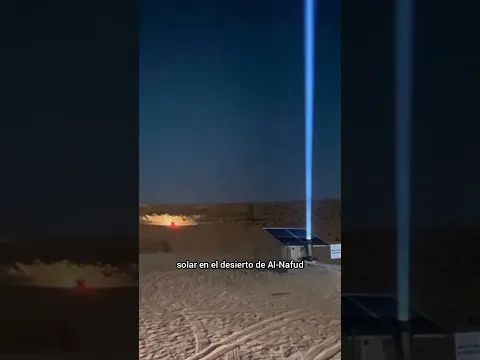
Each tower is installed next to artesian wells with depths between 150 and 1,500 meters. These wells supply communities, small farms, and nomadic groups, significantly increasing the chances of rescue and survival in emergencies.
Differentiators Compared To Other Navigation Technologies
Unlike GPS systems or mobile apps, laser beacons do not rely on connectivity or devices. They provide a constant and reliable visual reference, especially useful in areas lacking network signal.
Their simplicity and autonomy make this innovation in the Saudi desert one of the most effective solutions for remote areas where traditional infrastructure does not reach.
Social And Humanitarian Impact Of Laser Beacons In The Desert
Beyond preventing deaths, the beacons generate a sense of security for residents in isolated areas. Long-distance drivers, adventurous travelers, Bedouins, and local farmers now have a visible point of orientation, which can mean the difference between life and death.
The initiative also strengthens the community sense. Several tribes and residents have begun collaborating with local authorities to keep the beacons operating, protecting the wells and spreading awareness of their existence to travelers passing through the region.
Tourism And International Image Of Saudi Arabia
The implementation of the beacons has been well received internationally, aligning with the Vision 2030 plan, which seeks to transform the image of Saudi Arabia as an innovative, sustainable, and safe country for tourism.
Tourists exploring the desert perceive a real commitment to safety and intelligent infrastructure. This strengthens the country’s positioning as a destination for adventure tourism and ecotourism, as well as attracting investments in survival technology and sustainability in extreme climates.
Lessons For The World And The Future Of Technology In The Desert
The success of the laser beacon implementation raises a global reflection: how can we adapt simple and sustainable solutions to complex realities? In a world increasingly affected by climate change and desertification, projects like this demonstrate that it is possible to balance innovation, the environment, and human care.
Other countries with desert areas, such as Chile, Morocco, and Australia, can benefit from replicating this initiative, adapting it to their local needs. Humanitarian NGOs and climate institutions are already studying how to use the same technology in refugee camps, areas affected by extreme droughts, and conflict zones.
The Legacy Of A Light In The Desert
The installation of laser beacons in the Saudi desert symbolizes more than a technological solution — it represents a commitment to life, innovation, and the environment. In regions where every kilometer can be fatal, guiding a person to water sources in the desert is a gesture of profound social impact.
By uniting high technology with empathy and ecological intelligence, Saudi Arabia shows that there are effective ways to tackle the challenges of extreme climates. With over 100 beacons planned, this project is set to become a global model for how to save lives with ingenuity, light, and solidarity.





-

1 person reacted to this.