






 Portuguese
  Spanish


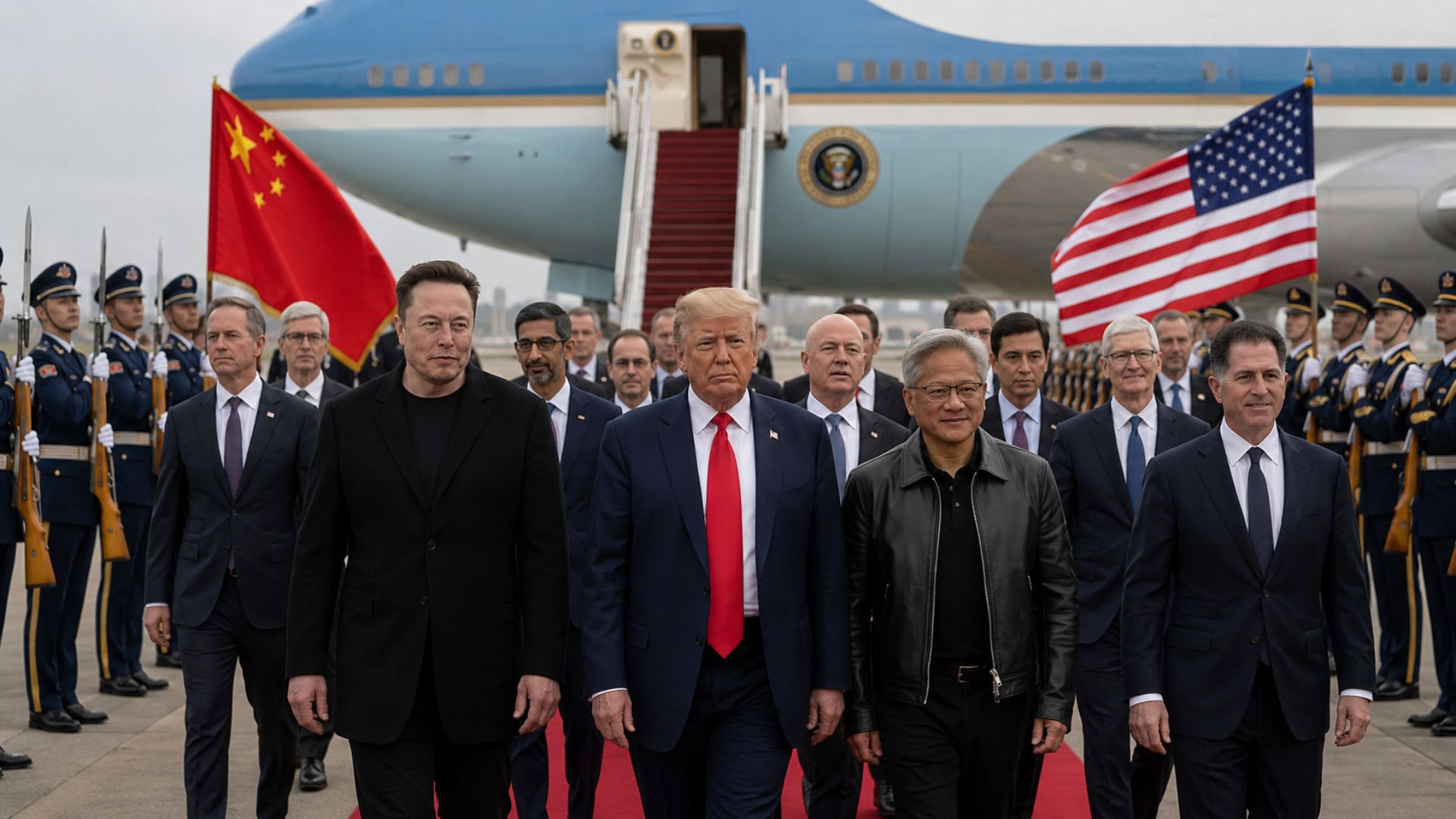

Trump brought an unprecedented delegation to Chinese territory, with Elon Musk and the CEO of Nvidia, Jensen Huang, aboard Air Force One. The meeting with Xi Jinping is expected to address tariffs, chips, Taiwan, artificial intelligence, and Iran, the main buyer of Iranian crude oil and a key player in Middle Eastern tensions.
According to Fox News, the President of the United States, Donald Trump, landed in Beijing on his first visit to China in almost ten years, accompanied by a delegation of executives representing about 12 trillion dollars in American economic power. The entourage includes names like Elon Musk and Jensen Huang, CEO of Nvidia, who traveled directly with the president aboard Air Force One, while other business leaders of the delegation arrived on commercial flights. The declared central goal of the trip is to pressure Chinese President Xi Jinping to open China’s domestic market to American companies.
The motivation for the visit combines commercial and geopolitical interest in a single agenda. Trump hopes to negotiate advances in tariffs, in American exports like beef and soybeans, in access to the Chinese market for technology giants and in sensitive topics like Taiwan, artificial intelligence, and chip production. Besides the economic agenda, the president also signaled the intention to discuss the situation in Iran, a country considered a key player in the Middle East crisis and the largest buyer of Iranian crude oil, a status that places China in a position of influence over the Tehran regime.
Who is in the delegation that landed in Beijing
The presence of Elon Musk and Jensen Huang aboard Air Force One drew immediate attention. They were the only CEOs who traveled directly with President Trump on the presidential plane, while other executives of the delegation had to travel to China on commercial flights.
-
Brazil’s 2026 Tax Refund: Record 9.58 Million Filers in Largest Payout Ever, But a Key Detail on Priority Recipients Draws Nationwide Attention

-
Itaú Alters Hybrid Work Model, Increasing Office Days from 2028, Prompting Employees to Adjust to New Routine
-
Facing Labor Shortage, Japan Plans to Invest $34 Million to Attract Foreign Workers in Construction, Healthcare, Industry, and Commerce

-
Brazilian City Makes Remarkable Leap, Becomes 4th Wealthiest in the Country with GDP of R$ 134.1 Billion



Trump posted on his social media the justification for personally bringing these names. According to the president, the idea was to bring these figures so they could work their “magic” and help unlock business between the United States and China, should the Asian country agree to open its market to American companies.
The complete delegation, according to information released by the Bloomberg program, represents about 12 trillion dollars in combined economic value. This amount places the entourage among the largest business missions ever sent by the United States to a foreign capital, signaling the weight the White House attributes to the negotiation with President Xi Jinping.
What is on the agenda of the conversation between Trump and Xi Jinping


The meeting agenda between the two leaders involves an extensive list of topics in dispute for years between the two powers. The agenda goes far beyond traditional tariff discussions and aims to reorganize the economic and technological relationship between the two countries.
Among the topics confirmed as priorities are:
- Review of trade tariffs
- Artificial intelligence and chip production
- Political and economic status of Taiwan
- American exports such as beef and soybeans
- Access of American companies to the Chinese market
- Geopolitical situation of Iran
Trump himself declared in audio released by the press that trade is the central axis of the conversation.
“We have many things to discuss. I wouldn’t say that Iran is one of them, to be honest with you. We will talk with the President about many different things. I would say that more than anything else it will be trade,” stated the American president.
The sensitive point of Nvidia chips
One of the most debated points by experts is Nvidia’s position in the negotiation. The company led by Jensen Huang produces the world’s most advanced chips for artificial intelligence, and China has shown clear interest in accessing this technology.
The scenario creates a strategic dilemma for the United States. Providing next-generation chips to China means giving up a critical competitive advantage in a strategic sector. On the other hand, completely blocking sales could harm American companies like Nvidia, which lose market to Asian competitors.
An intermediate solution was suggested in the Bloomberg program analysis. The proposal involves providing China with chips that are six months to a year behind the cutting edge, allowing Nvidia to profit from sales without delivering the most advanced technology. The model would maintain the technological advantage of the United States while preserving the trade flow between the two powers.
The Iran factor in the conversation between the two powers
Iran appeared as a sensitive topic on the agenda, despite Trump trying to minimize the importance of the issue upon his arrival in Beijing. China is the largest buyer of Iranian crude oil in the world, which gives the Asian country direct influence over the Tehran regime.
This strategic buyer position makes China a key player in any diplomatic movement involving Iran. For the United States, getting Xi Jinping’s engagement in containing Tehran could unlock negotiations about the Strait of Hormuz, a critical point for the international flow of oil, and reduce tensions in the Middle East.
Experts, however, have shown skepticism about China’s willingness to help on this front. Jerry Willis, an analyst who commented on the trip on the Bloomberg program, recalled the historical precedent of the Asian financial crisis of 1997 and warned that the United States tends to be “relentlessly naive” in expecting China to act against its own economic interests to favor Washington.
The contrast between the two systems that meet
The reception ceremony in Beijing brought striking symbolic contrasts. Children appeared waving flags of communist China and capitalist United States side by side, in a scene that laid bare the ideological differences between the two countries.
Analyst Jackie D’Angelus, from the Bloomberg program, noted the visual contradiction and emphasized that the two systems remain ideologically opposed. For her, Trump tends to achieve small trade victories during the visit, but Xi Jinping will not easily relinquish state control over strategic sectors of the Chinese economy.
Mike Murphy, also present in the analysis, highlighted that Trump has been controlling the message well by publicly defining the objectives of the trip. For Murphy, a more open China would be a greater victory for the United States than for China itself, precisely because it would structurally change the economic equation between the two powers.
Confidence in American innovation power
Despite concerns about possible reverse engineering of American technologies by China, analysts have shown confidence in the United States’ ability to maintain a lead in innovation. The premise is that the “intellectual power” of the delegation accompanying Trump ensures continuous advances in the technology sector.
Taylor Riggs, a Bloomberg analyst, supported this view. For her, the United States will always be one step ahead of China precisely because of the constant innovation capacity of companies like Nvidia, led by Jensen Huang, and other giants represented in the delegation.
The argument fuels the strategy of negotiating partial access to the Chinese market without delivering cutting-edge technology. While Beijing is still copying or trying to replicate what exists today, Washington would already be developing the next generation of products, maintaining the competitive advantage even in a scenario of broader commercial cooperation.
What the trip can change in the coming months
The outcome of the visit is still uncertain and depends on what effectively comes out of the talks between Trump and Xi Jinping. The possibilities range from a massive commercial reset to a total impasse, including specific agreements in areas such as soybeans, beef, and chips.
The most optimistic scenario would involve the partial opening of the Chinese market to the companies of the American delegation, which would yield immediate gains for Musk, Huang, and other executives present on the mission. In exchange, China could obtain some level of access to American technology, even if limited to versions lagging behind the top of the market.
The most pessimistic scenario would be the maintenance of the current impasse, without relevant agreements. In this case, the trip would remain a diplomatic gesture without practical consequences, although the symbolism of the 12 trillion dollar delegation in economic weight has value in itself. The international financial market follows every move closely, aware that decisions made in Beijing in the coming days could reorganize global trade and technology flows.
The presence of a 12 trillion dollar delegation in Beijing, with Elon Musk and Jensen Huang aboard Air Force One, places Trump’s trip among the most carefully prepared diplomatic moves of the last decades. The meeting with Xi Jinping could mark the beginning of a new phase in US-China relations, or just confirm the impasse that has been dragging on for years.
And you, what do you think about this trip? Do you believe Xi Jinping will agree to open the Chinese market to American companies? Do you think the strategy of bringing Musk and the CEO of Nvidia can really unlock negotiations? Leave your comment, share your opinion, and tag someone who closely follows geopolitics.









