






 Portuguese
  Spanish


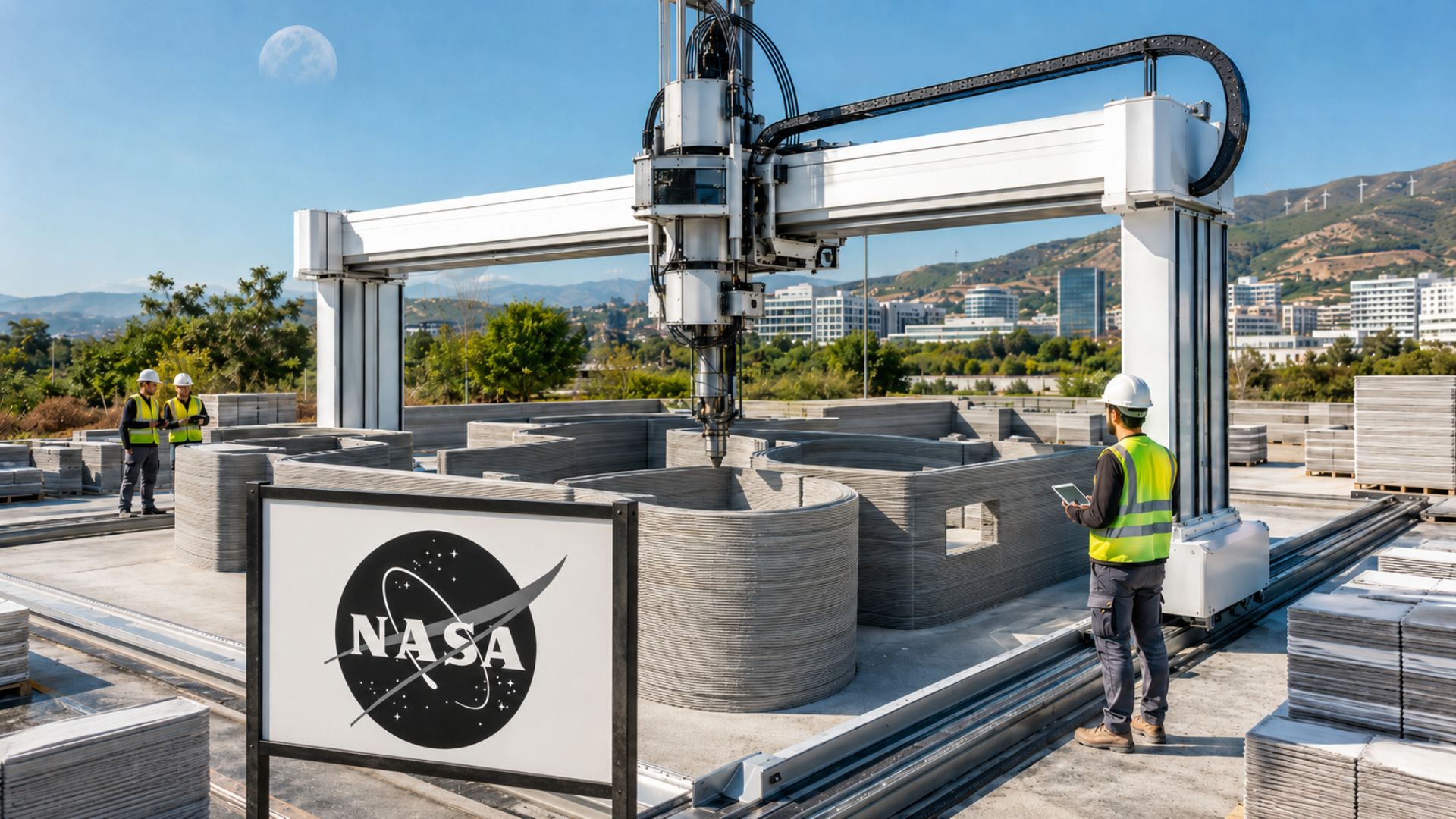


The technique named Freeform 3D Printing was created by the company Branch Technology Inc., from Tennessee, with support from NASA for future missions to the Moon. Instead of stacking heavy layers of concrete, it creates lightweight skeleton-style structures that serve as the base for entire commercial and residential buildings.
The NASA 3D printing, originally developed to erect habitats on lunar missions, is arriving at Earth’s construction sites to change the way commercial and residential buildings are constructed. The technology was named Freeform 3D Printing and is developed by the company Branch Technology Inc., based in the U.S. state of Tennessee, in partnership with the United States space agency for future space missions. The method transfers to the civil construction sector the same principles that would make it feasible to erect structures in a lunar environment, where resources are scarce and the margin of error needs to be zero.
The motivation for the leap from space to Earth combines three practical factors. First, the shortage of skilled labor affecting the construction sector in various countries. Second, the high waste of materials in traditional masonry methods, which weighs on the budget and environmental impact. Third, the need to industrialize construction, transforming projects into fast and standardized assembly processes instead of time-consuming artisanal constructions, with NASA’s 3D printing offering a direct response to these three structural challenges at the same time.
How NASA’s 3D Printing Technology Works

Freeform 3D Printing breaks away from the most common 3D printing method applied to civil construction. Conventional 3D printers used in projects stack heavy layers of concrete on top of each other, recreating solid walls similar to those produced by traditional masonry.
-
China Develops Custom 140-Ton Electric Mining Truck with 770 kWh Swappable Battery, Deploys 290 Units in Xinjiang’s Largest Zinc Mine

-
Meta to Launch Arena, a New Prediction App Targeting 3.56 Billion Users, Competing with Polymarket and Kalshi

-
Scientist Challenges Famous Human Evolution Theory, Argues Homo Sapiens Evolved Gradually Over Thousands of Years
-
15-Year-Old American Builds Ocean Generator with PVC Pipe and 3D-Printed Propeller for $12, Wins National Prize, Presents at White House, and Makes Forbes 30 Under 30 List




The technology supported by NASA follows a radically different path. Instead of solid and heavy layers, the machine creates geometrically complex and lightweight structures that function as the building’s skeleton. The difference is what makes the method compatible with the lunar environment, where transporting additional weight from space to the Moon is practically unfeasible.
The practical result is the possibility of creating geometric shapes that would be impossible or extremely expensive to execute using traditional carpentry or masonry methods. This cutting-edge hardware opens a new frontier for architects and engineers, who now have a tool capable of materializing projects previously restricted to the world of digital drawings.
The three direct benefits for the construction sector

The application of NASA’s 3D printing on construction sites addresses structural problems that the construction sector has faced for decades. The practical gains appear in three clear areas, affecting both the developers’ budgets and the environmental impact of the works.
The most highlighted benefits are:
- Zero waste: the system uses only the exact amount of material needed to ensure structural strength, eliminating leftovers and waste.
- Record speed: the assembly of prefabricated structures drastically reduces execution time on the construction site, following the logic of “assembling” instead of “building.”
- Superior strength: even though it is lightweight, the structure is designed to withstand extreme conditions, a direct legacy of tests conducted for the lunar environment.
The combination of these three factors transforms the construction site into something more akin to an industrial assembly line than traditional artisanal building construction. The model is similar to what already happens in sectors like the automotive industry, where prefabricated components arrive ready and only need to be fitted into the final product.
The legacy of the lunar program in terrestrial structures

NASA’s choice of this 3D printing technology is not accidental. The lunar environment imposes severe limitations that force extremely efficient solutions in material use and structural strength.
On the Moon, any additional kilogram of material needs to be transported from Earth at a very high cost. This means that heavy and wasteful structures are economically unfeasible for future missions. Branch Technology developed Freeform 3D Printing precisely to overcome these restrictions, creating lightweight and strong skeletons that could be erected on lunar soil with a minimal volume of material brought from the planet.
What was a solution for space became a solution for Earth at the same time. The same principles that reduce weight for space missions reduce cost and waste for terrestrial construction. The transfer of technology between the aerospace and civil construction sectors gains a new chapter with this application.
Brazil on the radar of applied space technology
The movement of bringing space technology closer to civil construction comes at a time when Brazil is also making its presence known in the aerospace sector. The São Paulo startup Condor Instruments had its actigraph, a device that measures the human biological clock, used by astronauts on NASA’s Artemis II mission.
The case shows that the integration between Brazilian technology and space innovations is no longer an exception. National companies are starting to supply equipment and solutions for programs like NASA’s Artemis, signaling that the Brazilian innovation ecosystem has the capacity to engage with the global space industry.
This context creates space for technologies like Freeform 3D Printing to also find application in Brazil. If national developers gain access to the method, the impact can be direct on the pace of construction, production costs, and the environmental sustainability of the civil construction sector.
The Brazilian scenario that makes the technology attractive
The arrival of industrialized solutions like NASA’s 3D printing finds fertile ground in Brazil. The civil construction sector faces two structural problems that make traditional methods increasingly unviable in the medium term.
The first problem is the housing deficit, which according to industry surveys reaches 6 million units in the country. This number would require decades of accelerated production to be reduced with conventional construction methods. The second problem is the shortage of qualified labor, which in some states reaches 30% of open positions in the sector, especially in technical roles such as bricklayers, carpenters, and steel fixers.
For developers who need to deliver increasing volumes with increasingly scarce labor, the transition to industrialized methods is no longer a technological curiosity. It becomes a matter of market survival, with a direct impact on deadlines, costs, and competitiveness of the projects.
Why assembly replaces traditional construction
One of the most profound changes brought by NASA’s 3D printing is conceptual. The construction site ceases to be the place where buildings are constructed from scratch and becomes the place where prefabricated components are assembled at an industrial pace.
This logic is already familiar in other sectors. Cars, appliances, and even ships are assembled on industrial lines that receive ready-made components from different suppliers and fit them into the final product. The construction industry historically resisted this logic, but economic pressures and labor shortages are forcing change in several countries.
The application of Freeform 3D Printing on the construction site accelerates this transition. Instead of building walls piece by piece with bricks, cement, and intensive labor, the construction receives ready-made skeletons, generated in the factory, that only need to be installed on the site and completed with coatings and final finishes.
The challenges that still hinder mass adoption
Despite the potential, the large-scale implementation of technologies like NASA’s 3D printing still faces concrete obstacles. The initial cost of the equipment is high, and the learning curve for construction professionals requires time and investment in training.
Another important challenge is regulatory. Brazilian technical construction standards were designed based on traditional masonry and reinforced concrete methods. The introduction of lightweight structures generated by 3D printing may require adaptations in standards, project approval procedures, and municipal inspection processes.
Despite the challenges, the general direction of the movement seems clear. The combination of demographic pressure for housing, a shortage of skilled labor, and the rapid advancement of industrialized technologies tends to push the construction sector towards solutions like NASA’s 3D printing in increasingly shorter timeframes.
The arrival of technologies originally developed for space missions to Earth’s construction sites shows how investments in aerospace programs return to everyday life in unexpected ways. NASA’s 3D printing can accelerate the transformation of the construction sector into something more industrial, more sustainable, and less dependent on traditional labor.
And you, what do you think about this novelty? Do you believe that Brazilian construction will adopt this technology in the coming years? Would you live in a building erected from 3D printing inspired by lunar projects? Leave your comment, share your opinion, and tag someone who works in construction.






