






 Portuguese
  Spanish
  6 min of reading
  0 comments


The Greenpeace ship set sail from Killybegs, Ireland, on May 8 with 13 scientists and an underwater robot to map ecosystems 3,000 meters deep in the Arctic for the first time before the race for underwater mining reaches the region.
The Greenpeace Arctic expedition departed from Ireland’s largest fishing port on May 8, 2026, and will operate until June 5 on the Mohn and Knipovich ridges in the Norwegian-Greenland Sea.
According to the official statement published by Greenpeace International, the mission will livestream science from the Arctic depths between May 15 and 30.
The 65-meter ship carries 13 researchers from four European countries and 22 crew members, and is equipped with an ROV capable of filming the seabed up to 3,000 meters deep.
-
Space technology used to search for water on Mars is now hunting for invisible leaks under the streets of São Paulo, using satellites, AI, and chlorine signals to help Sabesp recover up to 6.7 billion liters of water.

-
Japan sends ship to extract mud rich in rare earths at nearly 6,000 meters deep in the Pacific, attempts to lift 350 tons per day from the seabed, and transforms sediments near Minamitori Island into a strategic weapon to reduce dependence on China.
-
Venus Aerospace promises a rotating detonation hypersonic engine that takes the Stargazer to Mach 9 and crosses oceans in 1 hour, but the flight that made history barely surpassed the speed of sound.

-
Brazilian student creates a cheap formula that makes plants grow up to 90% faster and wins an award in a global scientific competition.


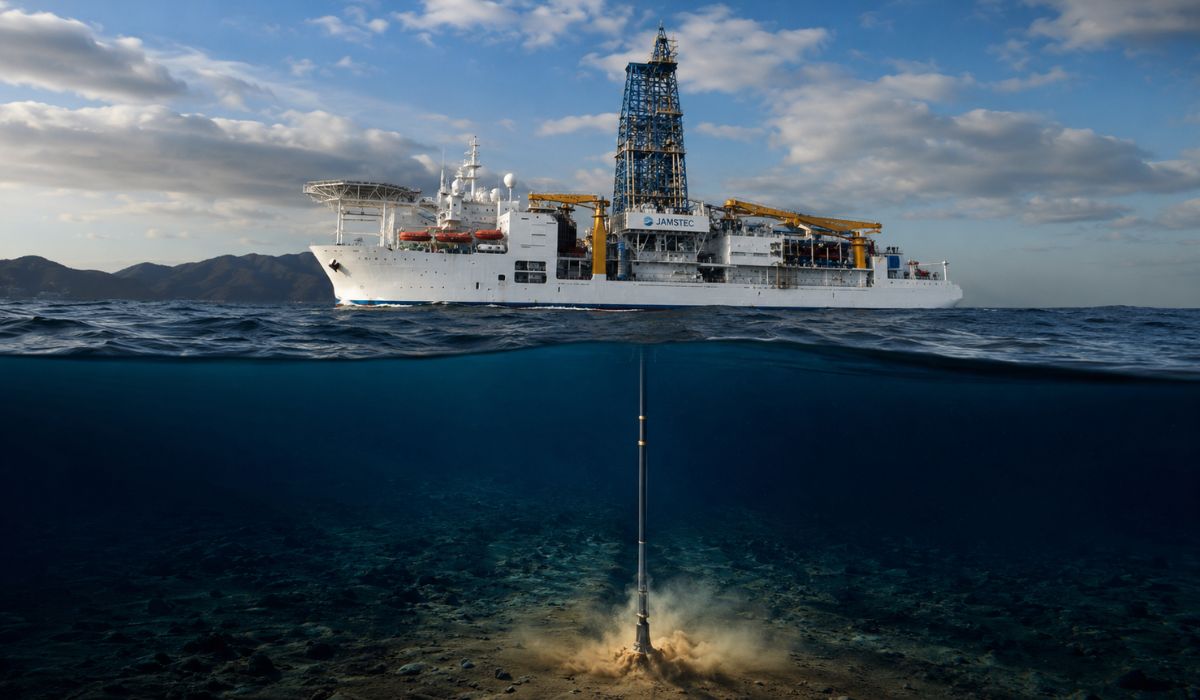


The expedition is the most ambitious deep Arctic research ever conducted by an environmental NGO.
According to the International Seabed Authority, the expedition comes at a critical time. In March 2026, the organization advanced negotiations on the future mining code in international waters.
Meanwhile, Norway has suspended all its Arctic plans until at least 2029 following a parliamentary decision.
On the other hand, the demand for cobalt, nickel, and rare earths for batteries has intensified the dispute between industry and science.
The expedition will collect biological samples, map abyssal sponge communities, and film hydrothermal fields that are still almost unknown.
The Greenpeace Arctic expedition will last almost a month and ends in Bergen
The ship carried 13 scientists, 22 crew members, and bathymetric mapping equipment for a 28-day journey.
According to the official record, the route covers the Mohn Ridge and the Knipovich Ridge, underwater volcanic systems in the Norwegian-Greenland Arctic, in waters that remain permanently below 4°C.
The main team is led by zoologists Paco Cárdenas and Julio A. Diaz from the Museum of Evolution at Uppsala University in Sweden.
Additionally, researchers from the University of Madrid, the University of Bergen, and the Senckenberg Society for Nature Research in Germany complete the group.
The results will be presented in Bergen, Norway, in June. Subsequently, the team will bring the documentation to the plenary of the next session of the International Seabed Authority.
The idea is to provide images and samples to the debate about what the sector still does not know about what it intends to drill.

The Greenpeace Arctic expedition targets the Frigg Vent Field at 2,700 m and the Freya Hydrate Mounds at 3,640 m
In November 2025, a team led by Professor Giuliana Panieri from the Arctic University of Norway discovered the Frigg Vent Field at 2,700 meters.
The Frigg is located in the Fram Strait, between Greenland and the Norwegian archipelago of Svalbard.
The site hosts fauna that lives in total darkness.
In December 2025, the same team published in Nature Communications the discovery of the Freya Hydrate Mounds at 3,640 meters on the Molloy Ridge.
Therefore, the finding expanded the known depth limit for gas hydrates by almost 1,800 meters.
According to UiT Tromsø, methane jets rose more than 3,300 meters through the water column, among the highest ever recorded.
“This discovery rewrites the manual of deep Arctic ecosystems and carbon cycles,” stated Panieri in a statement to the scientific press.
According to the published record, the two hydrothermal fields are hundreds of kilometers away from blocks that were being considered for future copper and zinc mining concessions.

Why the Greenpeace Arctic expedition is happening right now
According to the International Seabed Authority, the 31st session of the Council advanced in March 2026 on rules regarding payment and environmental protection in the future marine mining code. However, significant gaps remain.
In February, the Norwegian parliament decided to suspend all seabed mining in Arctic waters until at least 2029.
It was a political turnaround, as the country had been the most active advocate for opening this type of activity in Europe.
Therefore, 32 countries now support a moratorium or precautionary pause.
As reported by the Deep Sea Conservation Coalition, the pressure also came from the market.
There are 58 technology and electric vehicle companies, including Google, Samsung, Volvo, and Apple, that have signed a commitment not to purchase minerals from the seabed.
The countries voting for the moratorium and the companies refusing ocean minerals
Among the 32 governments in favor of the pause are Brazil, France, Germany, the United Kingdom, Chile, Canada, New Zealand, Costa Rica, and most Pacific island states.
For the countries of Polynesia and Micronesia, deep mining is seen as a direct threat to fishing and local culture.
- Technology: Google, Microsoft, Samsung Electronics, Apple
- Automotive: Volvo, BMW, Renault, Volkswagen
- Other sectors: Patagonia, IKEA, Triodos Bank, Allianz
Compared to the previous economy, the bloc of companies is significant because it consumes a large portion of the world’s cobalt and nickel.
Indeed, without demand from final buyers, investment in underwater machinery is at risk. Two of the largest private projects for nodule mining in the Pacific have already seen contracts canceled.
Study conducted in Clarion-Clipperton measured a 37% drop in seabed fauna after test
Compared to the theoretical data from mining companies, the most robust survey comes from the Natural History Museum in London in partnership with the University of Gothenburg.
To better understand, the team monitored an area of the Clarion-Clipperton zone in the Pacific for 160 days.
As a result, there was a 37% decrease in the number of animals and a 32% loss in species richness.
Subsequently, researchers collected 4,350 animals from 788 species, many new to science. Partial recovery only appeared five years after the test.
In practice, this would be one of the largest physical impacts of any documented industrial activity.
The fact is confirmed in a similar report on 6-ton robots descending into the Pacific for mining, published in the CPG archive.

The Greenpeace Arctic expedition arrives as Brazil approves a critical minerals law
In May 2026, the Brazilian Chamber of Deputies approved the National Policy on Critical Minerals.
The text provides for a Guarantee Fund of R$ 2 billion and tax credits totaling R$ 5 billion over five years.
The focus is on domestic exploration and transformation of cobalt, nickel, copper, lithium, and rare earths, minerals that the Brazilian oil and gas sector also consumes in electrical equipment and platform turbines.
In turn, this makes the topic directly relevant to the pre-salt.
For pre-salt engineers, the topic is of interest for another reason.
In other words, if terrestrial mining cannot scale to meet the energy transition, the pressure on the seabed, including potentially the South Atlantic, will increase.
Similarly, the energy sector closely follows discussions on energy transition and critical minerals in Brazil, published in the CPG archive.
The industry depends on imports for various elements of the battery supply chain.
The three questions the expedition wants to answer in Bergen
Firstly, the team wants to estimate how many endemic species the Mohn Ridge and Knipovich Ridge host. So far, less than 5% of the fauna of these systems has been cataloged.
Secondly, it seeks to document the connection between Arctic hydrothermal fields and deep ocean carbon cycles.
Finally, the expedition wants to show live video of what exists below the blocks being discussed at the ISA.
However, there is no guarantee that the moratorium will prevail. Proponents of exploration argue that marine minerals can reduce geopolitical dependence on suppliers like China and the Democratic Republic of the Congo.
However, the expedition will not resolve the impasse alone. Still, it will make it difficult for it to be decided without data on what is at stake on the Arctic seabed.


Be the first to react!