Portuguese
  Spanish



Amazing discovery reveals ancestral art hidden in cave for over a thousand years and changes understanding of indigenous cultures in North America
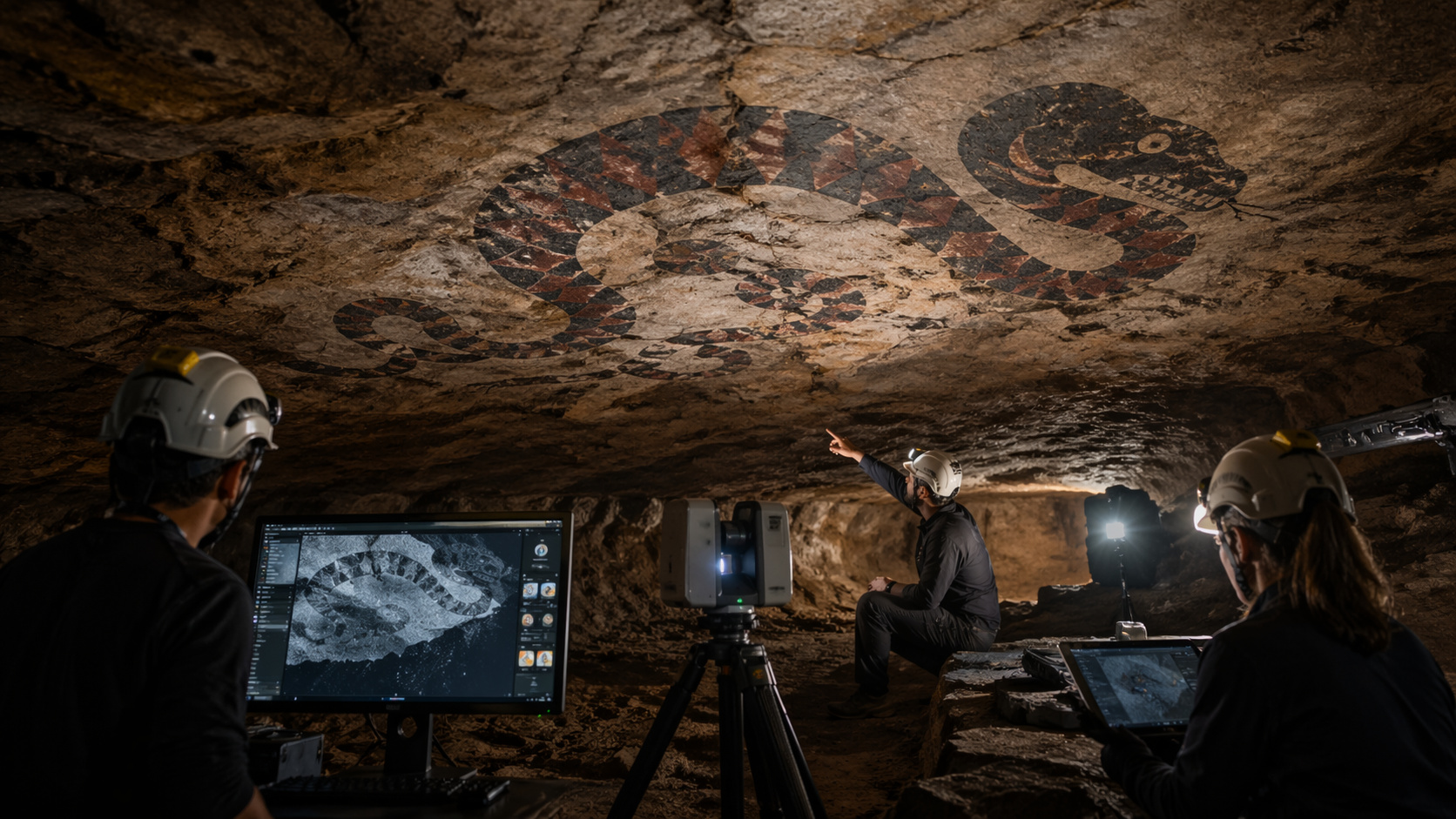
World archaeology has just gained a surprising chapter. Researchers exploring a cave in Alabama, United States, identified a monumental work hidden in the ceiling of the site — something that remained invisible for centuries. It is a painting measuring an impressive 3 meters in length, currently considered the largest indigenous image ever found in caves in the country.
The information was disclosed by the website “Science”, based on a recent study published in the scientific journal Antiquity, revealing technical and historical details that are completely changing the way experts interpret indigenous art in the southeastern United States.
Moreover, the discovery was only possible thanks to the use of advanced three-dimensional scanning technology. This is because the extremely low ceiling of the cave made it impossible to view the painting completely with the naked eye, keeping the secret preserved for about 1,000 years.
-
Bruno Guimarães, 28, Misses Crucial Penalty Against Norway in World Cup After Replacing Vinicius Jr.

-
Inspired by a school lesson on Africa’s water crisis, a young boy raised money through chores to fund a well that transformed a Ugandan community.

-
Brazilian Construction Worker Moves to France, Earns Up to €2,500 Monthly with Home Renovations, Gains Social Media Attention

-
US Navy Sinks USS Oriskany with 230 kg of C-4, Creating World’s Largest Artificial Reef in 37 Minutes







3D Technology Reveals Invisible Details and Exposes Unknown Monumental Figures
Initially, the archaeologists already knew that the so-called “19th unnamed cave” had a high concentration of indigenous rock art. However, what no one imagined was the existence of monumental-scale figures hidden in that environment.
To solve this challenge, the researchers used photogrammetry techniques, capturing hundreds of images that were later transformed into a navigable three-dimensional digital model. In this way, it was possible to “virtually illuminate” the cave ceiling and reveal details that could never be seen directly.

As a result, at least five large unprecedented glyphs were identified. Among them, the absolute highlight is a serpent approximately 3 meters long and 2.12 meters wide, possibly representing a rattlesnake with a pattern similar to that of the species Crotalus atrox.
According to specialists, this type of animal had strong spiritual significance for the indigenous peoples of the region, being frequently associated with sacred beliefs and deep symbolisms related to life and the underworld.
Giant serpent redefines the role of caves in indigenous spirituality
Consequently, this discovery is altering concepts that seemed consolidated in archaeology. Until now, there were no records of figures of this scale in caves in the southeastern United States, which led researchers to underestimate the artistic complexity of these cultures.
According to archaeologist Jan Simek from the University of Tennessee, the discovery significantly broadens the understanding of indigenous artistic production in North America. This is because, now, these images can be compared with other monumental manifestations found in different regions of the continent.

Furthermore, the cave itself reinforces its cultural importance. With over 5 kilometers in length (about 3 miles), the site had been previously documented in 1998, but never fully understood.
Within the indigenous cosmology of the Southeast, caves were seen as portals to the underworld, while earth mounds symbolized the upper world. In this sense, the presence of deep and hidden figures inside the cave strongly suggests a ritualistic and spiritual use of the space.
Therefore, more than just a simple archaeological discovery, this finding reveals a cultural heritage that is much richer and more complex than previously imagined — something that is now beginning to be finally understood thanks to the union of science and technology.