Portuguese
  Spanish


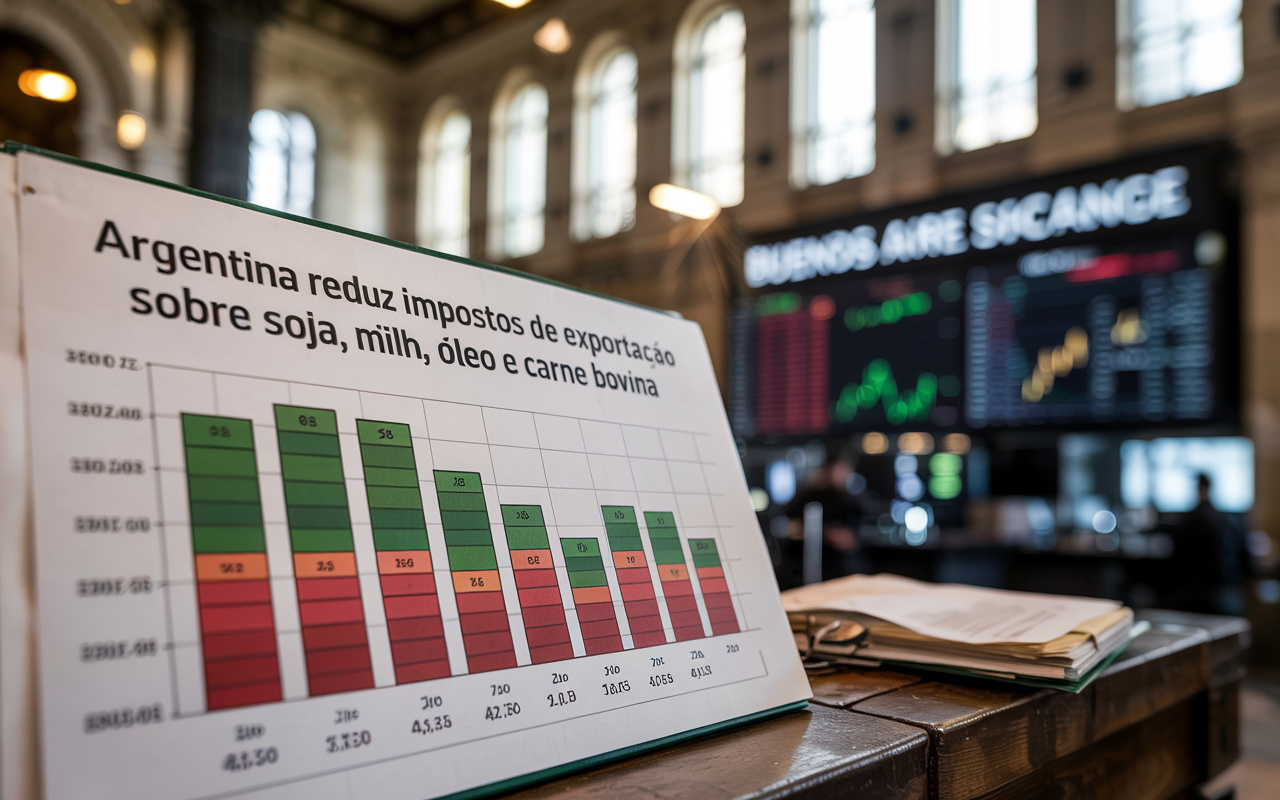


Argentina Reduces Export Taxes on Soy, Corn, Oil, and Beef by Presidential Decree. Measure Aims to Boost Competitiveness and Strengthen the Country’s Agribusiness.
Argentina initiated one of the most significant fiscal changes in recent years in the agro-export sector this Thursday (31), with the reduction of export taxes on soy, corn, oil, soymeal, and beef. The measure, announced last Saturday by President Javier Milei and formalized by decree in the Official Gazette, reinforces the government’s strategy to boost the country’s competitiveness in international trade and alleviate the tax burden on one of the most vital sectors of the Argentine economy.
With the decision, the rates on soy were reduced from 33% to 26%, while taxes on oil and soymeal were cut from 31% to 24.5%. Corn had its rate slashed by 2.5 percentage points, going to 9.5%, and beef saw a decrease of 1.75 points, reaching 5%.
Tax Reduction in Argentina: A Strategic Move by the Milei Government
The reduction of export tariffs is part of President Javier Milei’s liberal discourse, who classifies these taxes as “distorted” and advocates for their gradual elimination.
-
The world has nearly 12,000 nuclear warheads, with the majority held by the United States and Russia; see the figures for China, France, and the United Kingdom.

-
Venezuela Faces UN Alert for Hunger, Disease, and Service Collapse After Earthquakes Cause Nearly 2,000 Deaths and $6.7 Billion in Damages

-
Brazil Deploys Navy Field Hospital with ICU, Orthopedics, Pediatrics to Earthquake-Stricken Area in Venezuela, Offering 30 Beds and 150 Daily Consultations
-
European Union Announces €260 Million Investment to Extend EllaLink Submarine Cable to Northern Brazil, Reducing Digital Dependence on U.S. Routes



In the published decree, the government makes it clear that as the fiscal surplus allows, the plan is to continue reducing taxes until they are completely eliminated.


The measure has an immediate effect and is already starting to impact contracts and operations in the sector, which represents one of the main sources of foreign exchange for the country.
Soy Exportation in Argentina: Direct Effect on the Country’s Largest Product
Soy is the star of the Argentine agribusiness. The country is the world’s largest exporter of soy oil and meal, and any change in its tariffs has immediate repercussions in the international market. The reduction from 33% to 26% in taxes on the grain and from 31% to 24.5% for derivatives should improve the profit margin for producers and processors, encouraging sales and stimulating the local industry.
Experts believe that the measure could increase the competitiveness of Argentine shipments against countries like Brazil and the United States, the two largest competitors in the global soybean market.
Impact on Corn, Oil, and Beef: Strategic Sectors in Focus
Corn is also a pillar of Argentine exports. The country ranks third among the largest exporters of the cereal in the world, only behind the USA and Brazil.
The reduction of the tax from 12% to 9.5% could enhance the competitiveness of Argentine corn, especially in Asian and African markets that seek reliable suppliers and more attractive prices.
In the case of beef, Argentina is known for the quality of its cuts and ranks among the major global exporters. The reduction of the tariff from 6.75% to 5% is expected to benefit meatpackers and producers, increasing competitiveness in premium markets such as Europe and China, and strengthening the country’s image as a supplier of high-quality meat.
Why Reduce Taxes Now?
The decision to reduce export taxes is also a political and economic bet by the Milei government. The president, who took office with a liberal discourse, sees exports as an essential engine for the country’s recovery and for generating foreign exchange.
Additionally, the measure could stimulate producers to release stocks held in silos, a common practice in Argentina when taxes are high or the exchange rate is unfavorable. With the reduction of rates, the outflow of production could gain momentum, increasing the influx of dollars into the economy.
Market Reactions and Future Perspectives
The initial reactions from the agro-export sector were positive, with agricultural entities praising the tax reduction and calling for the continuation of measures until total tariff elimination. The international market also received the news well, as more competitive prices may mean greater flow of Argentine exports.
However, economists warn that the fiscal impact needs to be closely monitored. Revenue from exports represents a significant portion of the Argentine budget, and abrupt cuts could jeopardize the balance of public accounts if there is no proportional increase in export volumes.
Presidential Decree on Export: Path to the End of Tariffs?
The decree signed by Milei makes it clear that export taxes will be gradually reduced “until they disappear.” This goal, however, will depend on the fiscal surplus and the government’s ability to offset revenue losses with economic growth and increased export volume.
If the plan progresses, Argentina could become even more competitive in the global agricultural commodity market, expanding its presence particularly in Asia and Europe, and consolidating its position as an agro-export powerhouse.
The reduction of export taxes on soy, corn, oil, soymeal, and beef marks a strategic move by the Argentine government to strengthen the agro-export sector, attract foreign exchange, and improve the country’s competitiveness.
If the measure proves effective, Argentina could gain ground in international trade and boost its economy. But the success of this policy will depend on balancing revenue, fiscal surplus, and market response.