Portuguese
  Spanish


10,000-Year-Old Rice Beer Discovered by Archaeologists Reveals Origins of Fermentation and Rice Cultivation in Ancient China.
A recent study revealed that the roots of rice beer production in China date back approximately 10,000 years.
Evidence found in ceramics from the archaeological site of Shangshan, in the eastern part of the country, shows that prehistoric communities had already mastered cereal fermentation techniques, transforming it into an alcoholic beverage for rituals and social celebrations.
The discovery connects agricultural, social, and technological advancements in the region to the beginnings of Chinese civilization.
-
Brazil Approves Non-Hormonal Drug to Alleviate Menopausal Hot Flashes, Potentially Transforming Treatment

-
Giant Phantom Halo Appears Around Remote Pacific Islands, NASA Reveals It’s Created by Tiny Marine Organisms

-
Scientists Develop Method to Store Wind and Solar Energy by Liquefying Air for On-Demand Power Generation

-
Brazilian Engineer Who Grew Up Without Electricity Develops Software, Expands AltoQi to 67,000 Clients, Aiming for $21 Million by Digitizing Brazil’s Construction Industry





Archaeological Discovery in Shangshan Links Ancestral Beer to Rice Domestication
The studies were conducted by an international team of archaeologists and food chemistry specialists, who analyzed residues found in 12 ceramic fragments dating back about 10,000 years, excavated in Pujiang County.
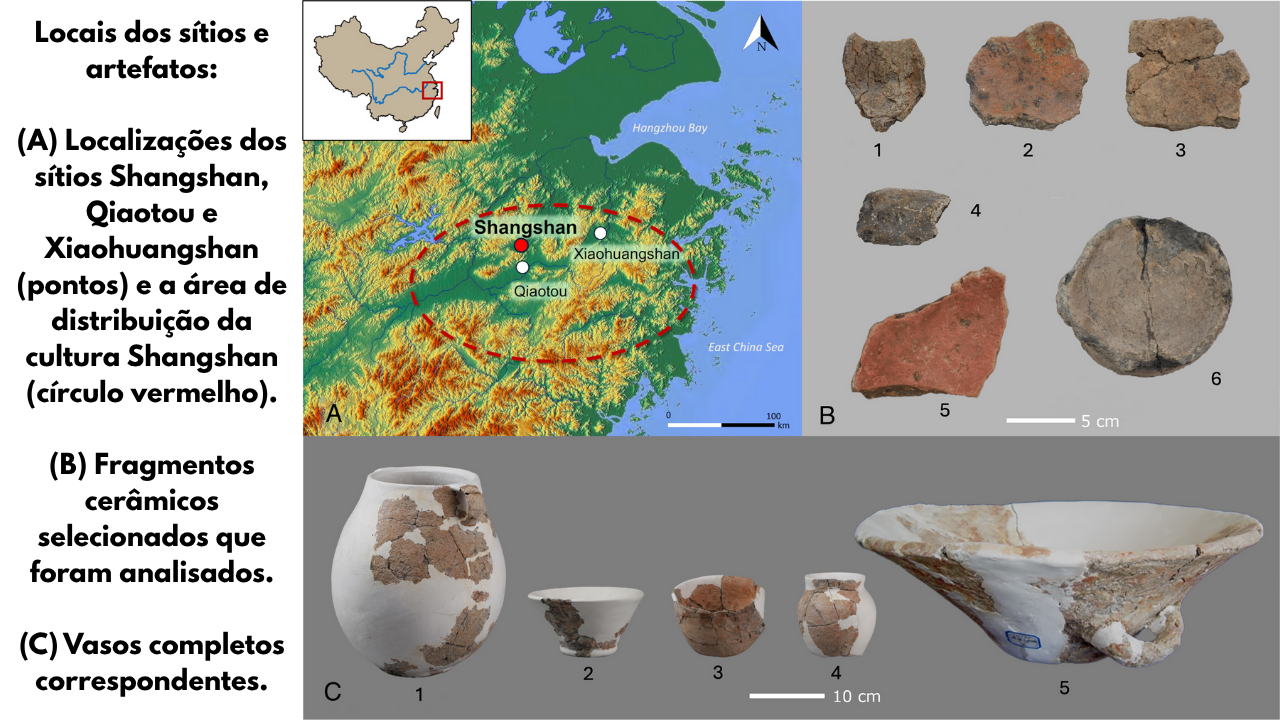
The pieces, originating from the archaeological site of Shangshan, included pots, cups, and bowls used in different contexts — from fermentation to serving the beverage.
Laboratory tests revealed the presence of rice starch, hull particles, Monascus-type fungi, and yeast.
This set of elements is characteristic of fermented beverage production, suggesting that a primitive form of rice beer was already being made at that time.
The Role of “Qu”: The Ancestral Chinese Fermenter
One of the key elements for producing this beverage was the use of “Qu” (pronounced “chu”), a fermenting agent made from molds cultivated on rice.
This traditional technique, still used in the production of Asian alcoholic beverages, was employed to transform rice starches into sugars, allowing for subsequent fermentation into alcohol.
Researchers suggest that the emergence of this technique may have occurred by chance during the storage of rice in warm and humid conditions — characteristics of the early Holocene, a geological period that favored the natural growth of the fungi used in fermentation.
Alcohol-Fueled Ceremonies and the Boost to Agriculture in China
The production of rice beer not only represented a dietary advancement but also played a significant social role.
The beverage was consumed in ceremonial rituals and community gatherings, helping to strengthen social bonds in the ancient communities of the Lower Yangtze River.
Over time, this ceremonial consumption appears to have encouraged the systematic cultivation of rice, making it a staple of the region’s agricultural economy.
These findings reinforce the importance of Shangshan culture in rice domestication — a process still debated among archaeologists but now gaining new evidence thanks to the direct relationship between fermentation and agriculture.
Impact of the Discovery on the History of Chinese Civilization
Published in the scientific journal Proceedings of the National Academy of Sciences (PNAS), the research establishes an unprecedented connection between the development of agricultural practices and the emergence of organized social practices.
In this context, rice beer appears not only as a beverage but also as a transformative agent of ancient Chinese society itself.
By demonstrating mastery over fermentation techniques so early, the communities of Shangshan reveal a high degree of practical knowledge and adaptation to their environment.
The discovery places China at the center of the millennia-old history of food fermentation — and, more specifically, of beer made from rice.