






 Portuguese
  Spanish
  4 min of reading
  0 comments


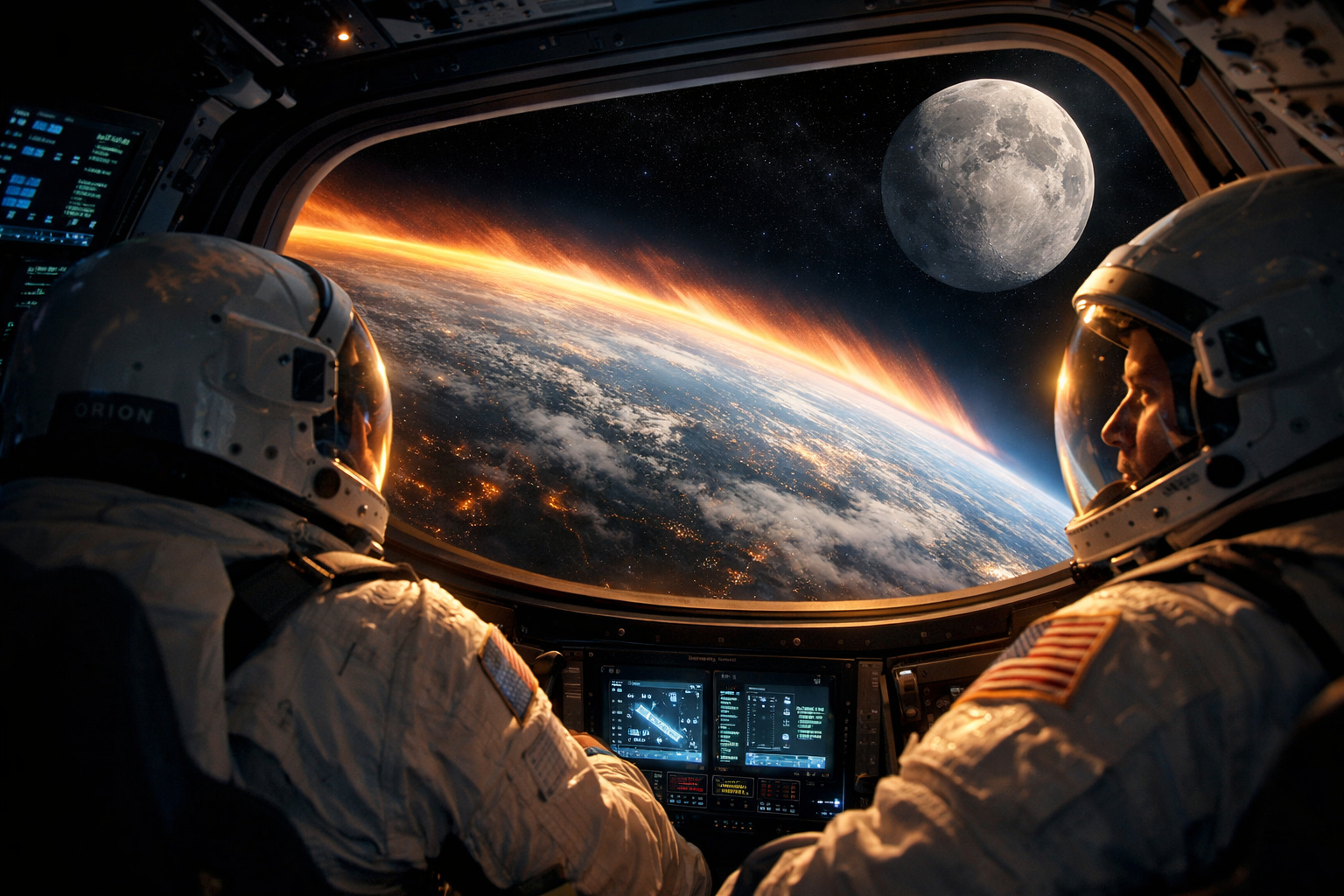
Historical mission marks new era of lunar exploration and reveals real challenges faced by astronauts during journey beyond Earth orbit
The Artemis II mission has definitively entered the history of space exploration by taking four astronauts to an impressive 252,000 miles (about 405,000 kilometers) from Earth, establishing a new milestone for crewed travel. Furthermore, the journey has reignited global interest in lunar exploration, solidifying NASA’s plans for a future landing on the Moon and the construction of a permanent base.
This information was released by the “Associated Press,” based on official reports from NASA and exclusive interviews with the astronauts, highlighting not only technological advancements but also the human challenges faced during the mission.
The most beautiful experience ever seen by humankind — but with extreme risks

Shortly after returning to Earth, the astronauts described the journey as one of the most impressive experiences ever lived. According to Commander Reid Wiseman, being 252,000 miles from home was “the most majestic and beautiful thing human eyes have ever witnessed.”
-
Helicopter Drops 180 Tons of Sand and Gravel on Swedish River to Revive Ecosystem Damaged by Decades of Exploitation

-
Brazilian Company Launches Retro Smartphone with 48 MP Camera, T9 Keyboard, and Privacy Features for Social Media-Free Use

-
Self-Taught Chinese Farmer Builds 5-Ton Submarine from Scrap, Launches It in Anhui River
-
Invisible Induction Technology Enables Wireless Power for Blenders, Coffee Makers, and Air Fryers, Reducing Countertop Cables





However, despite the indescribable beauty, the mission also presented moments of extreme tension. During reentry into the Earth’s atmosphere, the Orion capsule reached speeds equivalent to 39 times the speed of sound, making this stage one of the most dangerous of the entire journey.
In this context, Wiseman revealed that this was the scariest moment of the mission. After all, the risk involved is significant, especially when it comes to protecting human lives in such extreme conditions. As a result, the astronaut stated that during the flight, the desire to return home and hug his daughters became even more intense.
NASA technology impresses and ensures the success of the Artemis II mission

Despite the risks, the technology used in the mission demonstrated a high level of efficiency. The Orion capsule, named Integrity, performed excellently, especially regarding the thermal shield — an essential component to withstand the high temperatures of reentry.
The astronauts reported only minor losses of charred material at specific points on the shield, something considered within expectations. Nevertheless, NASA will conduct detailed analyses, examining each component with extreme precision.
It is worth noting that, previously, the thermal shield of the Artemis I mission, conducted in 2022 without a crew, showed more significant damage. Therefore, the space agency opted to modify the reentry trajectory for this mission, reducing thermal impact and increasing safety.
Additionally, another remarkable moment occurred just before landing in the Pacific Ocean. When the parachutes were deployed, astronaut Victor Glover described the sensation as a free fall similar to jumping from a skyscraper — an intense experience that lasted about five seconds before stabilization.
The future of lunar exploration has already begun

After nearly 10 days of mission, the capsule successfully returned, symbolically coinciding with the 56th anniversary of the Apollo 13 launch. This detail reinforces the connection between historical missions of the past and the future of space exploration.
Now, NASA is already working on the next step: the Artemis III mission. Unlike Artemis II, this mission will test operations in low Earth orbit, including docking with lunar modules developed by companies like SpaceX, founded by Elon Musk, and Blue Origin, founded by Jeff Bezos.
Subsequently, Artemis IV, scheduled for 2028, aims to take astronauts to land near the lunar south pole — a strategic region for future permanent bases.
Meanwhile, the astronauts of Artemis II are undergoing rigorous medical tests to assess balance, vision, muscle strength, and coordination. Additionally, they are already training with space suits in environments that simulate lunar gravity, equivalent to one-sixth of Earth’s gravity.
Risks exist — and are part of the achievement
Although the mission was considered a success, the astronauts were clear in stating that future trips will require acceptance of additional risks. According to Jeremy Hansen, it will be necessary to trust the team and deal with problems in real-time, as not everything can be predicted before takeoff.
Therefore, Artemis II not only paved the way for new missions but also left a clear message: space exploration remains a complex challenge, where technology, courage, and collaboration go hand in hand.
The information was released by ScienceAlert, based on data from the Associated Press and official information from NASA about the Artemis II mission.




-

1 person reacted to this.