






 Portuguese
  Spanish


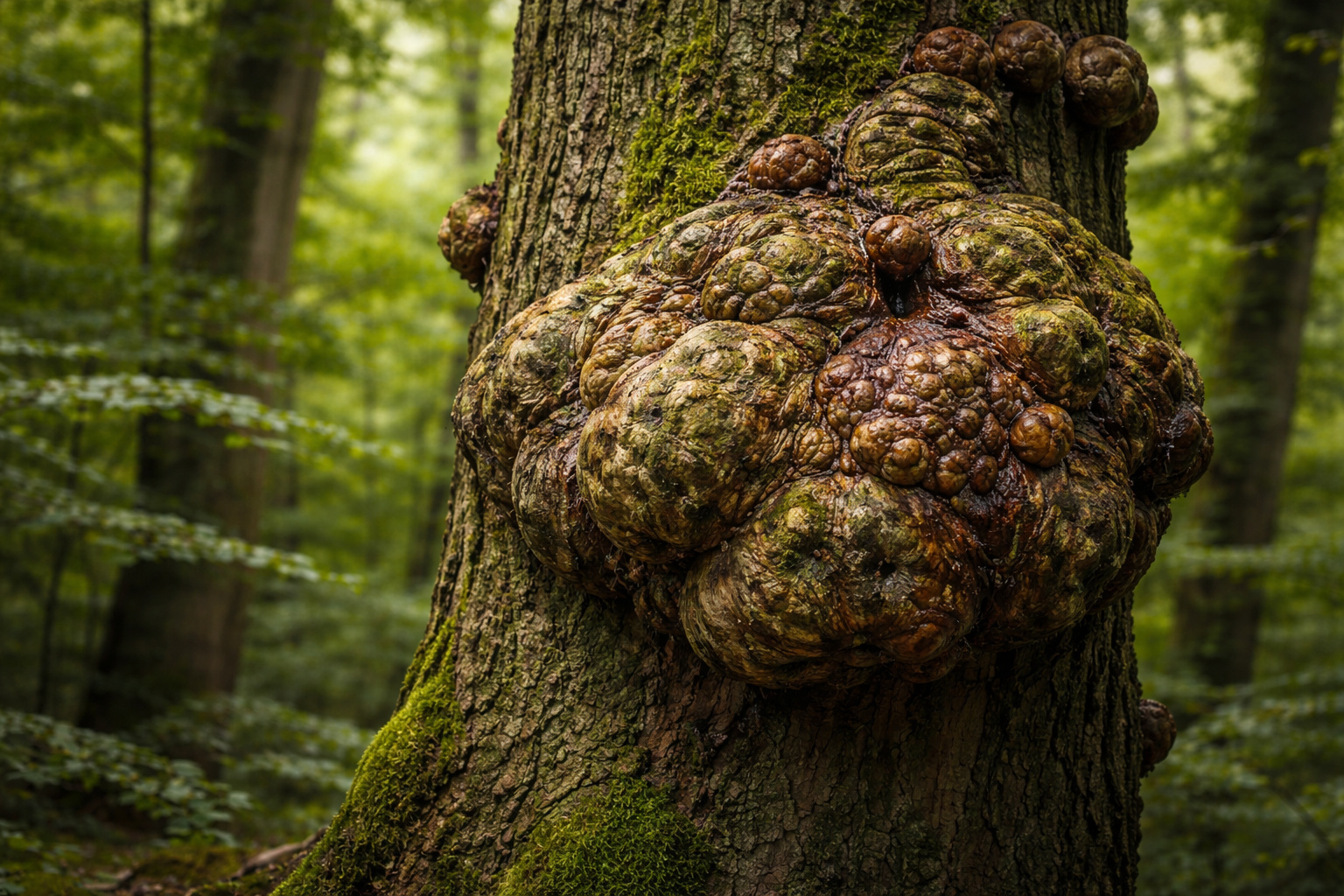

Understand Why Plant Tumors Exist but Do Not Behave Like Human Cancer
A common question has resurfaced in scientific debate recently: Can trees get cancer? The answer requires precision. Plants can exhibit abnormal cell growth; however, these processes do not equate to human cancer. The explanation involves profound structural differences between plant and animal organisms.
According to plant physiology experts, the term “cancer” applied to trees is technically inaccurate. While tumors do exist, the cellular behavior is different.
Scientific Review Explains Biological Differences
Human cancer occurs when mutations in DNA cause uncontrolled cell growth. Furthermore, these cells can invade tissues and spread throughout the body, a process known as metastasis. This factor makes the disease potentially lethal.
-
Women in São Paulo Unknowingly Tracked by Coin-Sized Tags Hidden in Cars and Belongings, Raising Stalking Concerns

-
Near a $750 million AI data center in Brazil, a resident’s well runs dry, leaving her unable to afford the $25,000 needed for repairs.

-
16-Year-Old from Brazil’s Sertão Wins Young Scientist Award for AI Predicting Rainfall with 94.5% Accuracy to Aid Farmers
-
Netherlands Reports First Child Euthanasia Case Since Rule Expansion for Minors


However, in plants, the cellular structure prevents this phenomenon. Plant cells have rigid cell walls, which blocks cellular migration. Therefore, even if abnormal proliferation occurs, it remains localized.
Additionally, contrary to the animal circulatory system, the vascular system of plants transports water and nutrients but not entire cells. As a result, tumor dissemination does not occur.
How Tumors in Trees Arise
The so-called “plant tumors” generally result from external agents. Among them, bacteria, fungi, and insects stand out. A classic example is the bacterium Agrobacterium tumefaciens, studied since the 20th century, responsible for the formation of galls in various species.
These galls emerge because the microorganism alters the plant’s genetic material. As a result, disordered growth occurs at the site of infection. Nevertheless, this process does not evolve into metastasis.
Moreover, viruses and insects can also stimulate abnormal formations. However, in these cases, growth depends on the continuous presence of the causative agent. When the external stimulus ceases, proliferation tends to stabilize.
Biological Impact and Real Risks
Although the term “tree cancer” is commonly used, experts assert that the comparison is not appropriate. According to researchers in the field of botany, plant tumors rarely lead to the plant’s death.
This occurs because growth remains restricted to the affected point. Thus, the plant continues to photosynthesize and transport sap normally.
However, if the infection is intense or affects essential structures, there may be damage to development. Even so, the mechanism does not correspond to human cancer.
Fundamental Difference Between Human Cancer and Plant Tumors
In the human body, cancer involves spontaneous and progressive mutations. Additionally, the ability of invasive cells compromises vital organs. Therefore, the disease requires complex medical treatment.
In contrast, in plants, abnormal growth largely depends on external factors. Furthermore, the plant cellular architecture prevents systemic dissemination.
Therefore, although there are tumors in trees, the absence of metastasis completely redefines the concept. Scientifically, asserting that plants “have cancer” is not correct.
Scientific Context and Current Understanding
Since the advancement of molecular biology in the 20th century, scientists have investigated how plant organisms control cell division. Studies published over the past decades reinforce that plants exhibit distinct genetic regulatory mechanisms.
Currently, researchers recognize that although they share basic cellular principles with animals, plants possess structural strategies that limit systemic damage.
Thus, scientific understanding indicates that trees do not develop cancer like humans, even though they may exhibit localized tumors.
Have you ever contemplated how the cellular structure of plants directly influences their resistance to serious diseases?


