






 Portuguese
  Spanish
  6 min of reading
  0 comments


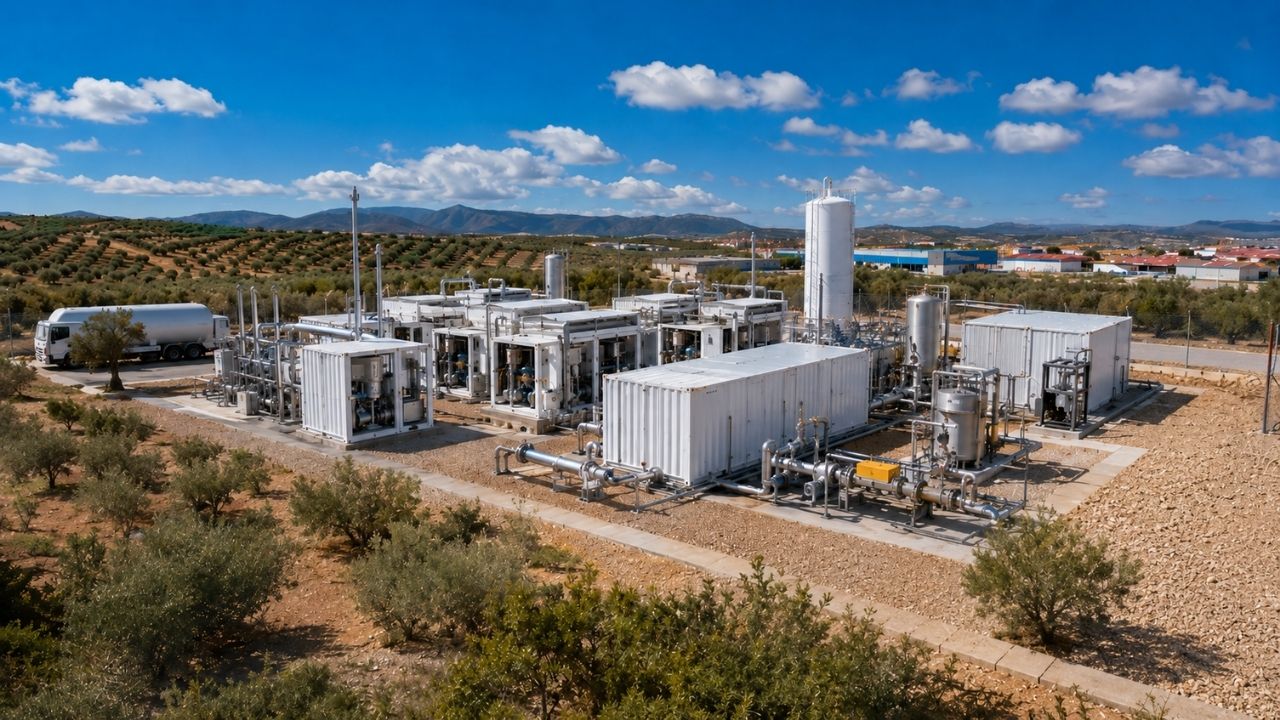
Green hydrogen advances in Extremadura with Turn2X’s T2X project, which uses Power to Gas to combine biogenic CO₂ and generate synthetic methane, creating renewable natural gas injected into the distribution network and aimed at industrial sectors difficult to electrify in Spain during the European energy transition with EU support.
The green hydrogen gained a new industrial chapter in Spain in 2026, with the advancement of the T2X project by Turn2X in Miajadas, Extremadura. The initiative, supported by the European Commission in the third auction of the European Hydrogen Bank, uses the plant inaugurated in 2024 to produce renewable natural gas from the combination of renewable hydrogen and biogenic CO₂.
According to the Xataka portal, the proposal draws attention because it is not limited to producing renewable hydrogen in isolation. The plant combines 100% renewable hydrogen with biogenic CO₂ to generate high-purity synthetic methane, creating renewable natural gas capable of being injected directly into the distribution network.
Green hydrogen enters a practical path with renewable gas
The T2X project is presented as the first initiative in Europe to supply green gas directly to the distribution network. The Turn2X plant in Miajadas had already been inaugurated in 2024 and now advances as a reference for the energy transition on the continent.
-
Invisible Induction Technology Enables Wireless Power for Blenders, Coffee Makers, and Air Fryers, Reducing Countertop Cables

-
Smart Outdoor Lighting Transforms Gardens into Living Spaces with Weather Resistance and App-Controlled Scenes

-
Green dot on top of smartphone intrigues users, signals privacy alert in Android 12 that experts say shouldn’t be ignored.
-
Humanoid Robot Climbs 6,263-Meter Volcano in Ecuador, Sets Sights on Everest Challenge





The central point is the practical application of green hydrogen. Instead of treating the fuel only as a future promise, the company uses the renewable molecule as a base to produce a gas compatible with the existing infrastructure.
This means that synthetic methane can be transported by pipelines and used by industrial customers. The advantage lies in leveraging part of the already installed gas infrastructure, reducing the distance between innovation and real use.
Extremadura stands out in this process because it brings together favorable conditions for renewable generation, especially due to the many hours of sunshine, in addition to being strategically positioned on the future European gas pipeline route.
Power to Gas combines renewable hydrogen and biogenic CO₂
The technology used in the plant is known as Power to Gas, or P2G. The process combines green hydrogen with biogenic carbon dioxide, captured from a nearby bioethanol plant, to generate synthetic methane gas.
This conversion occurs through the Sabatier reaction, which allows obtaining high-purity methane. In practice, renewable electricity helps produce hydrogen, and this hydrogen combines with CO₂ to form a gaseous fuel.
The result is called renewable natural gas because it does not depend on the extraction of fossil fuels to be produced. The logic is to transform renewable energy and biogenic carbon into a molecule that can circulate through the gas network.
The gas has already been successfully tested and injected without problems into the Gas Extremadura distribution network, according to the information released about the project.
Miajadas Plant Targets Hard-to-Electrify Sectors
The production of synthetic methane does not aim to replace all electrification. The focus is on sectors where replacing thermal processes with electricity is more difficult, expensive, or technically complex.
Examples cited include steel mills, ceramic industry, and maritime sector. These areas require intense energy, continuous operation, and solutions compatible with heavy industrial routines.
In this scenario, green hydrogen appears as part of a broader chain. It functions as an input to produce a renewable gas that can reach industrial customers through already known infrastructure.
The proposal is to use synthetic gas as a bridge to decarbonize activities that cannot abandon fossil fuels at the same speed as other sectors.
Project Will Have 9 Megawatts of Electrolysis
The T2X, managed by TURN2X Asset Co II EXTREMADURA SL, plans to implement an electrolysis capacity of 9 megawatts. The expectation is to produce approximately 6,390 tons of renewable hydrogen in the first ten years of operation.
As soon as the financing contracts are signed, expected in the last quarter of 2026, the initiative will receive a fixed European premium of € 0.62 per kilogram of certified hydrogen produced over a decade.
After this stage, companies will have a maximum period of five years to put the installation into commercial operation. The schedule shows that the project combines already initiated production, planned expansion, and dependence on formal financing and licensing stages.
To ensure the clean origin of the energy, Turn2X has signed a power purchase agreement with Axpo Iberia, with renewable electricity generated by Aquila Clean Energy.
Extremadura Becomes Spain’s Energy Showcase
The choice of Extremadura was not by chance. The region has high solar availability, an important element for projects that depend on competitive renewable electricity.
Moreover, the location is considered strategic for being on the route of the future European gas pipeline, which is expected to cross the region from north to south. This factor reinforces the area’s potential as an energy connection point.
The initial success also led Turn2X to propose an industrial expansion in Miajadas. The German company initiated environmental licensing procedures with the regional government to build a second unit in the city.
The region is no longer just a testing ground and is now competing as a hub for renewable energy production, attracting investments, and industrial development.
European support attempts to accelerate a still emerging chain

The selection of T2X by the European Hydrogen Bank shows that the European Union sees the project as part of a larger strategy. The goal is to accelerate solutions capable of reducing dependence on fossil fuels and expanding low-carbon alternatives.
The case is also connected to a national effort. Projects that meet technical requirements but remain on the reserve list of the European fund may receive additional funding, as Spain will contribute an additional 440 million euros through the Auctions as a Service mechanism.
This support is relevant because technologies like green hydrogen, synthetic methane, and Power to Gas still require scale, stable contracts, and regulatory security to advance competitively.
The energy transition does not only depend on the technology working; it also depends on financing, infrastructure, a buying market, and rules capable of sustaining projects for many years.
Renewable gas shows the way, but doesn’t solve everything alone
The Turn2X plant represents progress because it shows a concrete route to transform renewable hydrogen and biogenic CO₂ into gas usable by the grid. This brings the energy transition closer to real industrial applications.
At the same time, the project does not eliminate all challenges. Producing renewable natural gas at scale requires sufficient clean electricity, availability of biogenic CO₂, infrastructure, industrial contracts, and costs capable of competing with traditional alternatives.
Still, the experience in Miajadas shows that green hydrogen can move beyond being just a laboratory topic or a long-term plan. When combined with CO₂ and a distribution network, it enters a more concrete industrial logic.
In the end, Spain tries to transform an energy promise into real operation, using Power to Gas technology to create synthetic methane and supply sectors that are difficult to electrify.
Do you believe that renewable natural gas can accelerate the energy transition, or should the future be almost entirely electrified? Share your opinion



Be the first to react!