






 Portuguese
  Spanish
 5 min of reading
  0 comments


Supramax Ship M/V EMIR AKSOY delivered slag to TMIB, in Sergipe, and set a record with 39,450 tons unloaded, reinforcing industrial bulk, port capacity, and service to the cement chain in the North and Northeast, in an operation by VLI Logística that occupied 98.5% of the maximum gross tonnage capacity available at the Sergipe unit.
The M/V EMIR AKSOY ship, of the Supramax class, newly built by a shipyard in China, debuted its first commercial route in Brazil with a historic operation at TMIB, in Sergipe, recorded in early April 2026. The vessel unloaded 39,450 tons of slag in a single operation.
According to information from the site DatamarNews, the volume represented a historic record of unloading in a single vessel at the terminal operated by VLI Logística. More than a port number, the mark highlighted TMIB’s capacity to receive large vessels and serve industrial chains that depend on solid bulk in the North and Northeast.
Supramax Ship debuted commercial route with industrial cargo in Brazil
The M/V EMIR AKSOY belongs to the Supramax class, a type of vessel used in bulk and industrial cargo operations. In the case recorded at TMIB, the ship operated a load of steel slag, moved in a volume sufficient to set a new operational milestone at the Sergipe terminal.
-
Ports without drivers and cabins already move containers like automated factories: robotic cranes, autonomous electric vehicles, and software transform giant terminals into 24-hour logistics machines.

-
About 300 American ports still breathe diesel from trucks, cranes, and locomotives, but they are now trying to electrify heavy machinery to clean the air for 31 million nearby residents.

-
A 220-meter giant powered in part by solar energy and lithium batteries has just unloaded nearly 5,000 Chinese cars at the Port of Itajaí. It is the first of ten Grimaldi super ships and the first in the world prepared to run on ammonia as fuel.

-
The Port of SC has just entered the direct route to the largest hubs in Northern Europe with a new line from Maersk, gains a connection with Manaus in 13 days, and is preparing dredging to receive giant ships of up to 16,000 containers.
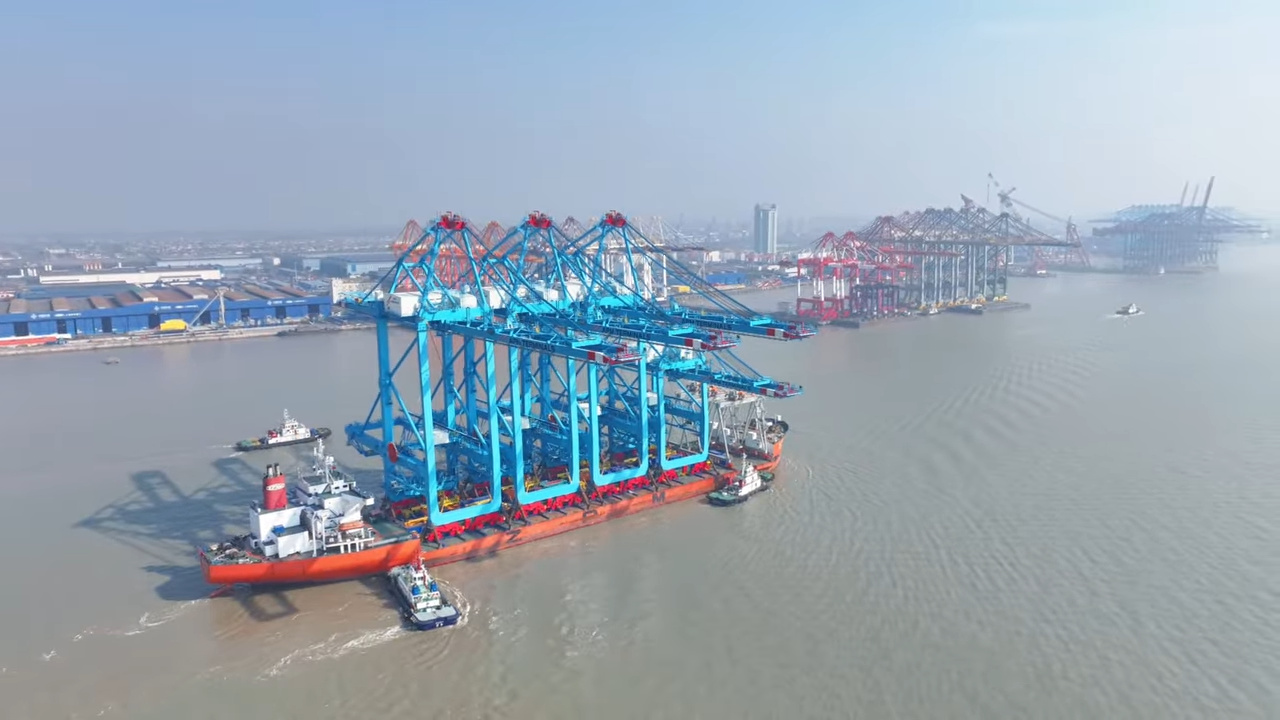



The operation took place in early April and gained prominence because it was carried out on the vessel’s first commercial route after its construction in China. This detail makes the episode even more relevant for port logistics, as a newly delivered ship entered operation with high capacity utilization right on its commercial debut.
The unloaded slag is not a waste without a destination. It is a byproduct of steel production, formed from the separation of impurities from iron ore during the industrial process.
After undergoing treatment and beneficiation, the slag becomes a strategic input for the cement industry, a sector that depends on raw materials and efficient logistics to maintain its operations.
Record at TMIB reinforces capacity for large vessels
The operation of the ship occupied 98.5% of the maximum gross tonnage capacity available at TMIB. According to the disclosed data, 64.1 thousand tons of DWT were used, out of a permitted limit of 65 thousand tons.
This utilization demonstrates the operational maturity of the port unit. In operations of this scale, it’s not enough to receive a large vessel; it’s necessary to coordinate capacity, safety, cargo flow, equipment, team, and unloading pace.
The record indicates that the terminal managed to operate near the allowed limit without losing operational efficiency. For industrial bulk logistics, this type of performance is relevant because it reduces bottlenecks and increases predictability for clients in the production chain.
TMIB is a private-use terminal managed since 2014 by the TMIB Consortium, formed by VLI Logística in partnership with Petrobras. The record operation reflects this management structure focused on infrastructure, efficiency, and market service.
Slag supplies a chain linked to cement production

The cargo transported by the ship is directly linked to the cement industry. After processing, steel slag can be used as an input in cement production, adding value to a material originating from the steel chain.
This point helps explain why the movement is of interest to industrial logistics. It’s not just about unloading a heavy cargo, but ensuring the supply of a chain that depends on regularity and scale.
Sergipe plays a relevant role in this scenario. The state is highlighted as surplus in cement production, which increases its importance in the country’s logistical and industrial dynamics.
When a terminal manages to operate large volumes of inputs, it strengthens the connection between port, industry, and regional distribution. This is the type of movement that can make local infrastructure more strategic for the Northeast.
North and Northeast enter the center of industrial demand
The operation also reinforces the role of TMIB in serving the industrial chain of the North and Northeast. According to the terminal’s assessment, these regions have been showing growth in demand for industrial inputs.
In this context, the unloading of the Supramax ship serves as a sign of logistical capacity. The greater the efficiency in the arrival of bulk, the greater the possibility of serving industries that need raw materials on a large scale.
The Operations Manager of TMIB, Osmar Selhorst Filho, stated that the milestone reinforces the strategic role of the terminal in serving the regional industrial chain. The statement highlights Sergipe as a relevant piece in cement production and industrial logistics.
The strength of this type of operation lies in the integration between port and consumer market. The terminal does not operate in isolation; it is part of a mechanism that involves maritime transport, storage, distribution, and industry.
Operation shows the importance of bulk logistics in regional development
Industrial bulk logistics usually attracts less public attention than containers or direct consumer goods, but it is essential for sectors such as cement, steel, energy, and construction.
In the case of TMIB, the record with the ship M/V EMIR AKSOY shows how a single operation can reveal the capacity of a port structure. The volume of 39,450 tons of slag highlights the scale needed to serve large production chains.
Efficiency also matters because operations with high capacity utilization tend to improve logistical competitiveness. The better the terminal uses its infrastructure, the more relevant it is for companies that depend on large volumes of cargo.
The result in Sergipe shows that the logistical competition also involves terminals capable of precisely operating heavy industrial loads essential to the regional economy.
Record puts TMIB in the spotlight on the Northeast industrial route
The record registered by the Supramax ship at the Inácio Barbosa Maritime Terminal was not just an internal milestone. It signals the terminal’s ability to receive large vessels, operate near the authorized limit, and meet industrial demands in the North and Northeast.
The commercial debut of M/V EMIR AKSOY in Brazil adds another element to the episode. A newly constructed vessel in China arrived in the country and participated in an operation that marked the history of TMIB.
For Sergipe, the landing reinforces the state’s position within the cement chain and industrial bulk logistics. For the terminal, it demonstrates operational maturity and the ability to absorb large-scale loads.
In the end, the ship that brought 39,450 tons of slag to TMIB showed how a port operation can go beyond the quay and reflect larger industry movements.
Do you think regional terminals like Sergipe’s can gain more space in the national industrial bulk logistics? Share your opinion.







Be the first to react!