Portuguese
  Spanish


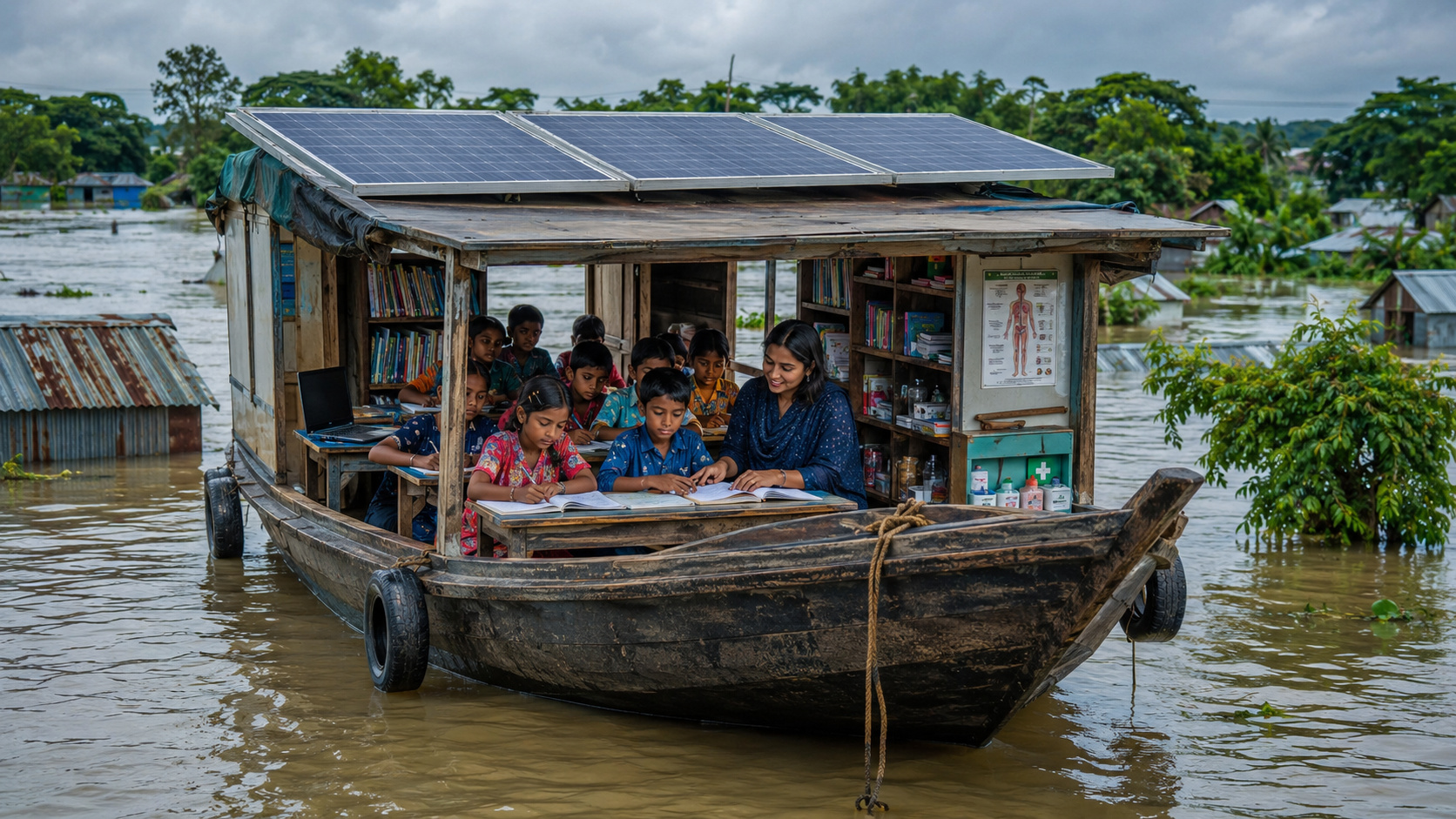

In Bangladesh, floating schools with solar panels offer a simple solution to keep children studying during floods, with boats that bring classrooms, libraries, internet, and healthcare to communities where water disrupts paths, closes schools on land, and hinders access to basic services
When floods close schools and leave children without classes in Bangladesh, boats with solar panels start making the journey that students cannot. The vessels transform into floating classrooms and bring education to water-affected communities.
The report was published by Shidhulai Swanirvar Sangstha, a non-profit organization in Bangladesh. The entity operates floating schools, libraries, clinics, and training centers in flood-prone areas.
The idea draws attention because it changes the logic of the traditional school. Instead of waiting for the water to recede for the child to return to the classroom, the school sails to the students, with solar energy, access to information, and basic support for families.
-
How to Prevent Brown Recluse Spider Bites: Common Hiding Spots and Free Tips to Reduce Risks

-
Natto: The Unusual Japanese Superfood Gaining Popularity on Social Media and Driving Record Exports
-
Brazilian Mayor Goes Undercover as Homeless for 24 Hours to Assess Public Services

-
15-Year-Old Entrepreneur Malu Lira Publishes 20 Children’s Books on Financial Education, Earns $500,000, and Expands Her Project to the Amazon Rainforest




Boats with solar panels become floating schools and keep children studying during floods
In flood-affected regions, the simple act of going to school can become an impossible task. Paths disappear, movement is limited, and many children end up distanced from the learning routine.


The school boats emerge as a practical response to this problem. They navigate to vulnerable communities, get close to the students, and function as classroom spaces in places where the school on land may be closed.
The solution is strong because it uses the water itself as a path. What once blocked access is now used to bring education, books, and internet to those who need it most.
The school sails to the students and turns the flood into a learning route
The project created by Mohammed Rezwan starts from a straightforward idea: when the student cannot reach the school, the school needs to reach the student. This simple change makes education more resilient to flood periods.
Inside the vessels, the environment ceases to be just transportation. The boat becomes a classroom, meeting point, and place for accessing knowledge.
This model also helps maintain a routine for the children. In a scenario of interruption, the presence of the floating school reduces the distance from study and creates an alternative adapted to the local reality.
Library, internet, and solar energy expand the reach of floating classrooms
The solar panels help maintain important resources within the boats. The energy captured from the sun allows the use of equipment related to information and learning.
Besides the classes, the vessels carry a library and internet. This expands children’s access to books, digital content, and new ways of learning, even in areas where common infrastructure suffers from flooding.
The presence of these resources makes the boats more complete. They do not function merely as improvised classrooms but as mobile centers of education and information.
Shidhulai Swanirvar Sangstha reports annual service to about 160,000 people in vulnerable communities
Shidhulai Swanirvar Sangstha, a non-profit organization in Bangladesh, provided the numbers and core services of the initiative. The entity claims to serve about 160,000 people per year in communities vulnerable to flooding.
This reach shows that the boats do not only serve students. The vessels also bring support to families through floating clinics and training centers.
In practice, the initiative combines education, health, and training in a single model. The boat becomes a mobile structure to deliver essential services where water usually complicates everything.
Floating clinics and training centers provide support beyond the classroom
The floating clinics expand the project’s impact. In places where flooding makes it difficult to reach health units, the service moves to the communities.
The training centers are also part of this support network. They help bring practical knowledge to residents of vulnerable areas, reinforcing the role of the vessels as mobile service points.
This set of actions makes the initiative more comprehensive. The floating school not only brings educational content but also health, information, and training.
The solution draws attention because it is simple, visual, and easy to understand
The image of a school on a boat sums up the problem and the solution in a few seconds. The water closes doors on solid ground, but it also opens a path for the school to reach.
This contrast makes the initiative very strong for the public. It brings together children, education, floods, solar energy, and social innovation in a concrete story.
The project also shows that adaptation doesn’t need to be distant from real life. A vessel with solar panels can become a classroom, library, clinic, and information center for communities living with water.
Floating schools show how adaptation can protect education in flooded areas
The floating schools of Bangladesh demonstrate a simple response to a serious problem. When the flood interrupts the way to school, boats with solar panels bring the school to the children.
With library, internet, health, and training, the vessels expand access to basic services in vulnerable communities. The initiative shows that education and adaptation can go hand in hand, even when water changes the entire routine.
Do you think models like floating schools could inspire solutions for Brazilian communities affected by floods? Share your opinion in the comments.