






 Portuguese
  Spanish
  4 min of reading
  0 comments


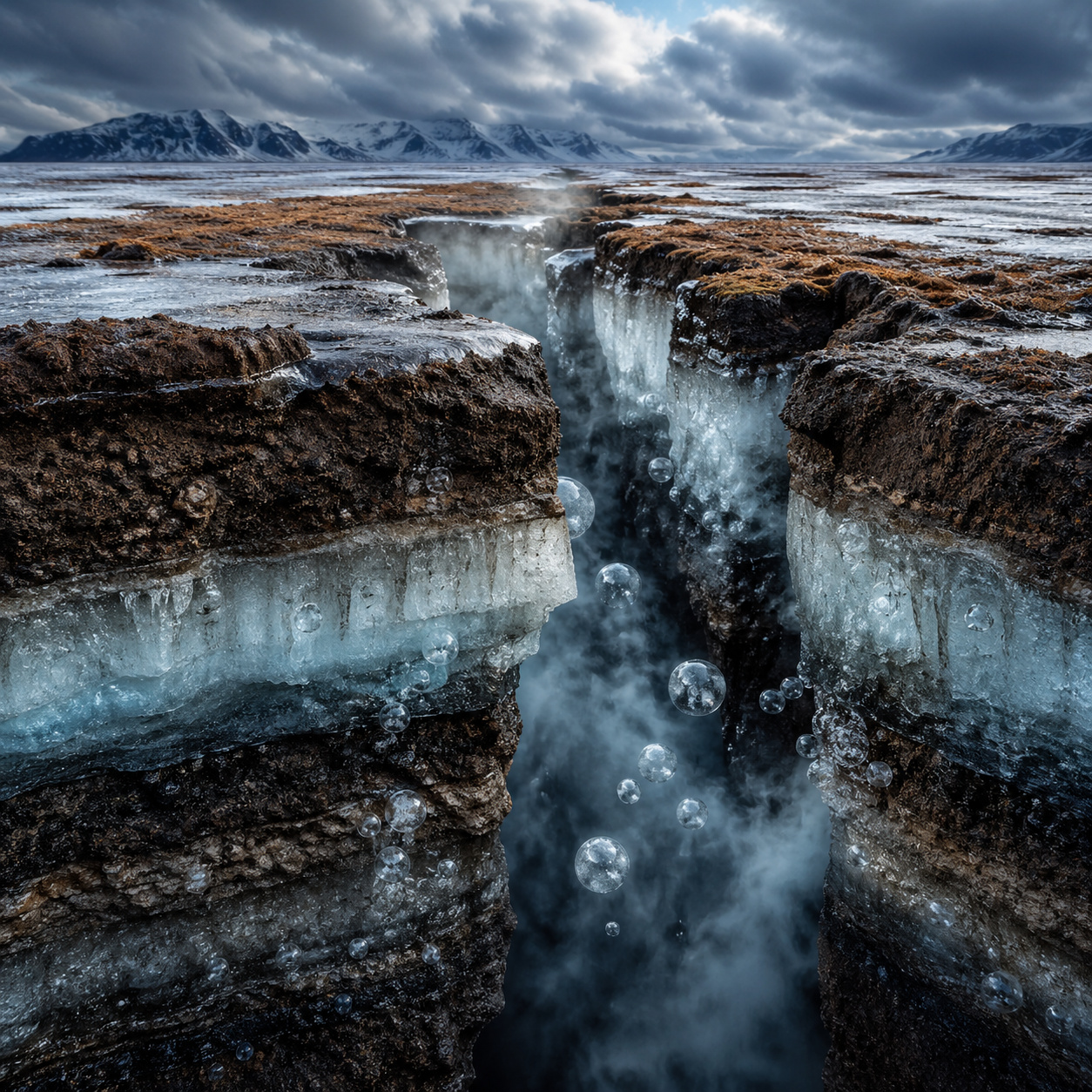
2025 study shows that deep permafrost emits methane and CO₂ like the surface layers, potentially doubling ignored climate emissions.
According to the journal Nature Geoscience, a study published in January 2025 drilled 20 meters of sediment at the bottom of a thermokarst lake in the Arctic, an unprecedented depth for this type of environment, and revealed that the deep layers of permafrost produce methane and carbon dioxide in amounts comparable to the shallow layers.
This discovery contradicts a central assumption of global climate models, which considered that only the first meters of thawed soil contributed significantly to greenhouse gas emissions. The study’s conclusion indicates that the total emission potential may be underestimated by up to two times.
Permafrost stores carbon equivalent to twice that of the atmosphere and its stability depends on the continuous freezing of the soil
Permafrost is defined as soil that remains frozen for at least two consecutive years, although, in practice, in Arctic regions, it remains frozen for thousands of years.
-
Space technology used to search for water on Mars is now hunting for invisible leaks under the streets of São Paulo, using satellites, AI, and chlorine signals to help Sabesp recover up to 6.7 billion liters of water.

-
Japan sends ship to extract mud rich in rare earths at nearly 6,000 meters deep in the Pacific, attempts to lift 350 tons per day from the seabed, and transforms sediments near Minamitori Island into a strategic weapon to reduce dependence on China.
-
Venus Aerospace promises a rotating detonation hypersonic engine that takes the Stargazer to Mach 9 and crosses oceans in 1 hour, but the flight that made history barely surpassed the speed of sound.

-
Brazilian student creates a cheap formula that makes plants grow up to 90% faster and wins an award in a global scientific competition.






It covers about 25% of the land surface of the northern hemisphere, including areas of Siberia, Alaska, Canada, Greenland, Tibet, and Scandinavia. Below the active layer, which thaws seasonally and is generally less than 1 meter, the soil remains frozen for tens to hundreds of meters.
In this environment, organic matter accumulated over millennia remains preserved, including remnants of plants, animals, and microorganisms.
Frozen organic matter in permafrost decomposes upon thawing and releases CO₂ and methane with high climate impact
When permafrost thaws, microorganisms become active again and begin decomposing the organic matter.
This process generates carbon dioxide in aerobic conditions and methane in anaerobic conditions. Methane is particularly relevant because it has a global warming potential about 80 times greater than CO₂ over a 20-year horizon.
The study highlights the role of thermokarst lakes as mechanisms for deep thawing. These lakes form when the ground collapses after the melting of underground ice, accumulating water on the surface.
Water transfers heat to the soil more efficiently than air, promoting the vertical thawing of permafrost.
Thermokarst taliks create deep thawed zones that can reach tens of meters below the surface
The heat from the lakes forms structures called taliks — regions of thawed soil within the permafrost.
These taliks can reach depths of 20, 30, or even hundreds of meters, depending on local conditions. Within these zones, decomposition occurs in an anaerobic environment, favoring methane production.
20-meter drilling allowed direct measurement of gas production in deep layers never analyzed
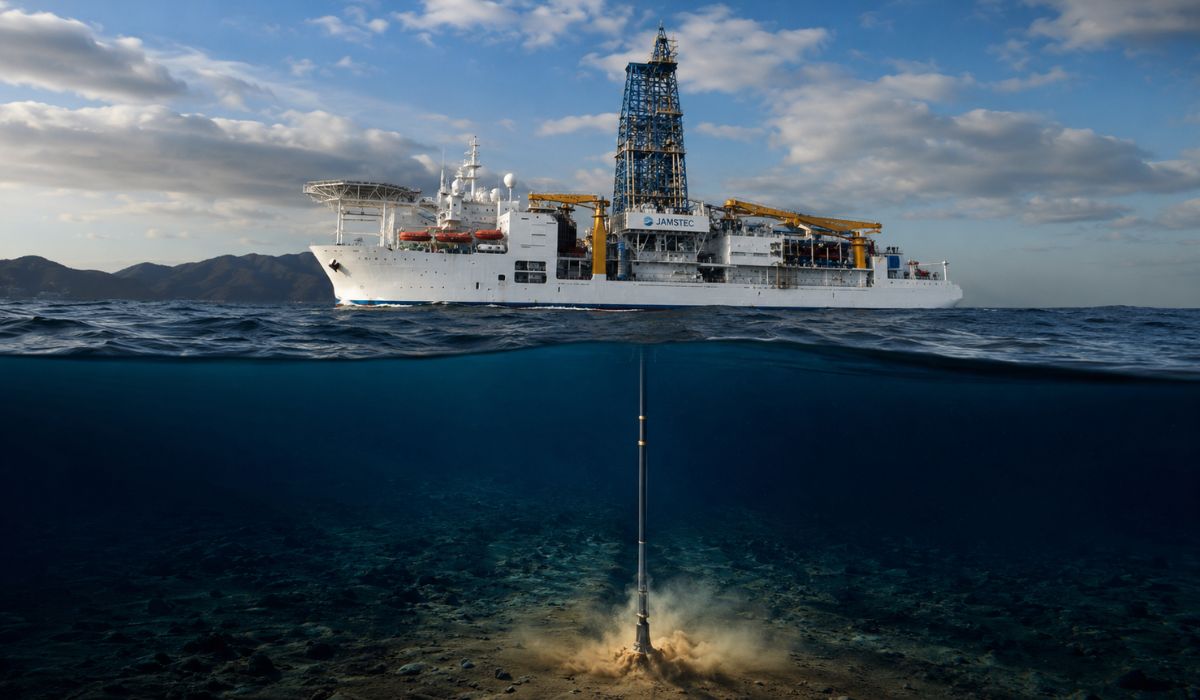
The study was the first to drill a complete sediment core up to 20 meters deep in a thermokarst lake.
Samples from each layer were incubated in the laboratory under anaerobic conditions to measure gas production. The results showed that the deep layers have significant biological activity.

The measurements indicate that gas production in the deep layers is comparable to that of the surface layers. This suggests that climate models that consider only the active layer are underestimating total emissions.
Deep thawing occurs on a decadal scale, much faster than gradual thaw models predicted
The study showed that thawing beneath lakes can reach great depths in just a few decades. This process is significantly faster than gradual surface thawing.
Since 2014, giant craters have been appearing in Siberia. These formations are associated with the accumulation of methane gas under the permafrost and its explosive release.
Abrupt permafrost thaw is non-linear and difficult to represent in global climate models
Traditional climate models are based on gradual processes. Abrupt thawing, associated with lakes and fractures, occurs non-linearly and depends on local factors.
The Arctic has about 3.6 million lakes. A significant portion of them are over permafrost and contribute to deep thawing.

Lakes can expand or drain. When they drain, they expose sediments to oxygen, reducing methane and increasing CO₂.
Incorporating these emissions into models can increase warming projections. The new evidence indicates that the climate system may be underestimating one of its main risks.
In your view, do models need to be urgently revised, or are there still uncertainties that prevent more definitive conclusions?


Be the first to react!