Portuguese
  Spanish


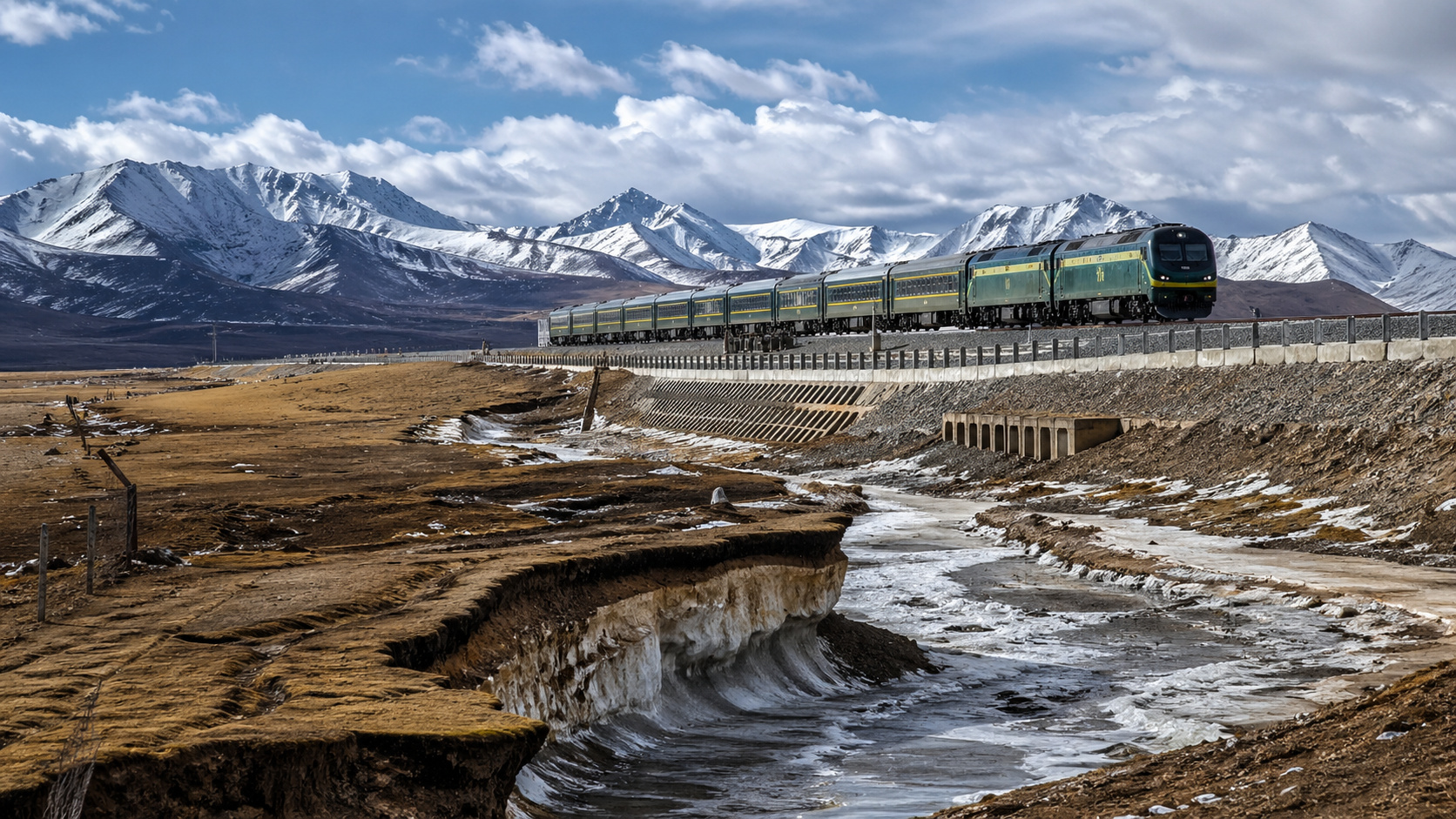

The advance of global warming already compromises the Qinghai Tibet railway, increases structural risk, raises maintenance costs, and may require billions in investments by the end of the century to avoid serious failures
The Qinghai Tibet railway, recognized as the highest in the world, faces a growing problem occurring beneath the tracks. The frozen ground that supports the structure is beginning to lose stability with rising temperatures.
The impact is already concerning. Projections indicate that almost 40% of the lines may be at high risk by 2050, while extra costs could exceed US$ 6 billion by 2090, putting pressure on the railway’s maintenance and safety.
Frozen ground loses stability and increases risk on the tracks
The railway crosses 632 km of permafrost, a type of ground that remains frozen throughout the year. This terrain is highly sensitive to heat and undergoes changes when the temperature rises.
-
Collector adapts forklift electric motor in a Kombi Corujinha pickup, hides 16 batteries under the bed, and makes the Brazilian classic run silently with up to 90 km of range.

-
Goodbye traditional vacuum: Samsung surprises and launches 2-in-1 robot with steam, AI that recognizes floors and stains, self-cleaning station, hot air drying, automatic emptying, water refill, and app control.
-
Brazil is transforming acerola waste discarded by the pulp industry into an ambitious and surprising project that could forever change the way the country utilizes one of the most invisible by-products of the fruit sector.
-
Scientists have created a colossal digital twin to predict tsunamis in real time, a simulation of 55.5 trillion unknowns run on 43,520 GPUs that reduced 50 years of calculation to 0.2 seconds and could change the defense of coastal cities.


Warming in the region progresses at about 0.35°C per decade, a rate above the global average. This increase causes the ground to partially thaw, leading to subsidence and deformations.
These changes compromise the base of the tracks. The risk of structural failures grows, including situations that could lead to derailments in more vulnerable sections.


Billion-dollar loss pressures the maintenance of the Qinghai Tibet railway
The effects of thawing are not limited to the physical structure. The financial impact is also noteworthy, with a forecast of up to US$ 6.31 billion in additional costs by 2090.
In more critical areas, the lifespan of structures may decrease by up to 50%, necessitating constant interventions. This increases the need for investments to keep operations safe.
Nature Climate Change, an international scientific journal focused on climate and environment, presented the numbers and scenarios indicating that limiting global warming could reduce some of these costs.
Engineering attempts to keep the ground frozen to avoid greater damage
To address the problem, technical solutions have been applied along the railway. One involves the use of stone blocks that help circulate cold air, reducing ground warming.
Thermal tubes with ammonia are also used, functioning as heat exchangers, along with structures that block heat during the summer.
These strategies create an effect that keeps the ground cooler, allowing for greater stability even in adverse conditions. About 550 km of sensitive areas have already received this type of intervention.
Constant monitoring becomes essential to avoid collapse
The railway relies on a continuous monitoring system. Sensors track the temperature and humidity of the ground, allowing for the identification of changes before they cause serious damage.
This monitoring helps reduce risks and allows for quick actions in critical points. In more fragile regions, elevated structures are also used to lessen the impact of unstable ground.
Nature Climate Change, an international scientific journal focused on climate and environment, detailed that these measures are part of an essential preventive strategy to keep the railway operating.
Qinghai Tibet railway exposes the global challenge of climate change
The case of the railway reveals a larger problem already affecting different cold regions of the planet. The thawing of permafrost impacts not only tracks but also roads, airports, and entire cities.
This scenario shows how global warming demands urgent adaptation in major constructions. Without this, costs rise and risks become increasingly difficult to control.
The Qinghai Tibet railway becomes a clear example of how modern infrastructure can be directly affected by climate changes.
The progression of the problem raises an important question. To what extent can major constructions resist the climate changes that are already underway? Leave your opinion in the comments and share this content with other people interested in the topic.