Portuguese
  Spanish


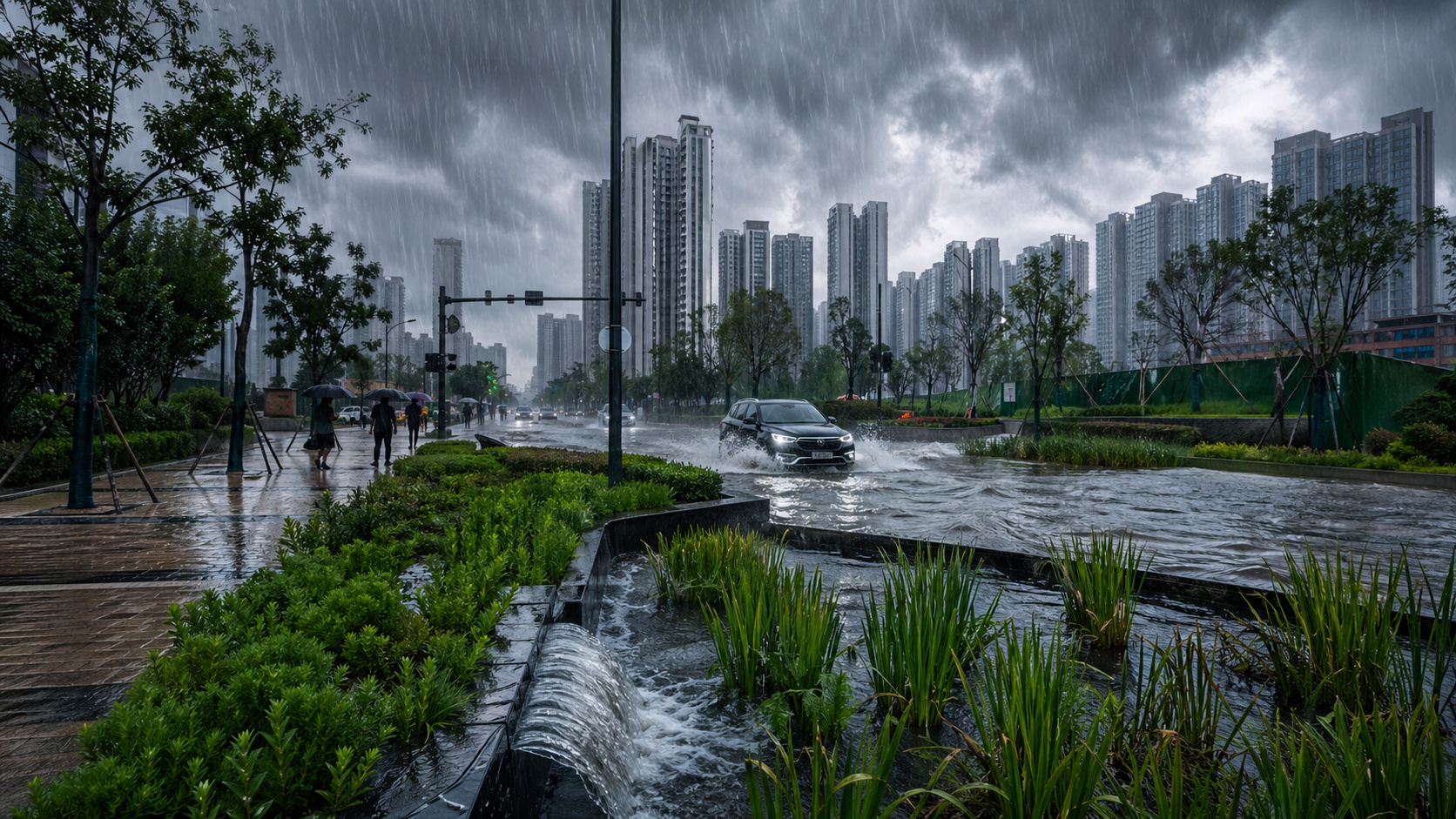

Sponge cities use permeable pavements, rain gardens, and reservoirs to reduce floods, but the model has limits when extreme storms dump water beyond urban capacity and put entire neighborhoods at risk.
Sponge cities have become one of China’s most well-known bets to tackle floods, but extreme rains have shown that this solution cannot hold any volume of water.
The investigation was published by The Straits Times, a Singapore newspaper. The central idea is straightforward: the system helps with regular rains, but does not solve extreme events on its own.
In practice, the city tries to absorb rain like a sponge. To do this, it uses permeable pavements, rain gardens, and urban reservoirs. The problem arises when water arrives too quickly and exceeds the capacity of these structures.
-
Brazilian Construction Worker Moves to France, Earns Up to €2,500 Monthly with Home Renovations, Gains Social Media Attention

-
US Navy Sinks USS Oriskany with 230 kg of C-4, Creating World’s Largest Artificial Reef in 37 Minutes

-
U.S. Dumped Tanks, Jeeps, and Coca-Cola into the Pacific in 1945 After British and French Lowball Offer, Creating “Million Dollar Point”
-
WHO Warns of Unnecessary Interventions in Natural Births Worldwide, Advocates for More Human-Centered Care, Reigniting Debate on Medicalization





The promise of sponge cities seemed simple, to make the city absorb the rain before it turned into a flood
The concept of a sponge city gained traction because it seems easy to understand. Instead of letting all the water run through the streets, the city creates spaces to absorb, store, and gradually release this water.


This model uses floors that allow water to pass through, green areas prepared to receive rain, and reservoirs that help reduce pressure on drains and channels. In normal rains, these solutions can reduce flooding and improve drainage.
But the promise has limits. When rain turns into a deluge, the water arrives in much greater volume than the structure can support. At this point, green technology ceases to be total protection and becomes just a part of urban defense.
The technical limit appears when the storm is stronger than the absorption capacity
A sponge only absorbs liquid up to a certain point. After that, the water runs off. With sponge cities, something similar happens.
Permeable pavements and rain gardens work best when the rain is within the planned capacity. When the storm is extreme, the system can become saturated and the water returns to occupy streets, avenues, and low-lying areas.
The Straits Times, a Singapore newspaper, highlighted this warning by showing that the Chinese strategy has value but was not designed to withstand any climate event. The statement by Ma Jun, director of the Institute of Public and Environmental Affairs, sums up the point: “Even the real sponge has a problem of capacity.”
In simple language, even a real sponge has limits. Therefore, a city cannot rely solely on draining floors, gardens, and reservoirs to face increasingly strong storms.
Permeable pavements and rain gardens help, but do not perform miracles against deluges
Permeable pavement is a type of flooring that allows part of the water to pass through. This reduces surface runoff and helps relieve the drainage system.
A rain garden is an area with plants and soil prepared to receive water. It holds part of the rain and slows down the speed at which this water reaches drains and channels.
These solutions are useful. They can reduce flooding in more common situations and improve the city’s relationship with water. Even so, they are not sufficient when extreme rain exceeds the entire capacity of the urban system.
Urban risk increases when the city treats a partial solution as a complete response
The contradiction of sponge cities lies in the name itself. The expression conveys the idea that the city can absorb rain and broadly prevent floods.
In reality, the solution reduces risks but does not eliminate the problem. If the volume of water is too high, the drainage becomes overloaded, and flooding can occur even in areas with modern works.
The risk increases when governments and residents start to see the technology as a definitive answer. Sponge city does not replace urban planning, cleaning of drainage systems, escape areas for water, and quick alerts for the population.
Climate innovation remains important, but it needs to go hand-in-hand with prevention
Sponge cities should not be dismissed. They represent an attempt to make the urban environment more prepared to deal with rain, heat, and impermeable soil.
The critical point is elsewhere. Technology needs to be treated as part of the solution, not as an absolute guarantee against floods. In times of more unstable weather, a safe city needs to combine green infrastructure with efficient drainage and rapid response.
When rain exceeds its limit, the difference between reducing damage and experiencing a tragedy can lie in planning. Therefore, the discussion is not just about engineering, but also about how cities prepare for extreme events.
China’s warning applies to any city suffering from floods
The case of sponge cities shows that beautiful solutions on paper need to be tested against the reality of the streets. When extreme rain arrives, water reveals flaws, limits, and poorly resolved urban choices.
For residents, the consequence is simple. Even with green technology, floods can still close roads, invade homes, and interrupt services. The promise of absorbing rain needs to be accompanied by clear information about what the system can achieve.
Sponge cities remain an important tool against floods, but their limit has become evident. They help with common rains, relieve part of the drainage, and improve urban space utilization, but they cannot overcome a deluge alone.
The big question now is different: if even cities planned to absorb rain can fail in the face of extreme storms, are Brazilian cities truly preparing or just waiting for the next flood to happen? Leave your opinion in the comments and share this post with those who experience this problem firsthand.